
English Edition
- By CNI
- Category: English Section
- Hits: 270
CNI News
April 27, 2026
Business owners report that operations are facing significant delays following the Central Bank's decision last February to restrict cash withdrawals. The move was intended to prevent the flow of currency into the US dollar, gold, real estate, and automotive markets.
Economists and business analysts pointed out that imposing such controls on the economy hinders national growth and acts as a barrier to the country reaching its full economic potential.
Economic analyst U Thet Zaw told CNI News that instead of restricting transactions to control export earnings and the real estate, dollar, and gold markets, the government could utilize its authority through alternative taxation systems.
"Control it however you want, but you can control it through taxes. To put it simply, improve the E-government system. If E-government is effective, it’s impossible to bypass. We have always said that merely imposing limitations and tightening controls in Myanmar needs reform. It is unclear who is currently providing economic advice, but when the main structures are flawed, the national economy fails to grow as it should," he said.

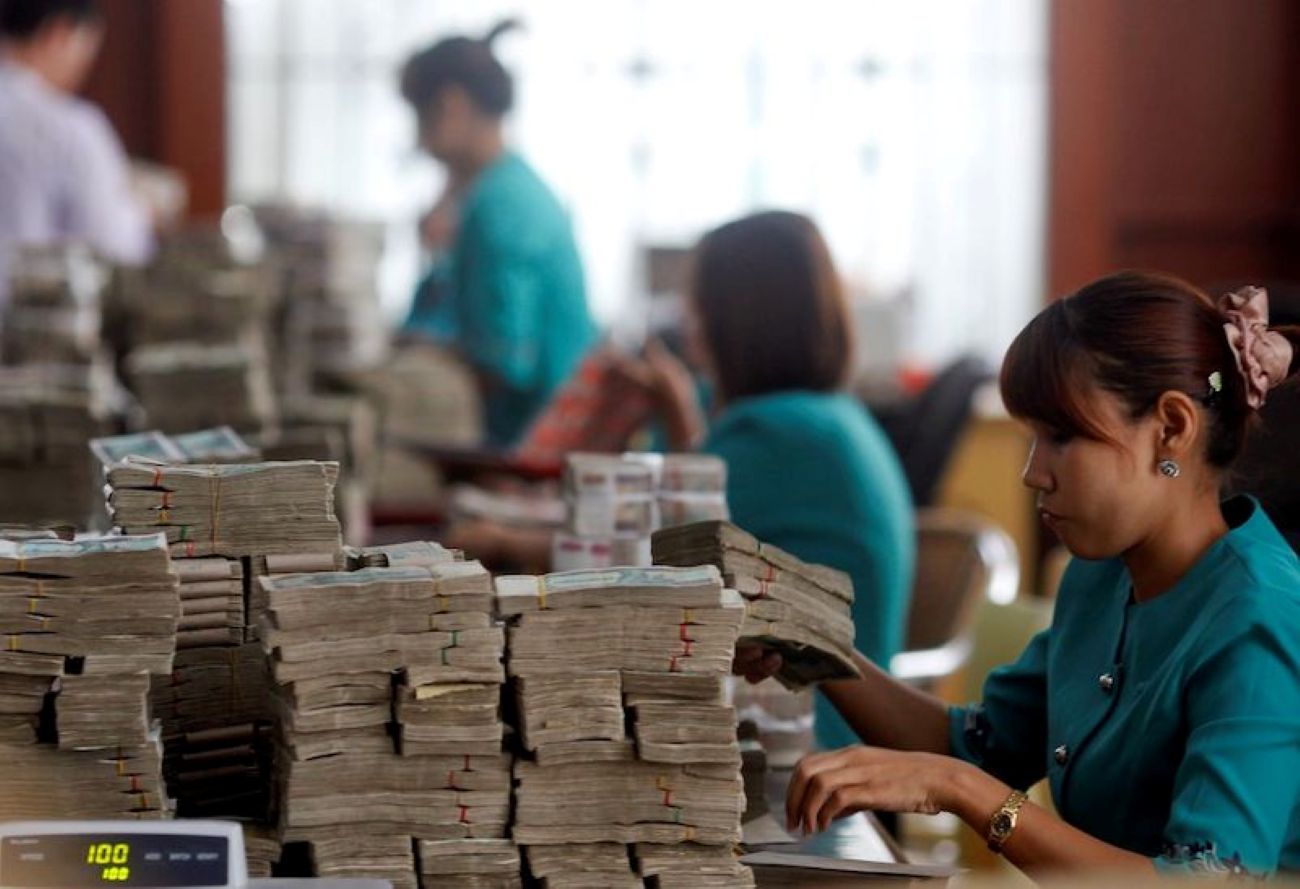
Images of Myanmar citizens at a bank.
Since the political changes in 2021, difficulties in withdrawing cash through banks have persisted. Currently, the primary issue facing the public and entrepreneurs is the limited amount of cash banks are willing to dispense.
While banks previously allowed withdrawals in the hundreds of lakhs (millions of Kyats), they are now restricting withdrawals to just 5 million Kyats (50 Lakhs), leading to operational bottlenecks. Additionally, reports suggest that gold shops are prioritizing cash buyers over those using online payment systems.
U Htay Aung Kyi, an economic and banking expert, told CNI News that restricting cash withdrawals primarily impacts the working class and further fuels inflation.
"The grassroots level will be hit the hardest. What will people do once they get their money? They buy land or gold because those assets don't lose value. They might hold them for a month or two, or even just a few days, then sell for a profit. This cycle increases consumption and drives inflation higher than necessary," he explained.
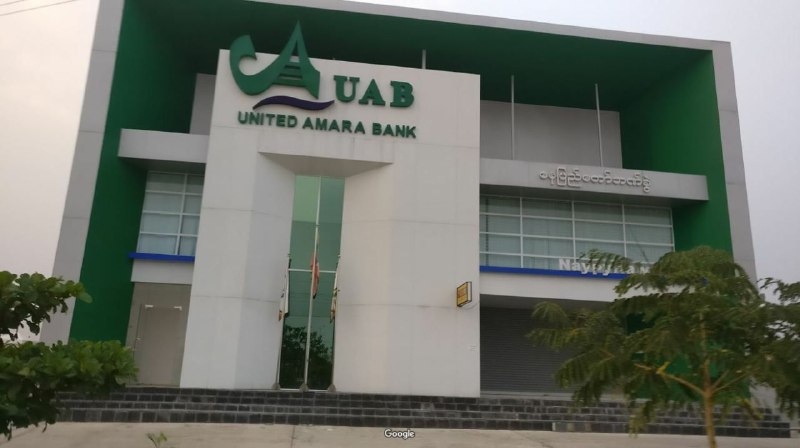
Image of a UAB Bank branch.
While the current new government’s "100-Day Plan" includes initiatives regarding business operations, entrepreneurs and observers are closely watching how the Central Bank—a key player in the monetary sector—will make adjustments.
Analysts also pointed out that as the international community shifts toward reducing cash usage, Myanmar needs to focus more seriously on digital payment systems.
Currently, while banks such as AYA, KBZ, CB, and others are limiting withdrawals of deposits, members of the public noted that UAB Bank has not imposed such restrictions, leading to an increase in new account openings at UAB.
- By CNI
- Category: English Section
- Hits: 172
CNI News
April 28, 2026
Political analysts and parliamentarians are currently debating the importance of the ASEAN organization for Myanmar.
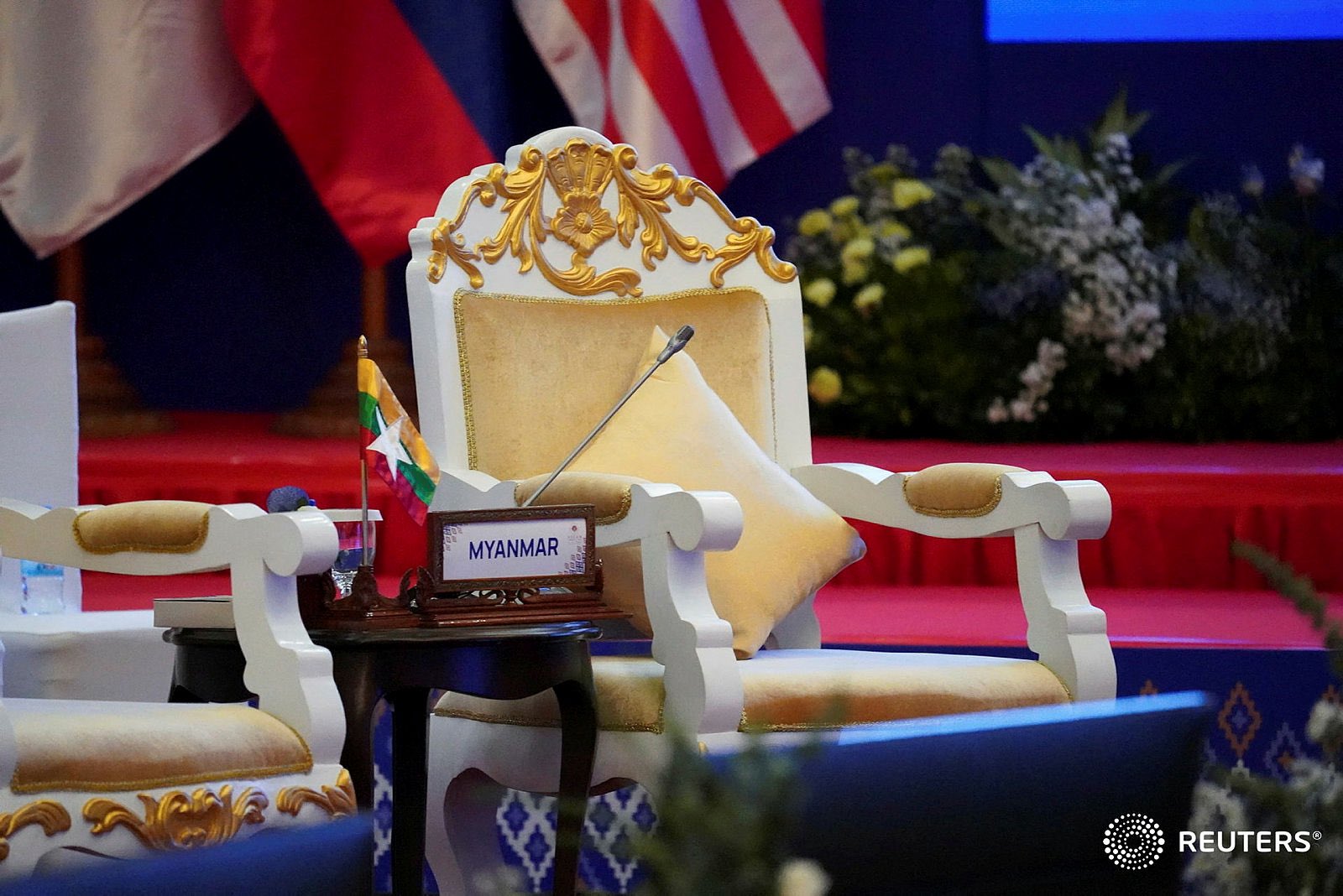
Following the events of February 1, 2021—where the Myanmar military declared a state of emergency and ousted the NLD government over unresolved 2020 general election voter list disputes—ASEAN took an active role in handling the Myanmar crisis. Consequently, Myanmar's military leaders have been excluded from ASEAN meetings to this day.
Observers are now closely watching whether the new government, formed following the recent elections, can restore relations with ASEAN.
Political analyst Dr. Aung Myo told CNI News that ASEAN is vital for Myanmar across three sectors, warning that total reliance on China for export markets is an unfavorable prospect.
Market Diversification: "Broadly speaking, ASEAN is important for Myanmar. Relying entirely on China for our export market is not good. It is unwise to depend on a single country for a single product or as a sole partner. We need balance, and the ASEAN market is significant."
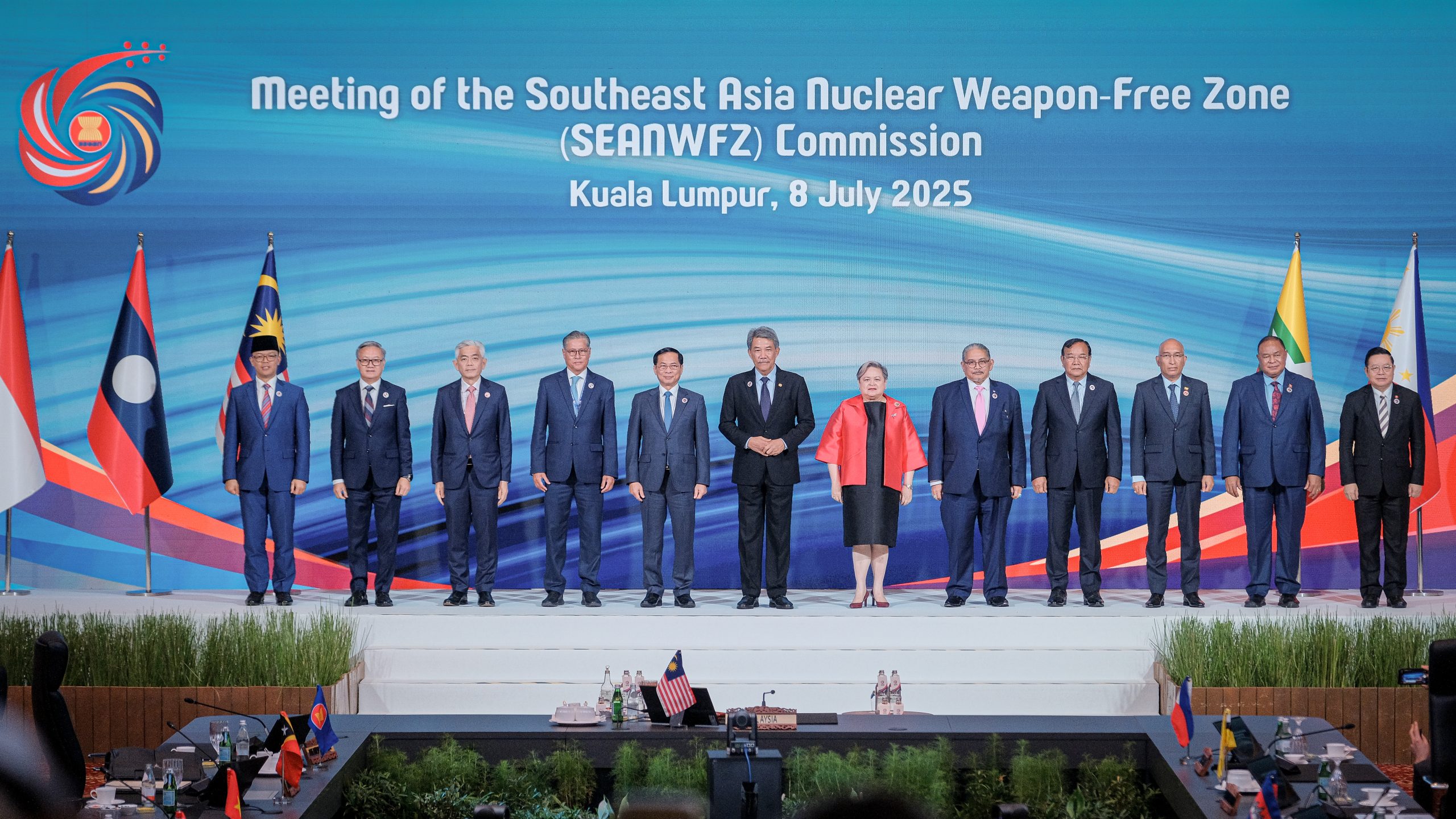
Attendees at an ASEAN summit.
Energy and Resources: "In the future, we must use clean coal for electricity until hydropower can be fully implemented. Hydropower projects in ethnic regions often feel like a 'resource curse.' A smart government should not over-rely on hydropower from ethnic areas but should look toward ASEAN neighbors like Indonesia for coal."
Diplomatic Counterbalance: "Regarding foreign relations, the US isn't interested in us directly to counterbalance China's influence; if they are interested, they engage via Singapore. ASEAN is vital for us in terms of Foreign Direct Investment (FDI), diplomacy, technology, and external employment opportunities."
Analysts point out that Thailand's stance as a neighbor is key to restoring ties, but progress depends on the government implementing ASEAN's "Five-Point Consensus."
Dr. Kyaw Swe, a People's Assembly (Pyithu Hluttaw) representative from the Unity and Development Party (UDP/Taysany), emphasized that Myanmar cannot survive on Chinese support alone.
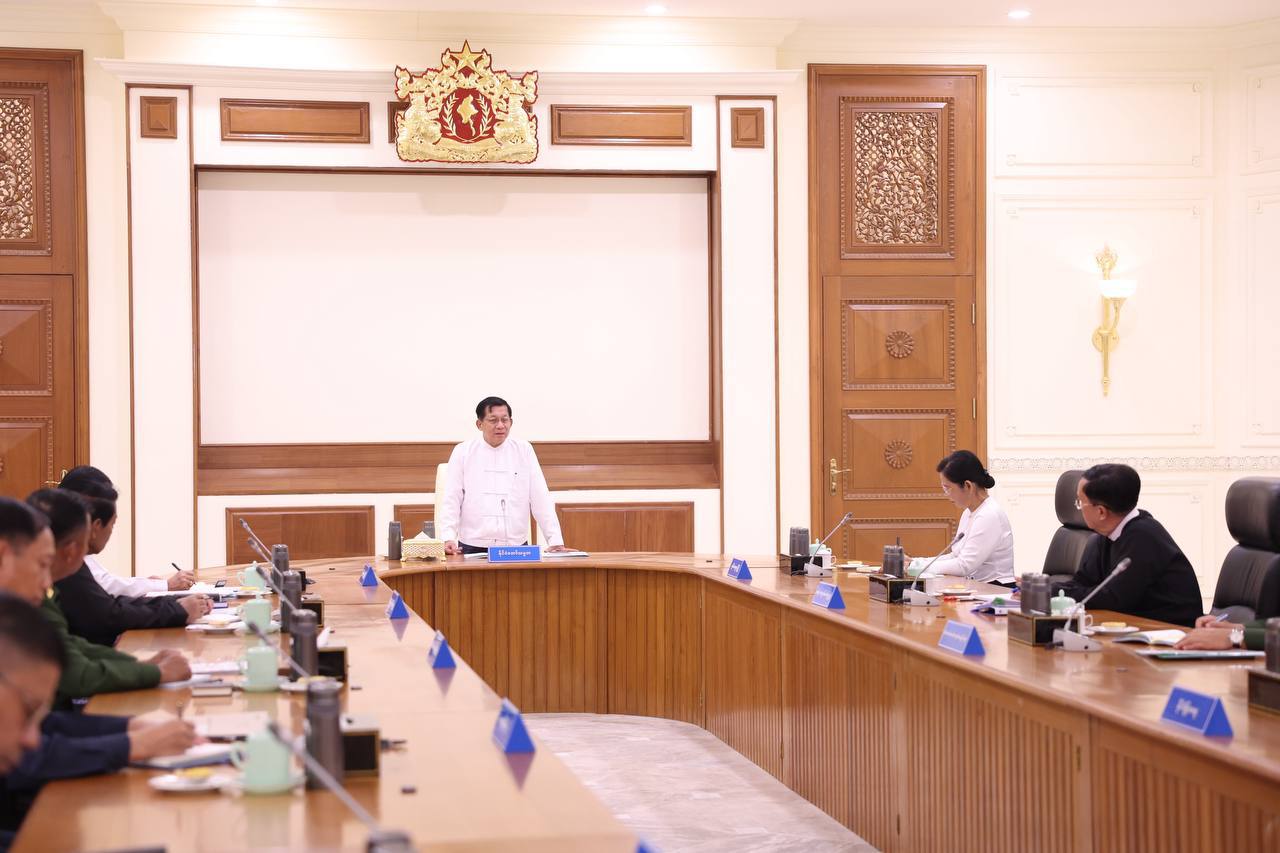
President U Min Aung Hlaing at a National Defense and Security Council (NDSC) meeting.
"Myanmar is in a diplomatic crisis. We cannot rely solely on China. Long-term development projects are only possible if we enhance diplomacy and cooperate with neighboring countries and organizations. If you cannot get along with your closest community (ASEAN), you cannot hope to get along with the rest of the world. Just being on good terms with one or two neighbors isn't enough."
"Without passing through ASEAN, we won't be able to engage widely in the global diplomatic arena, and our exports will face market barriers. Furthermore, as long as international recognition for our domestic political movements remains low, it diminishes the dignity of being a citizen. For the sake of the people, we believe the best path is to comply and harmonize with all international partners."
Political analyst U Htet Aung Kyaw added that while close neighbors like China, India, and Thailand are important, global integration is the ultimate goal.
"Myanmar is a member of the global family. While some might think having good ties with China, India, and Thailand is enough during difficult times, it's always better to be on good terms with everyone. We must think about how to become a country that the world respects and values."
On April 10, 2026, during the first regular session of the third Union Parliament(Pyidaungsu Hluttaw), President U Min Aung Hlaing stated that as Myanmar is an ASEAN member, the government will strive to restore normal relations with the organization.
- By CNI
- Category: English Section
- Hits: 317
CNI News
April 28, 2026
Military and political analysts are raising questions regarding how the Naga and Shanni armed groups should be considered within the peace invitation extended by the transitional government led by President U Min Aung Hlaing in Myanmar.
On April 21, 2026, President U Min Aung Hlaing invited armed groups—including those that have signed the Nationwide Ceasefire Agreement (NCA), those that haven't, and groups like the KNU, CNF, and ABSDF (who signed the NCA but have not held talks between 2021 and 2025)—to engage in peace negotiations by a July 31 deadline.
In light of this, questions have emerged regarding the status of the Shanni State Army (SNA) and the National Socialist Council of Nagaland (NSCN). Analysts are debating whether these groups are included in the invitation, and whether they should or should not be excluded from the process.
Sai Htay Aung, Chairman of the Tai-Leng (Shanni) Nationalities Development Party: Speaking to CNI News, Sai Htay Aung noted that it remains unclear whether the current government recognizes the Shanni as an Ethnic Armed Organization (EAO).
On the Naga: "The Naga have already signed agreements at the regional level, so it is likely they could be included in this invitation."
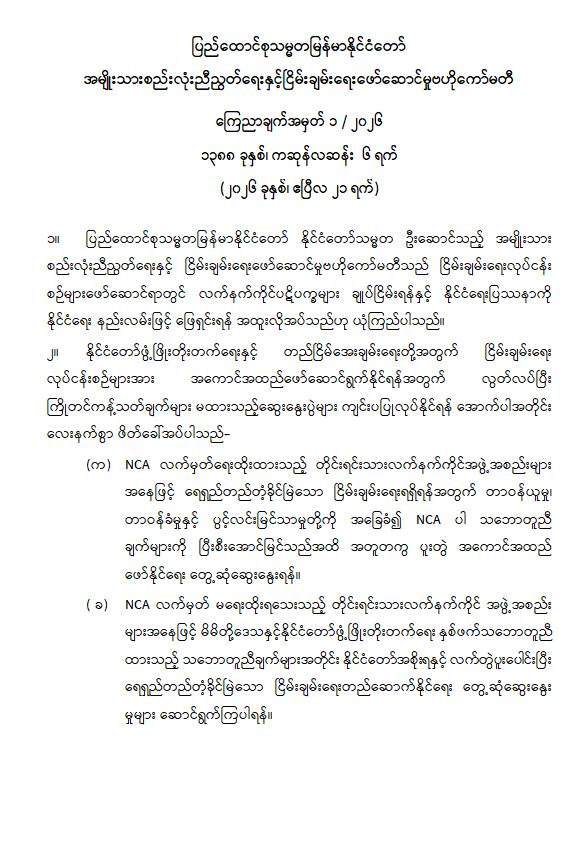
The government’s peace invitation notice.
On the Shanni (SNA): "The Shanni have not signed any agreements at the regional or state level. Furthermore, there is the question of whether the current government even recognizes them as an EAO. It’s hard to say if they are included. Ideally, peace invitations should be made after analyzing the desires of all armed revolutionary groups. If they are invited under a revised policy, it would benefit the peace process, though having more groups involved also increases the complexity of the negotiations."
On Political Goals: He mentioned that the SNA will likely follow its five-point policy toward the goal of establishing a Shanni State, but cautioned that achieving this beyond the current constitution is difficult. He cited the "Wa" region as an example—despite meeting requirements, they have not yet achieved statehood because it isn't in the constitution.
U Thein Tun Oo (Executive Director, Thayninga Institute for Strategic Studies): U Thein Tun Oo suggested that while the invitation is theoretically open to everyone, the practical implementation depends on existing bilateral agreements and the level of cooperation.
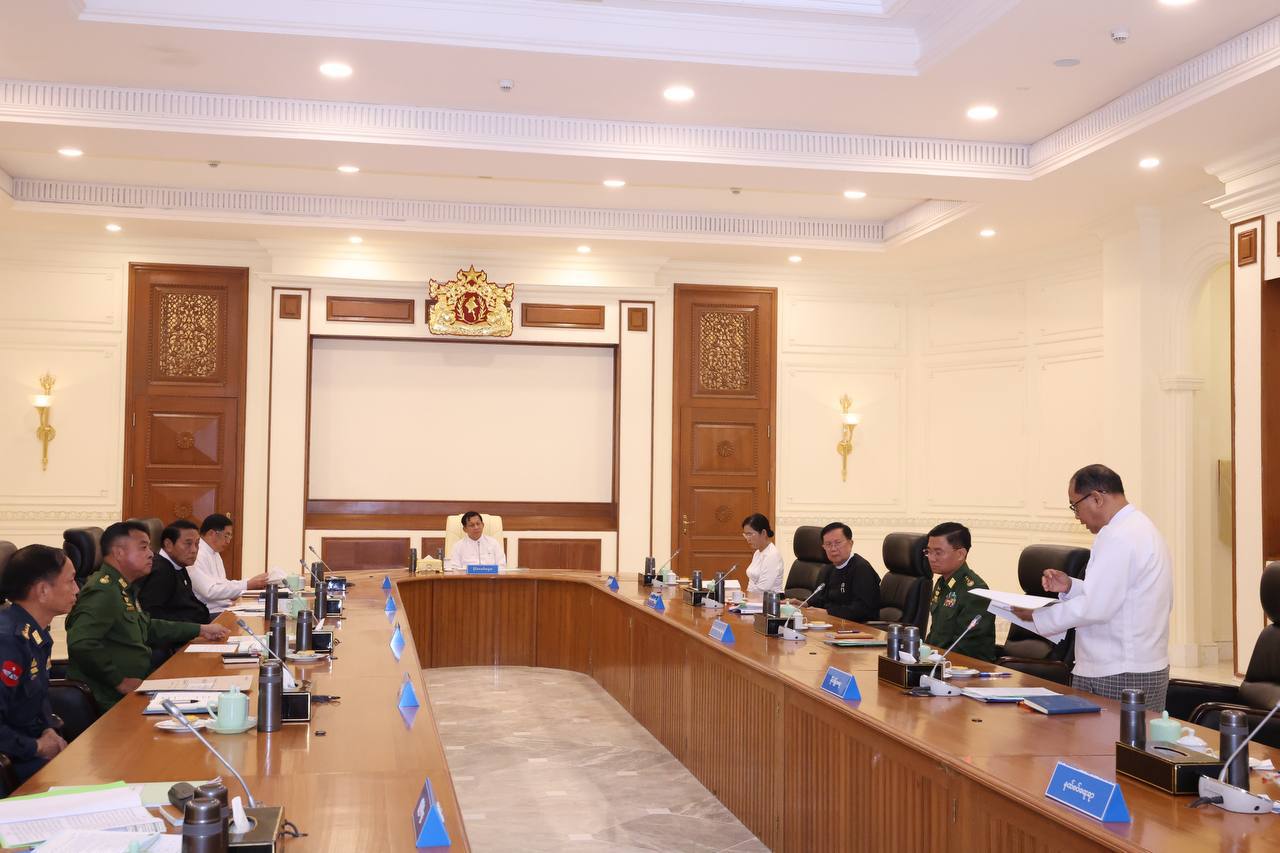
A meeting of the new government’s Nation Defense and Security Council (NDSC).
"The invitation is intended for everyone. However, discussions and cooperation will depend on existing bilateral arrangements. If groups operating within the government's administrative reach are not currently in active conflict but wish to proceed under the NCA framework, negotiations are necessary. However, it would be much more effective to negotiate with groups in areas where actual physical clashes are occurring."
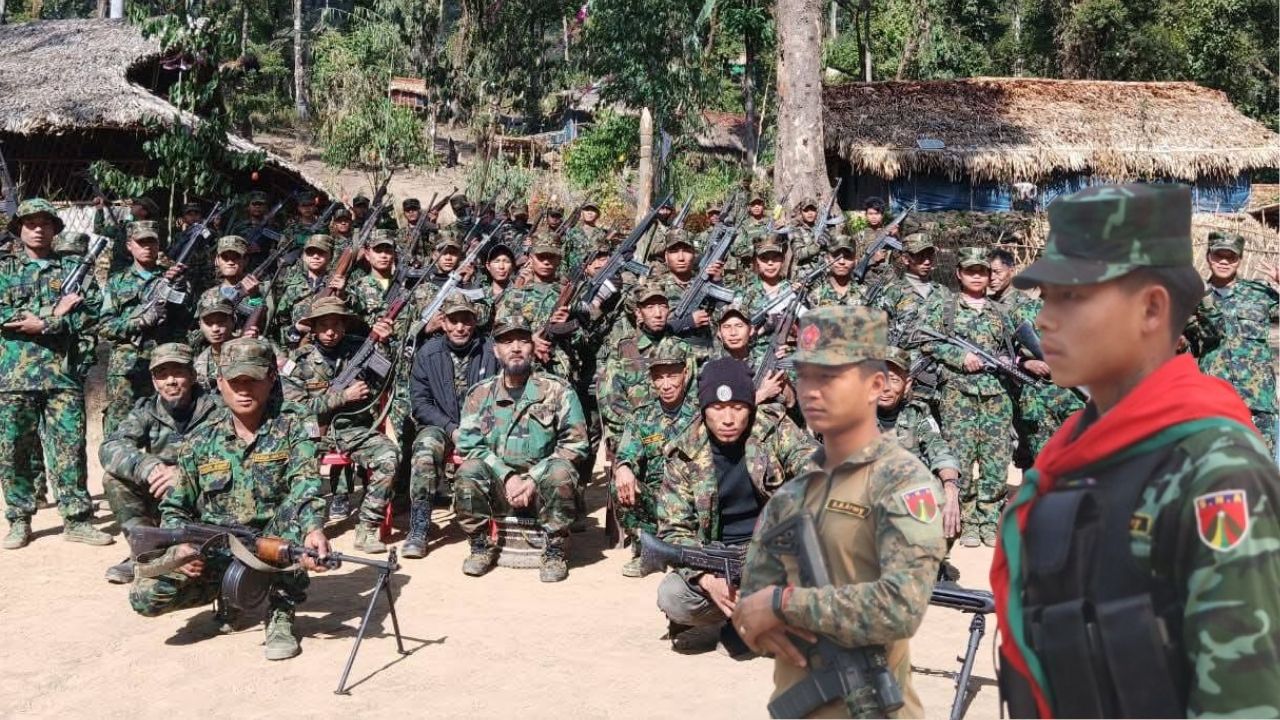
Shanni State Army (SNA): An ethnic armed group striving to re-establish a Shanni State by unifying Mawlaik, Kalay, Hkamti, Katha, and Tamu districts in the Sagaing Region with Bhamo, Myitkyina, Mohnyin, and Mogaung areas in Kachin State.
National Socialist Council of Nagaland (NSCN): An ethnic armed group seeking to establish an independent Naga Federation, unifying Naga people living across the India-Myanmar border.
Military and political observers warn that if these two groups are excluded or ignored in the peace invitation, it could lead to the opening of new military fronts for the Myanmar military within Sagaing Region and Kachin State. They draw comparisons to 2015, when the exclusion of the AA, TNLA, and MNDAA from the NCA process contributed to the large-scale conflicts seen today.
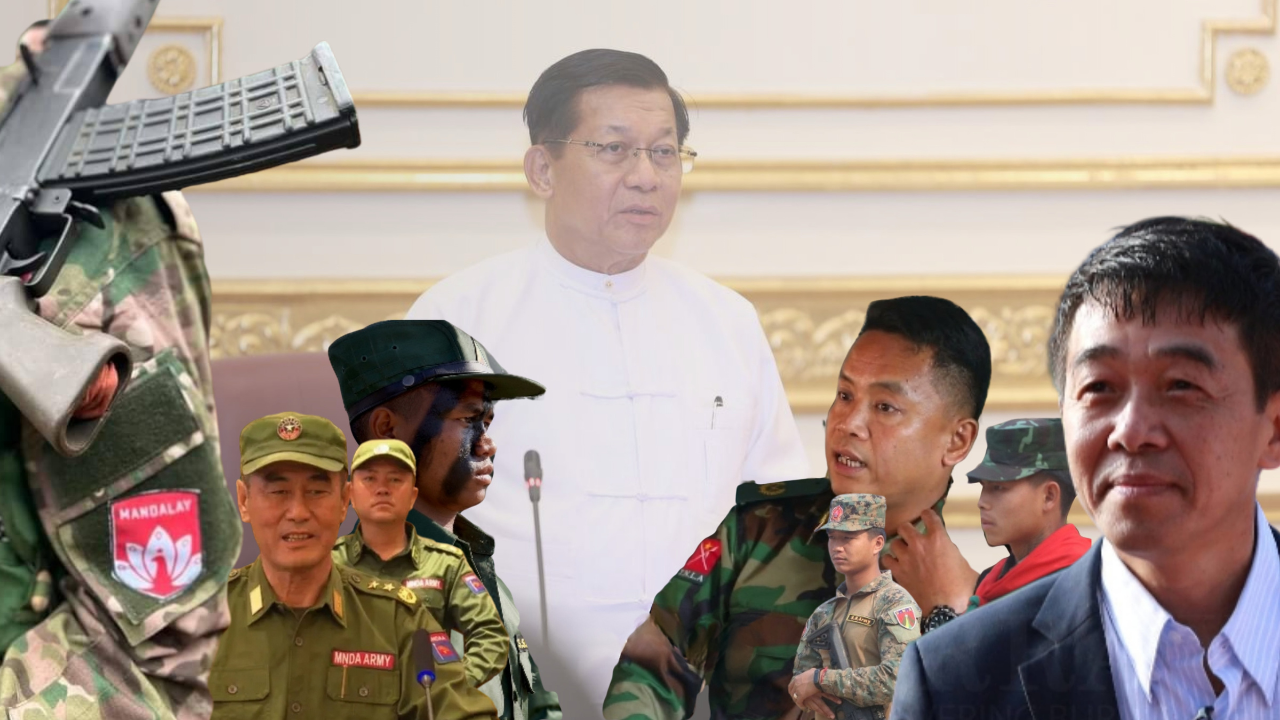
- By CNI
- Category: English Section
- Hits: 155
CNI News
April 28, 2026
In inviting various armed organizations in Myanmar to peace talks and dialogue, it is necessary for them to see that their interests and benefits will not diminish even if they lay down their arms, said Dr. Kyaw Swe, a Pyithu Hluttaw representative from the National Unity Party (NUP), in an interview with CNI News.
He stated, "There is much to be done regarding peace. Primarily, we see a lack of trust between the various organizations. Trust is the most important factor. The armed groups will need to have faith in the government’s peace invitation, and the armed groups will need to genuinely desire and follow through with peace after accepting the commitments and opportunities provided. Currently, I see a situation where mutual trust is missing. The main point I want to make is that armed organizations need to see that laying down weapons will not decrease their interests, and that peace will better support regional development."
Currently, the administration led by President U Min Aung Hlaing includes peace negotiations as one of the tasks to be implemented within a "100-day plan."
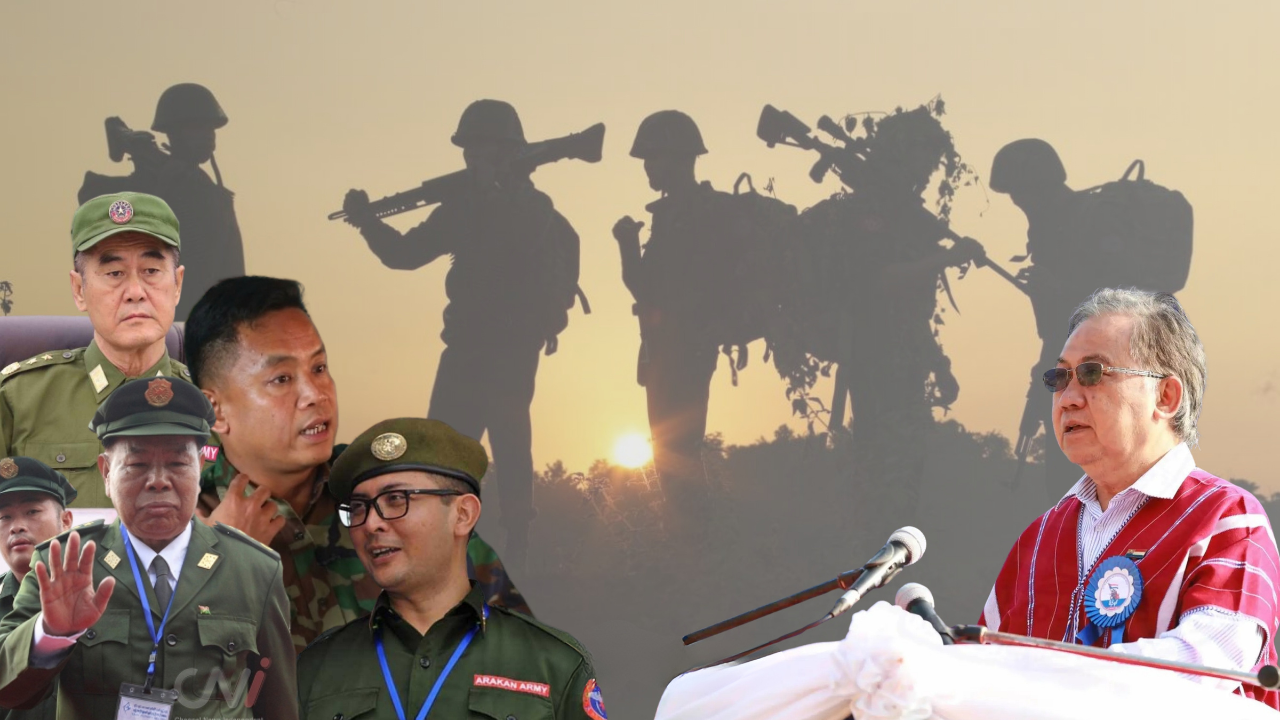
leaders of armed groups.
President U Min Aung Hlaing has stated that from April 20 to before July 31, all PDFs, Ethnic Armed Organizations (EAOs) that have signed the NCA, and those that have not yet signed are invited to meet for peace talks, with a deadline for negotiations set for July 31.
Daw Saw Mra Raza Linn, Chairperson of the Arakan Liberation Party (ALP)—a signatory to the NCA—told CNI News that as a group that has signed the agreement, they wish to see its implementation through to completion, though the starting topic of discussion remains a point for consideration.
She said, "What kind of topic do they want us to start discussing? That is something to think about. Organizations that have signed the NCA must have accountability and responsibility aimed at long-term, sustainable peace. Based on transparency, we need to implement the agreements within the NCA until completion. Furthermore, our desire is to participate as 'a brick and a grain of sand' in building a Union based on democracy and federalism. Speaking for myself as a signatory, I have the desire to work until what we signed is fully implemented. However, others may not feel the same as I do. Therefore, we must move forward in various forms depending on the individuals and organizations. There must be transparency, and I also want to add that there must be goodwill and compassion."
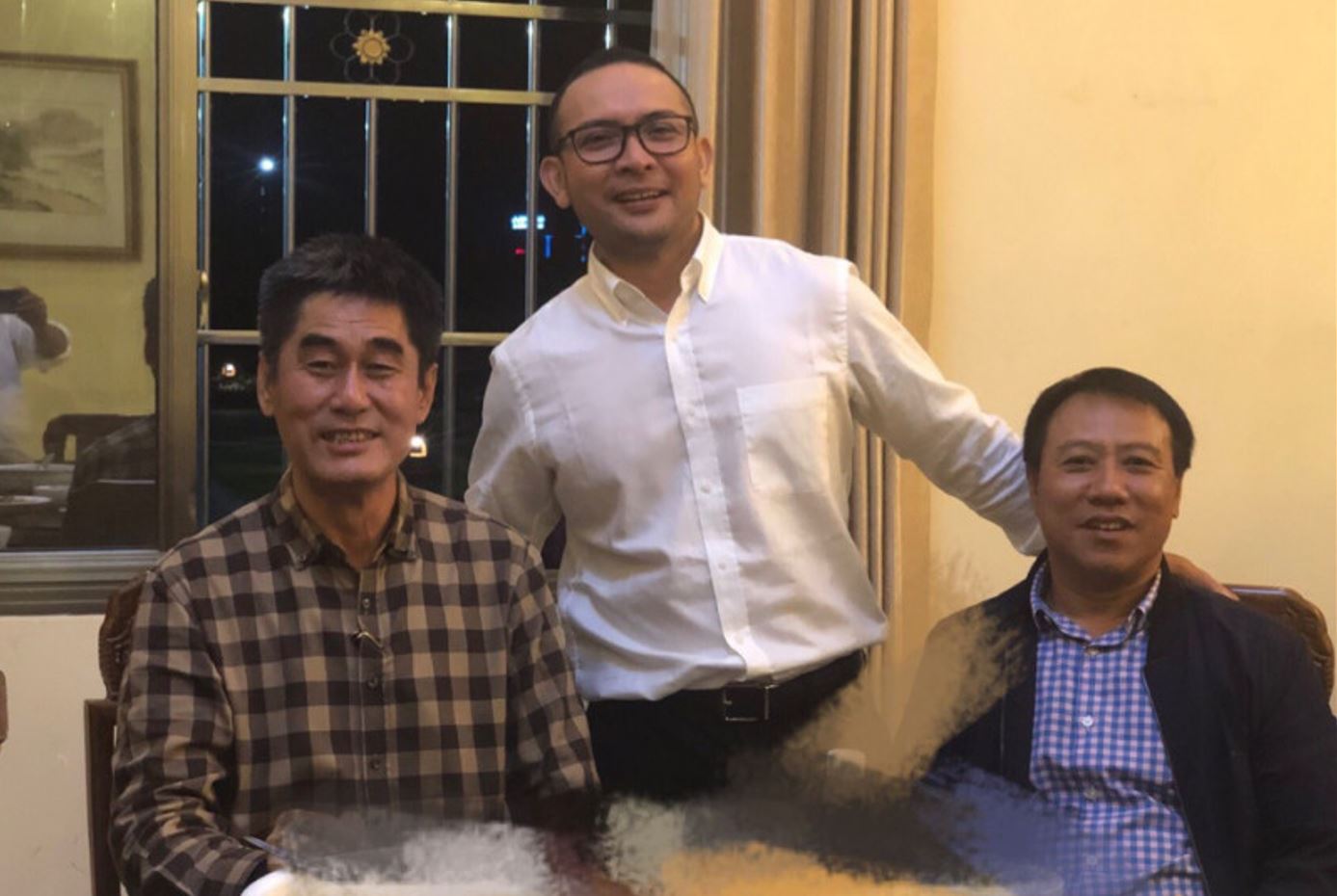
Leaders of the AA, MNDAA, and TNLA seen together.
Following 2021, the Myanmar political landscape has seen armed conflicts grow larger and more widespread, with the number of ethnic armed groups and other armed forces increasing by the hundreds.
Moreover, most ethnic armed organizations have become stronger than before and currently hold significant territorial gains through military force. Over the past five years, the Myanmar military has lost numerous territories to ethnic armed groups and revolutionary forces.
Among the major ethnic armed organizations, the Northern Alliance groups—the Myanmar National Democratic Alliance Army (MNDAA) and the Ta'ang National Liberation Army (TNLA)—are currently groups that have agreed to a ceasefire with the Myanmar military.
- By CNI
- Category: English Section
- Hits: 201
CNI Interview
April 27, 2026
Following the emergence of a transition government in Myanmar, President U Min Aung Hlaing invited armed organizations to peace talks on April 21, 2026. On the other hand, armed forces have been conducting territorial seizure battles to realize goals of "Confederation" status or secession.
CNI News Agency contacted Dr. Kyaw Swe, a Member of Parliament (Pyithu Hluttaw), to interview him regarding these situations.
Q: Now that a government and parliaments have emerged, how should peace processes be carried out?
A: There is a lot to do regarding peace. We see the main issue as a lack of trust between various organizations. Trust is paramount. There needs to be trust from the armed groups toward the government’s peace invitation. Conversely, there must be trust that the armed groups—after accepting the government's commitments and offered opportunities—genuinely desire peace and will follow through. Currently, I see a situation where mutual trust has vanished.
The main point I want to make is that armed groups need to see that laying down arms does not mean their interests or benefits will diminish. Rather, they must realize that only peace can effectively support regional development.
Q: How should the government extend the peace invitation?
A: Based on the current invitation letter, the government has made many concessions. Since we already have the NCA (Nationwide Ceasefire Agreement) path in place, I believe continuing implementation through this NCA route is more convenient. It already includes all international monitoring processes.
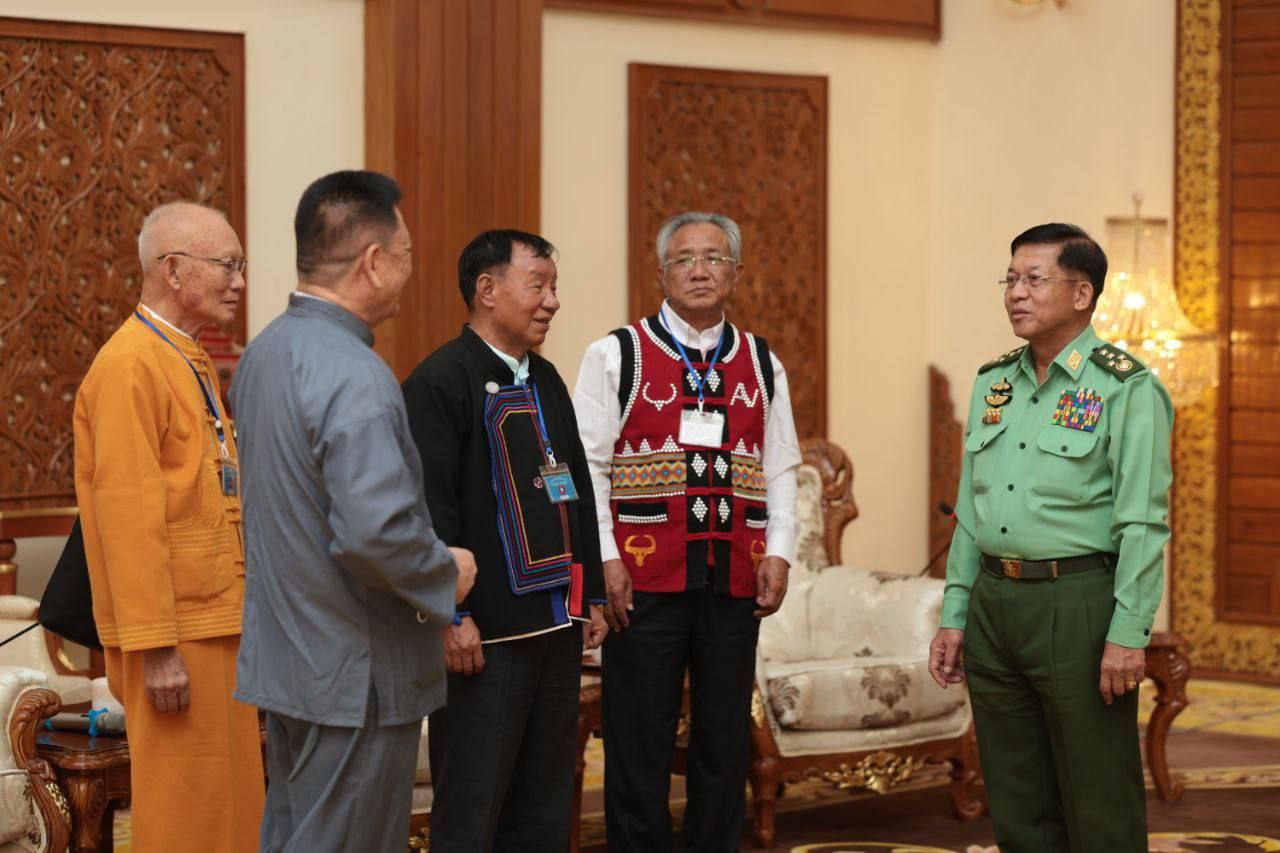
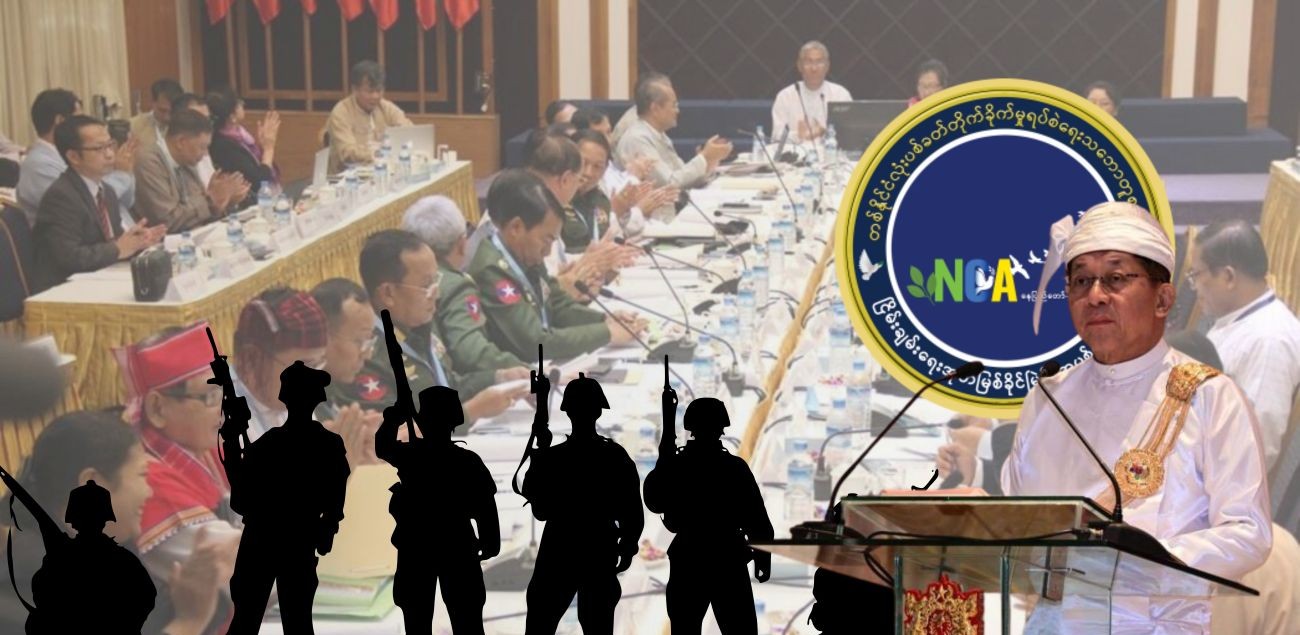
Current President U Min Aung Hlaing seen with ethnic armed groups.
Q: Some say that even if groups cannot attend the peace talks, they can still stop fighting. They analyze "peace" and "ceasefire" as two different things. What is your view? Should a ceasefire be prioritized if full peace cannot yet be achieved?
A: Peace and a ceasefire are not the same. Peace involves a genuine desire to work on regional development. A ceasefire, frankly, often feels like a period where both sides rest to replenish their forces.
That is how it has been in the past. Stopping the fight as soon as possible is best. If we achieve a ceasefire first, the people will begin to feel at peace; it’s the first step. To reach actual peace, we are in a situation where issues must be resolved through a mediator or witness that both sides can accept. One side stopping the fire is not enough to reach the peace stage.
Therefore, the peace stage will only be reached with strong support or problem-solving capabilities from a mediating organization. However, stopping the fire is the most urgent priority. That is why we welcome ceasefires. I believe all armed organizations will start implementing a ceasefire first.
Q: If a ceasefire starts to be implemented, some groups have already begun. However, in 2022, there was a ceasefire with the AA (Arakan Army), but fighting resumed in 2023. What should both sides do to prevent battles from recurring despite ceasefire agreements?
A: The main thing is for a "Third Party" mediator to be involved with strong influence—for example, organizations like the UN, ASEAN, or other international bodies. When such entities intervene, both sides tend to exercise more restraint to maintain their dignity and respect the power of the mediating body. The mediating group should also include national experts and active individuals who desire peace.
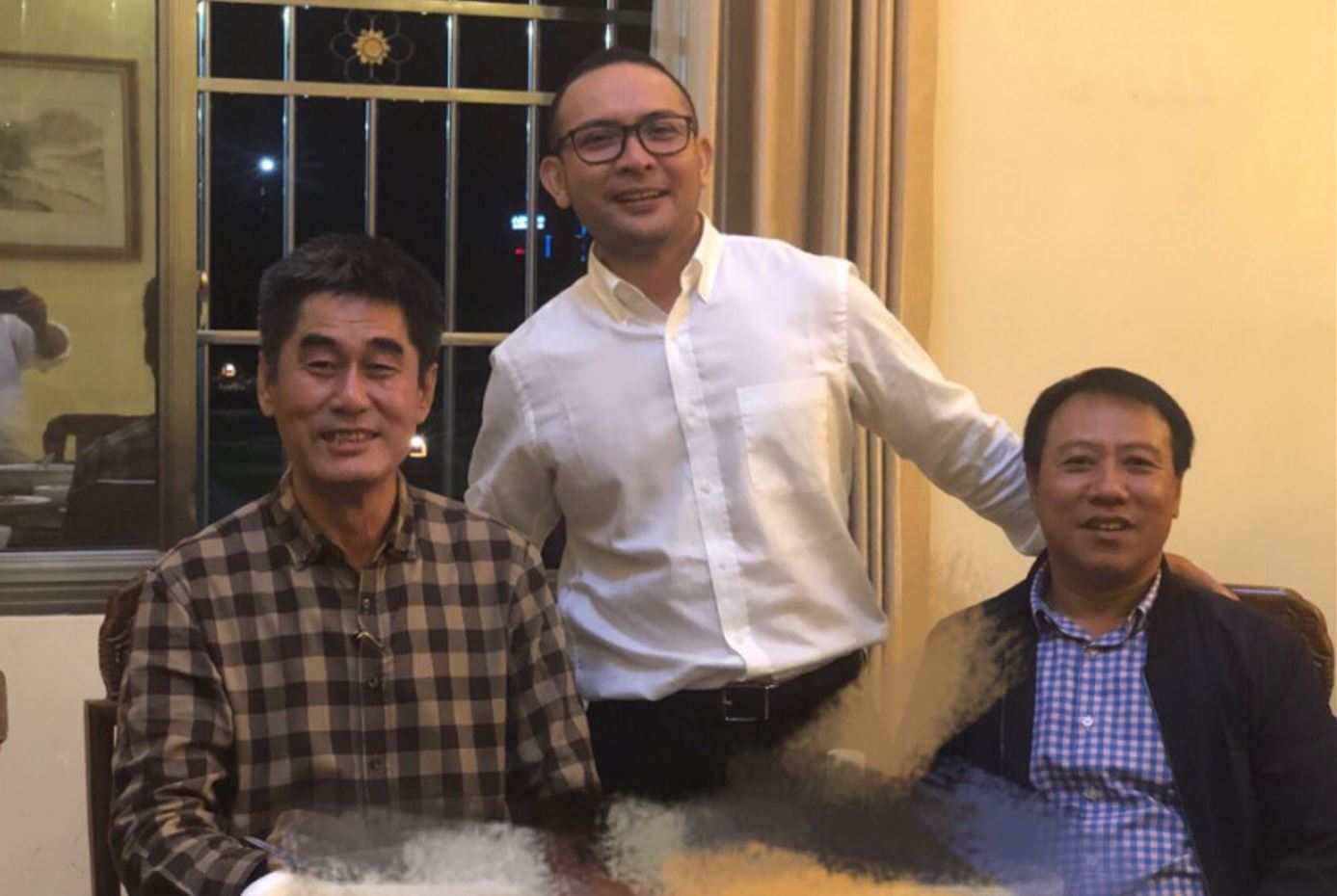
Leaders of the MNDAA, AA, and TNLA seen together.
Q: Currently, some ethnic armed groups are demanding things that exceed a "Confederation." Since there is no constitutional basis for such demands, what other ways can territory or status be granted?
A: There are no specific provisions in our Constitution for granting such territories. Truthfully, "Confederation" as a concept isn't widely practiced in the world anymore—though the European Union functions as a confederate-like entity.
However, they operate as separate, individual countries. In our case, parts of Myanmar cannot be severed and given away. We cannot grant "Confederate" status. We must work on "Federalism" through the NCA route by incorporating the common agreements agreed upon by all ethnic groups into the current Constitution.
If it doesn't align with the Constitution, the Constitution must be amended. If the Constitution cannot be amended yet, we can amend the peace agreement first. The Union Accord has over 40 points. If these 40 points are brought under the Constitution, we can say Myanmar’s Constitution has taken a massive step toward a Federal structure.
Q: When discussing peace and ceasefires, many demand that troops remain exactly where they are ("Point-to-Point"). From another perspective, the Myanmar military has lost significant territory. Is a "stay where you are" scenario realistic?
A: It is not easy. The Constitution already has designated borders for Ethnic Self-Administered Zones. If those borders are overstepped, it becomes a constitutional violation by the very groups meant to protect it.
To be honest, those who currently hold the upper hand on the ground use the phrase "stay where you are" because they do not want to lose the economic opportunities they have gained. Legally speaking, this is a situation that the Constitution simply cannot permit.
Q: Myanmar has faced crises for the past five years. The economy and living standards have declined. Now that a new government and parliament have appeared, what should be prioritized?
A: The issues in Myanmar are such that we don't even have the luxury to choose what to prioritize. Everything is equally important and urgent. First, however, we must prioritize stability and peace. After that, we must boost production in agriculture and livestock—Myanmar's main economy. When more people are in the workforce and the economy is circulating, the country will begin to breathe again. We cannot rely solely on natural resource extraction anymore.
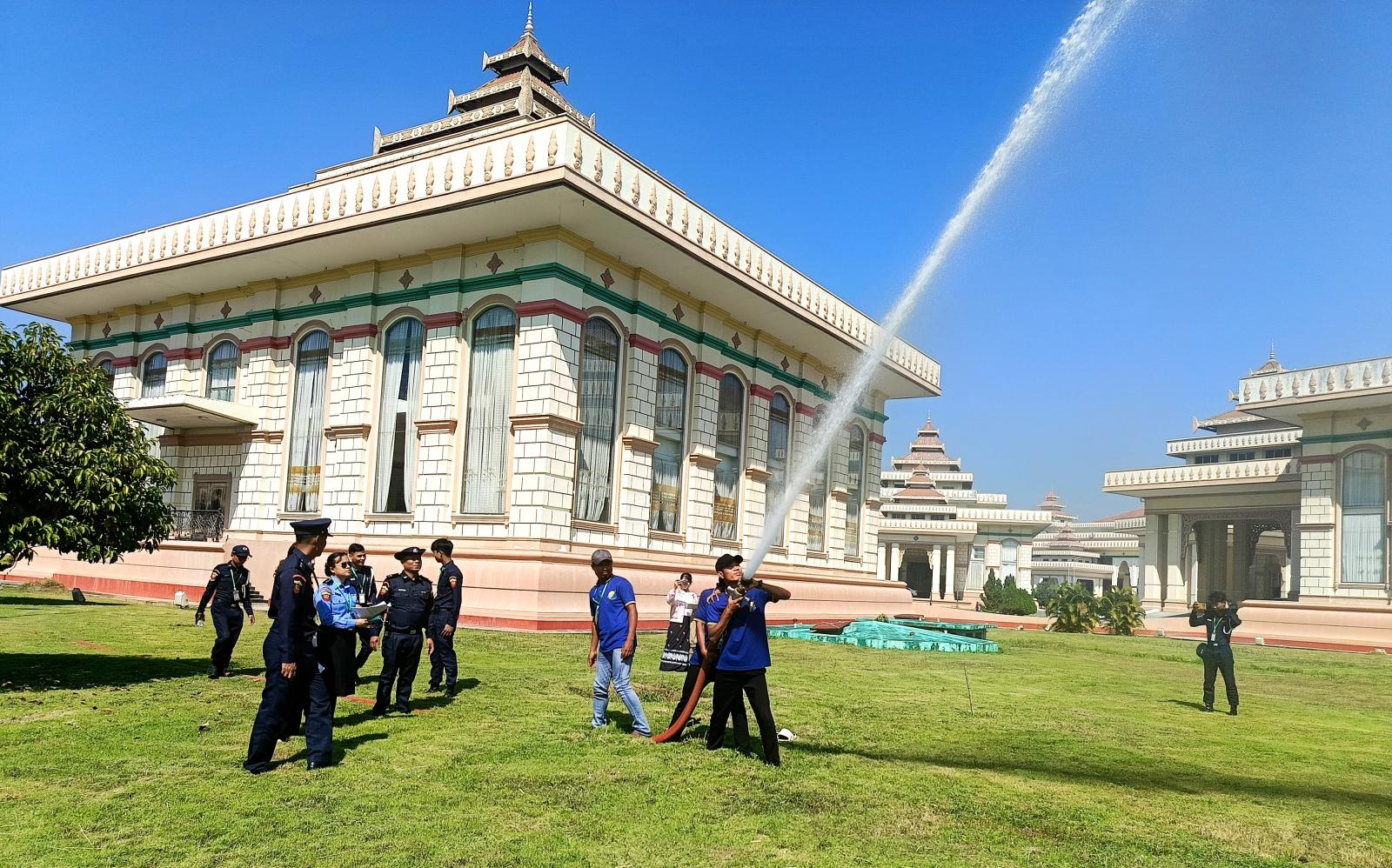
The Parliament (Hluttaw) is seen.
Q: What is the role of Parliament in this setting?
A: The role of Parliament is to introduce the points already agreed upon in the Union Accord as motions and integrate them into the Constitution. If the majority in Parliament agrees, these changes can be implemented.
Q: The "Wa" (UWSA), the strongest ethnic armed group, always states they will not secede from Myanmar. How does this firm stance affect other groups?
A: Not all ethnic armed groups in Myanmar are fighting to secede. They took up arms because they felt they weren't receiving full rights for their people and believed they had to demand them through force. We see that later on, due to the personal agendas of leaders, they haven't been able to achieve the original goals for their ethnicities.
Thus, the voices of these groups don't always represent the entire ethnic population. What we want is for no ethnicity to secede from the current map of Myanmar. That is how the Union will endure. Secondly, the central or Union government must provide rights so that they do not want to secede. I want this to move toward a systematic method of demanding rights. Leaving the armed path to demand rights through political channels is better for the long term.
In modern warfare, there is no such thing as a "total victory." The government will not be able to completely defeat any armed group either. In this situation, both sides must negotiate. Regarding Federalism, what percentage of their demands can we meet? If you ask for 100, we might start by giving 10. You accept that 10, then demand 20, then work to get 30, and eventually reach 50 or 100. If we set a "Time Duration Frame" for this, Myanmar will find peace quickly.
Q: Any final thoughts on the current situation?
A: I want all ethnic armed groups to empathize with the crises being faced by ethnic people on the ground. I want them to join in building a nation with the stable social and economic life that the ethnic people truly desire.
Revolutionary fighting over small details is no longer sufficient or feasible given today's political technology. Therefore, I don't want any ethnicity to consider secession. We will work to create a mechanism where they can negotiate and demand what they truly need from the central government. From the Parliament side, we will stand by the people and the ethnic groups to the best of our ability.
- By CNI
- Category: English Section
- Hits: 293
CNI News
April 25, 2026
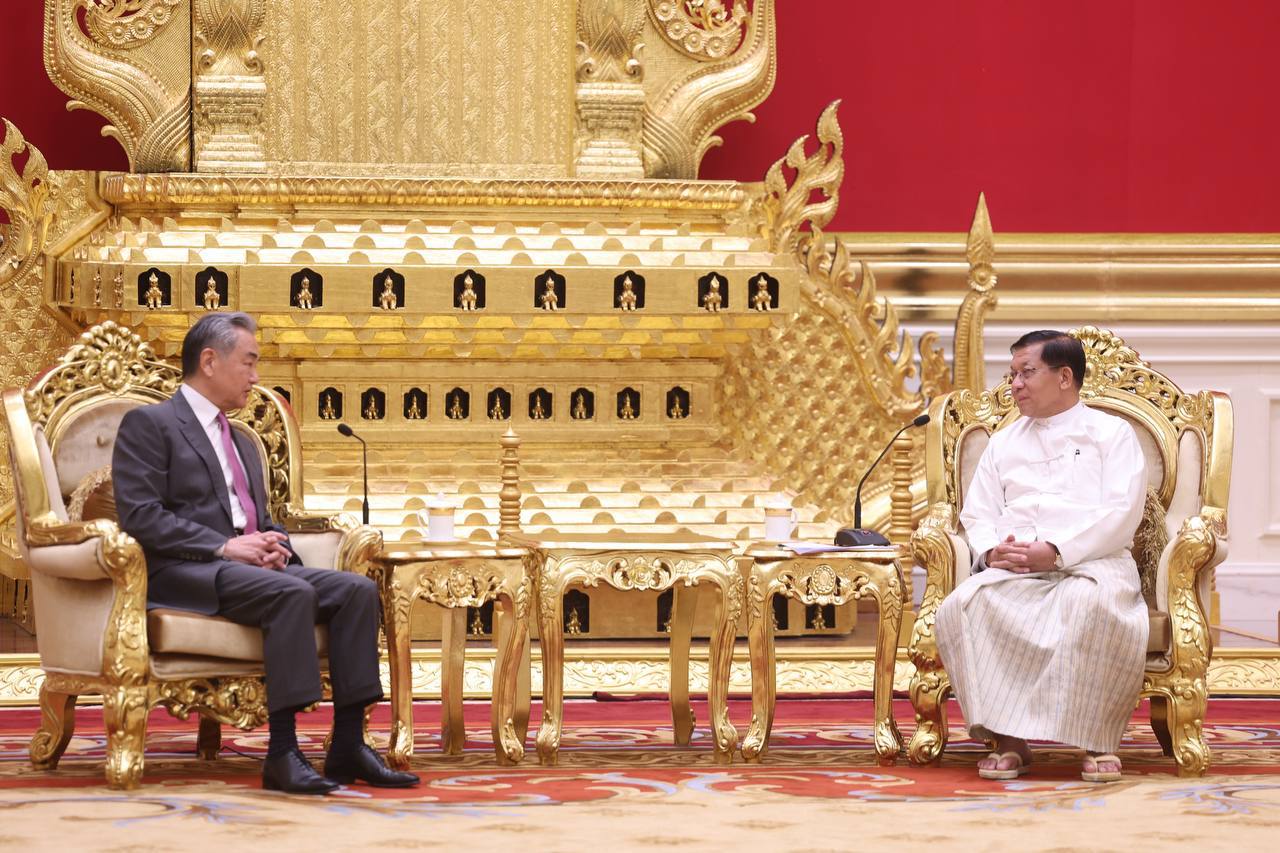
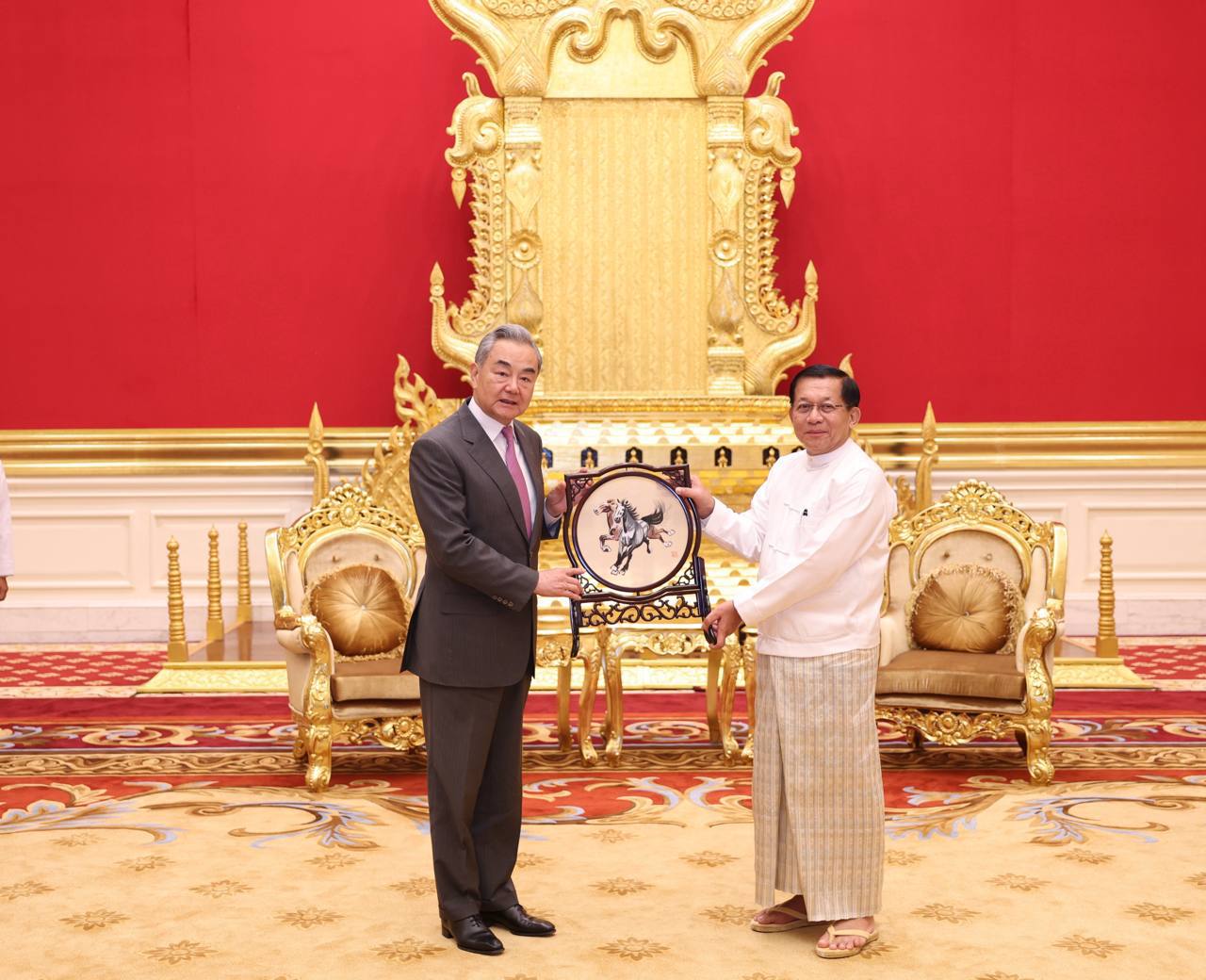
Chinese Foreign Minister Mr. Wang Yi visited Myanmar and met with President U Min Aung Hlaing on April 25, 2026, for high-level discussions.
President U Min Aung Hlaing stated that during his administration's tenure, efforts will continue to further improve and strengthen the relationship and cooperation between Myanmar and China.
In response, Mr. Wang Yi expressed his belief that under the President’s leadership, Myanmar will become a long-term developing nation. He noted that both countries would accelerate cooperation on matters that benefit the socio-economic lives of their peoples and affirmed that China would continue to stand by and support Myanmar on the international stage.
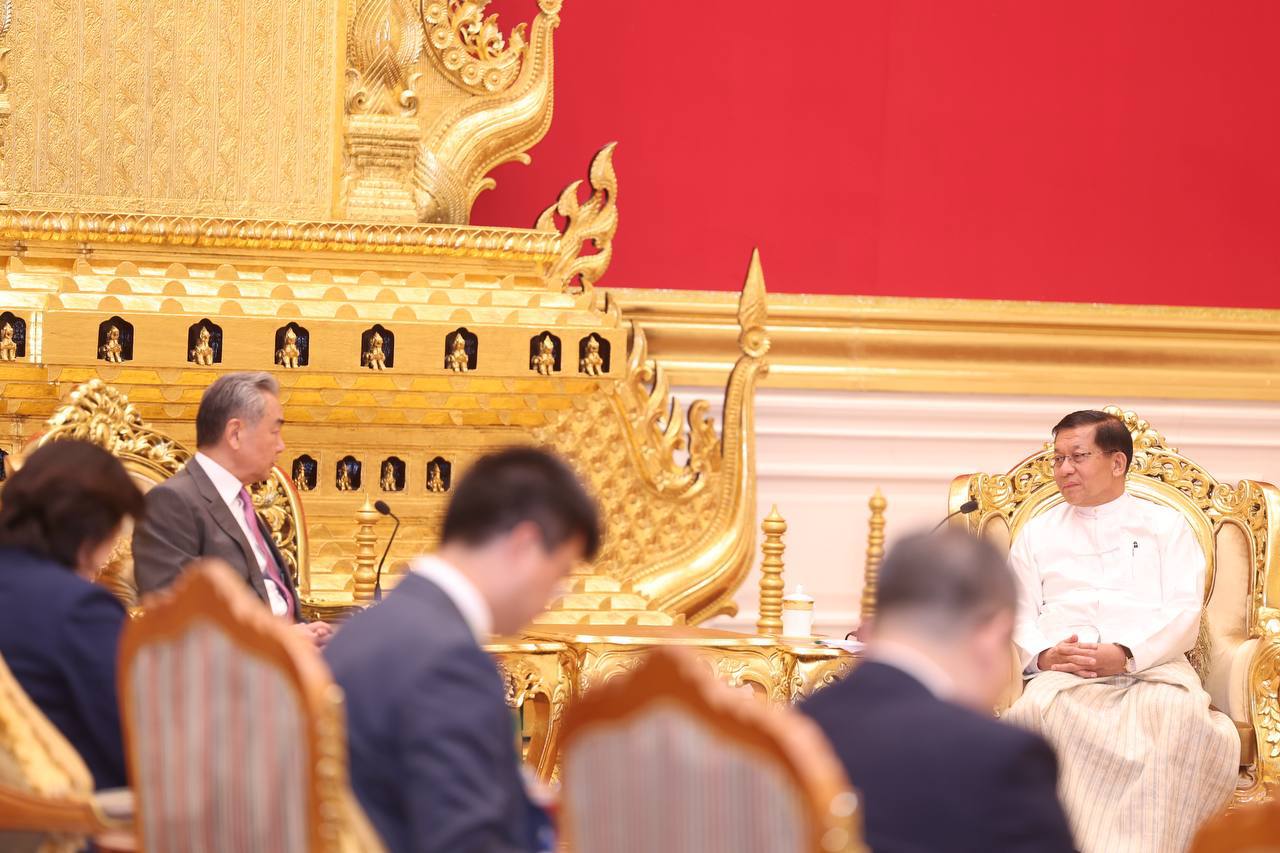
The leaders discussed several critical sectors and cooperative efforts:
Sovereignty and Stability: China reaffirmed its firm support for Myanmar’s national sovereignty, territorial integrity, and stability. Support was also pledged for national reconciliation and social harmony.
Border and Peace: Both sides agreed to continue coordinating on border stability, ensuring smooth and rapid trade flows, and achieving internal peace.
International Relations: Discussions covered Myanmar’s enhanced cooperation within the international arena and the ASEAN community.
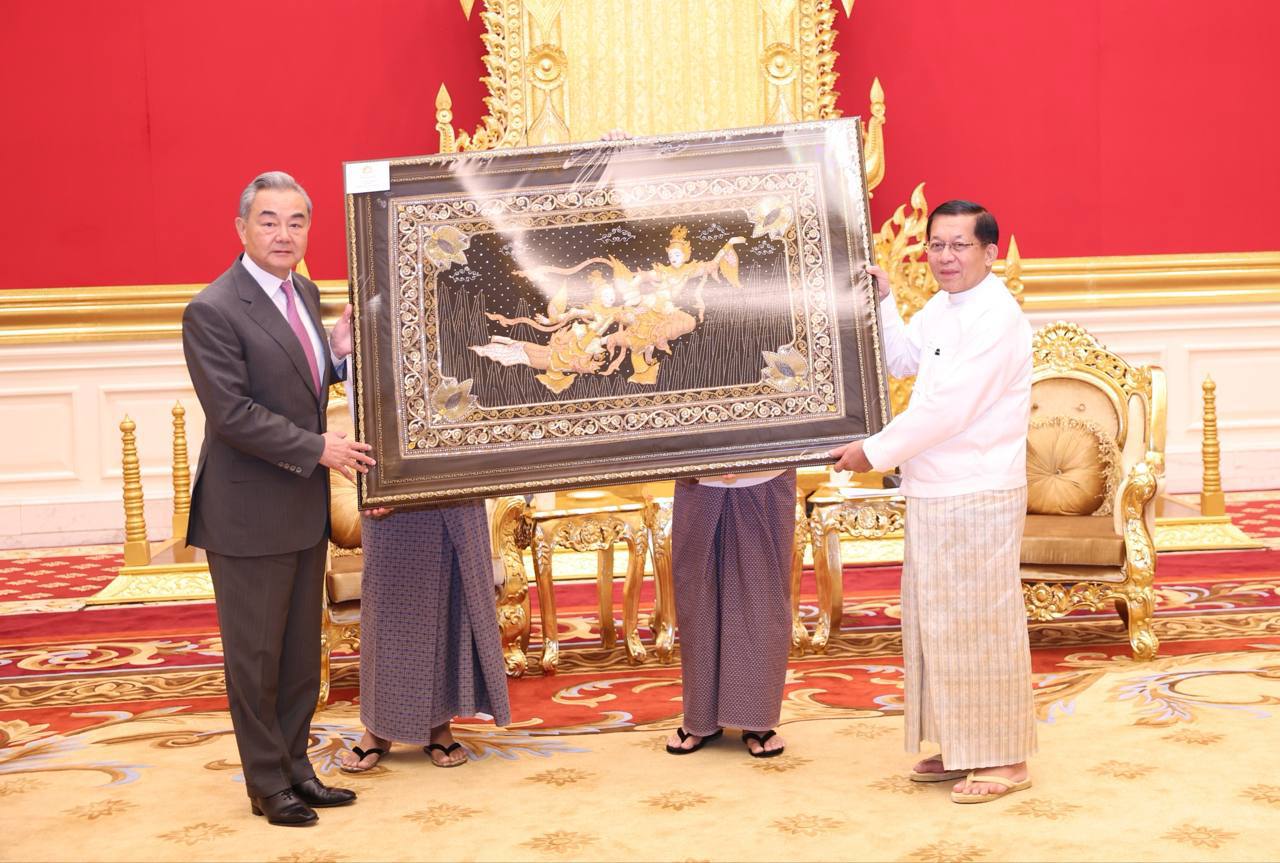
Democratic Transition: Following the successful holding of a free and fair multi-party democratic general election, the leaders discussed how the people-elected government is firmly moving forward on a democratic path and will increase its participation within ASEAN.
Regional Peace: Myanmar expressed support for President Xi Jinping’s four-point proposal for peace and stability in the Middle East.
Economic & Technical Cooperation: Strengthening cooperation in border trade, energy, minerals, agriculture, and technology sectors.
Cybercrime: A commitment to jointly combat online fraud and illegal gambling operations.
From the Chinese side:Foreign Minister Mr. Wang Yi, Chinese Ambassador to Myanmar Ms. Ma Jia, Vice Minister of Foreign Affairs and spokespersons.
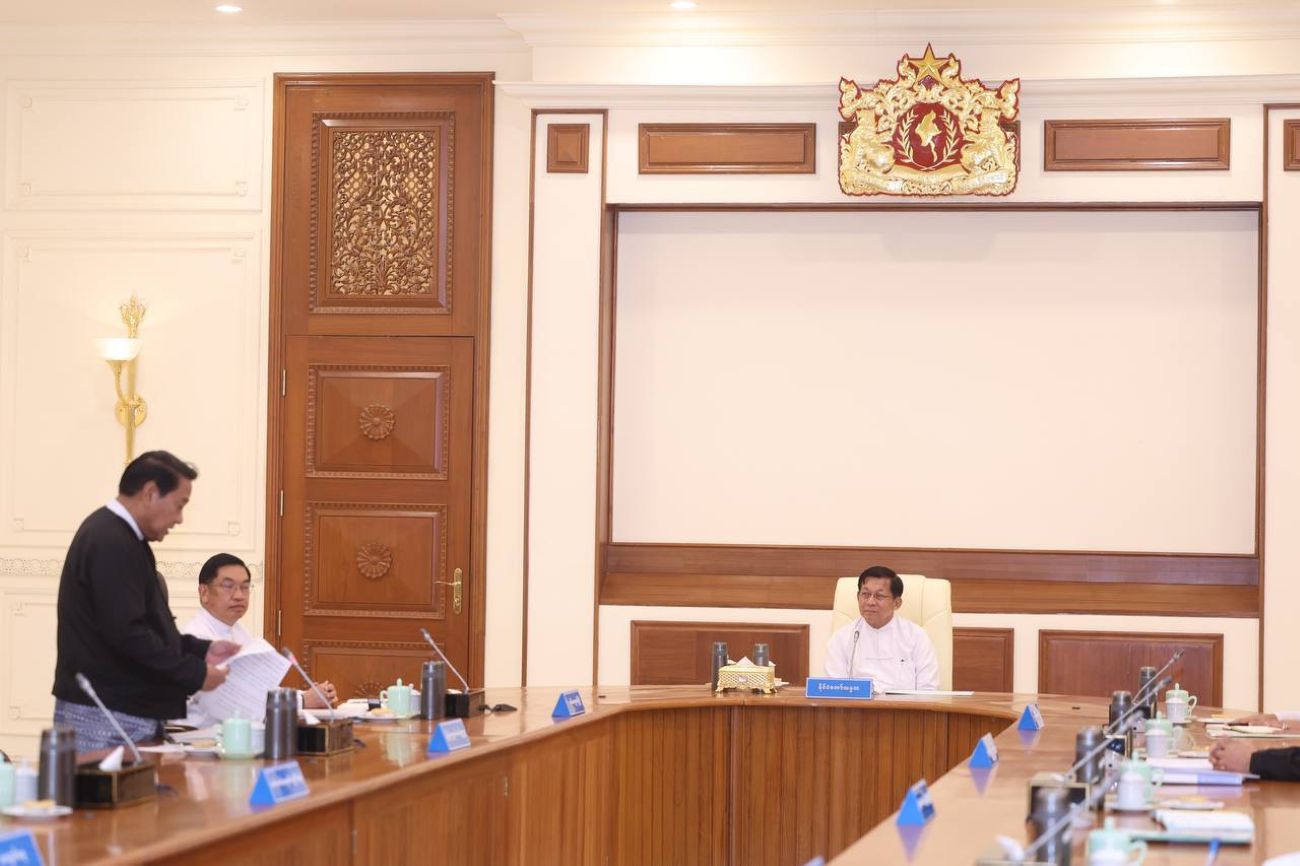
From the Myanmar side: President U Min Aung Hlaing, Foreign Minister U Tin Maung Swe, Minister of the President’s Office U Khin Maung Yi, Minister for Home Affairs Lt-Gen Nyunt Win Swe,NSPCC Chairman Lt-Gen Yar Pyae.
- By CNI
- Category: English Section
- Hits: 209
CNI News
April 25, 2026
Military and political analysts are examining the potential implications of the exclusion of Parliament(Hluttaw) from the newly reconstituted peace process bodies—the NSPCC, NSPWC, and NSPNC—under the transition government led by President Min Aung Hlaing.
On April 11, 2026, the government announced the reorganization of the National Solidarity and Peacemaking Central Committee (NSPCC), the National Solidarity and Peacemaking Working Committee (NSPWC), and the National Solidarity and Peacemaking Negotiation Committee (NSPNC).
Because Parliament was omitted from this structure, analysts are questioning whether this implies that the legislative body is no longer considered relevant to peace-related affairs.
Dr. M Kawn La told CNI that the decision to exclude Parliament suggests a strategy to prioritize negotiations between armed groups first.
The Strategy: He believes the focus is currently on inviting Ethnic Armed Organizations (EAOs) and the PDF to discuss military matters and ceasefires rather than making immediate political commitments.
The Process: "I think the political process—and the role of Parliament—will come only after they negotiate and establish what those commitments will be. It seems the goal is to have armed groups work things out among themselves first."
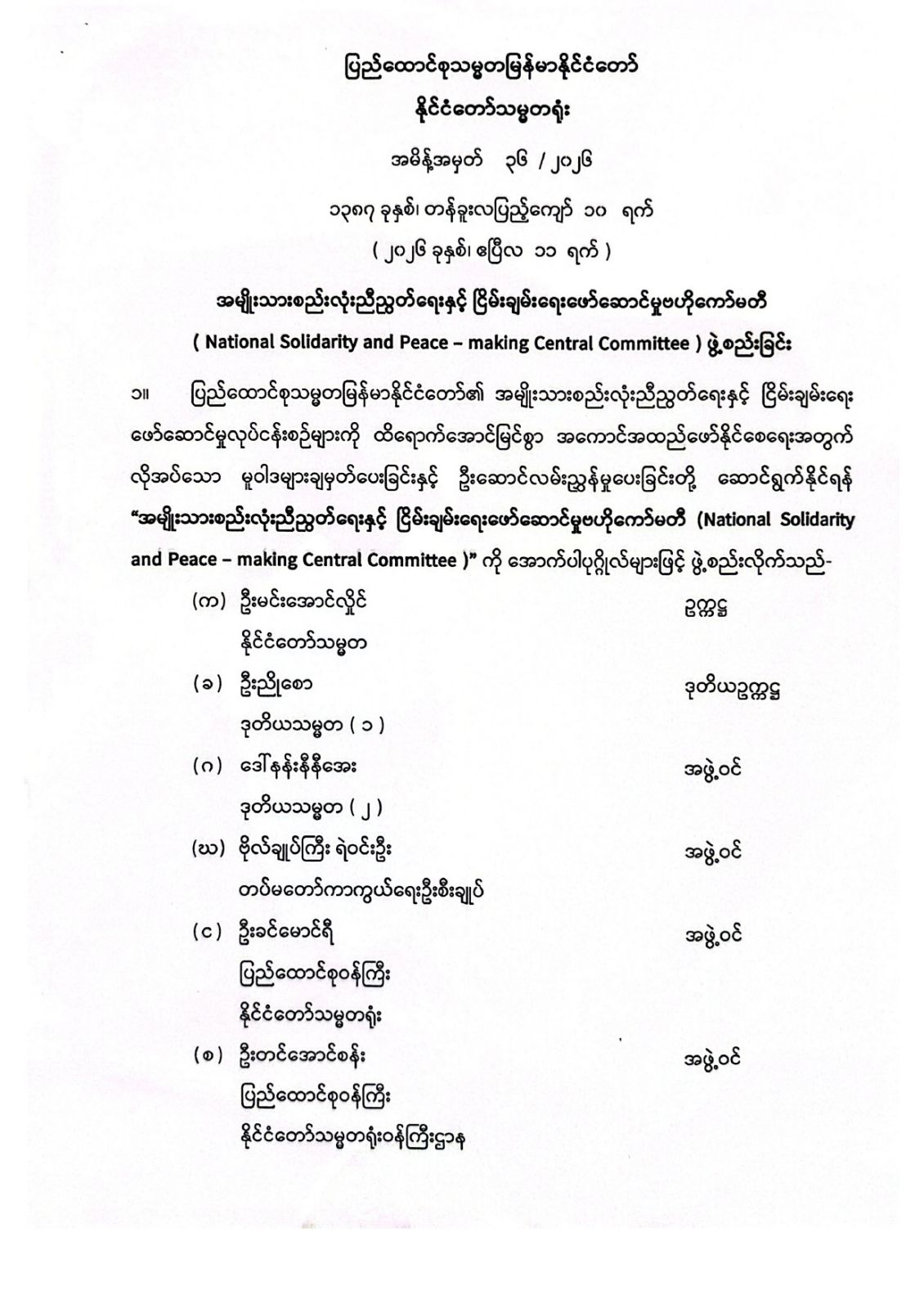
The official announcement regarding the formation of the NSPCC.
Pros & Cons: * Advantage: Decisions and policy changes can be made and moved quickly.
Disadvantage: There is a lack of public representation. Without Parliament, the "mandate" and "backup" of the people are missing, making the political dialogue less representative.
Sai Htay Aung (Chairman, Tai-Leng (Shanni) Nationalities Development Party):
Sai Htay Aung noted that the current formation deviates from the structure of the Union Peace Dialogue Joint Committee (UPDJC) defined in the NCA.
A New Model: The committee is comprised only of the Government and the Military. However, it includes a wide range of government ministries.
Advantage: With many ministries involved, decisions can be made rapidly, and proposals can be implemented almost immediately.
Disadvantage: Because Parliament is not directly involved, any matters requiring parliamentary approval will have to go through a multi-step process rather than being handled directly, which could become a weakness.
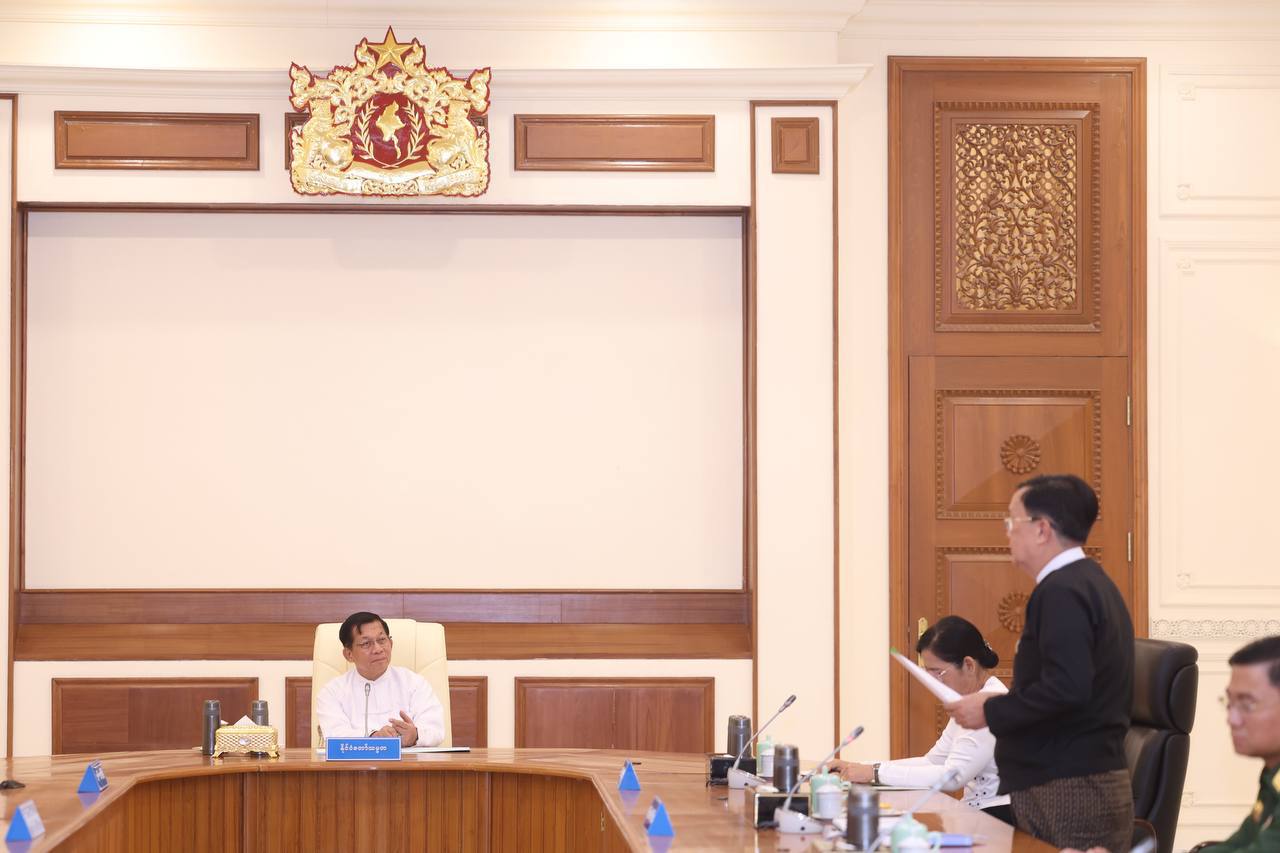
Amyotha Hluttaw Speaker U Aung Lin Dwe speaking during a National Defense and Security Council (NDSC) meeting.
The current structure marks a significant shift from previous administrations:
Thein Sein & NLD Eras: Both the UPCC (under President U Thein Sein) and the NRPC (under the NLD government) included parliamentary roles.
2021–2025: During the military's period of governance, Parliament was non-existent, so it was naturally excluded from the NSPCC.
2026 (Present): Despite the 2025 General Election having taken place and a Parliament now being in session, the April 11 reorganization still opted to exclude legislative representatives.
Military and political observers point out that:
Constitutional Challenges: The absence of Parliament may create significant hurdles when it comes to discussing constitutional amendments.
Military Dominance: The current landscape suggests that the military’s influence and direct involvement remain the dominant force in the peace process.
- By CNI
- Category: English Section
- Hits: 223
CNI News
April 25, 2026
If Myanmar’s transitional government can fully implement the Nationwide Ceasefire Agreement (NCA), it could restore the country's regular relations with ASEAN, according to Colonel Khun Okkar, Chairman of the Pa-O National Liberation Organization (PNLO-NCA/S).
ASEAN has previously demanded that Myanmar follow a Five-Point Consensus, which includes:
Releasing political prisoners.Cessation of violence. Holding inclusive peace dialogues with all stakeholders. Providing unhindered humanitarian assistance.
Due to the government and military’s failure to implement these points, Myanmar was excluded from ASEAN summits from 2021 to 2025, with only non-political representatives invited.
Colonel Khun Okkar noted that if the new government fully executes the NCA, it would inherently fulfill ASEAN’s requirements, potentially paving the way for a return to the summit table.
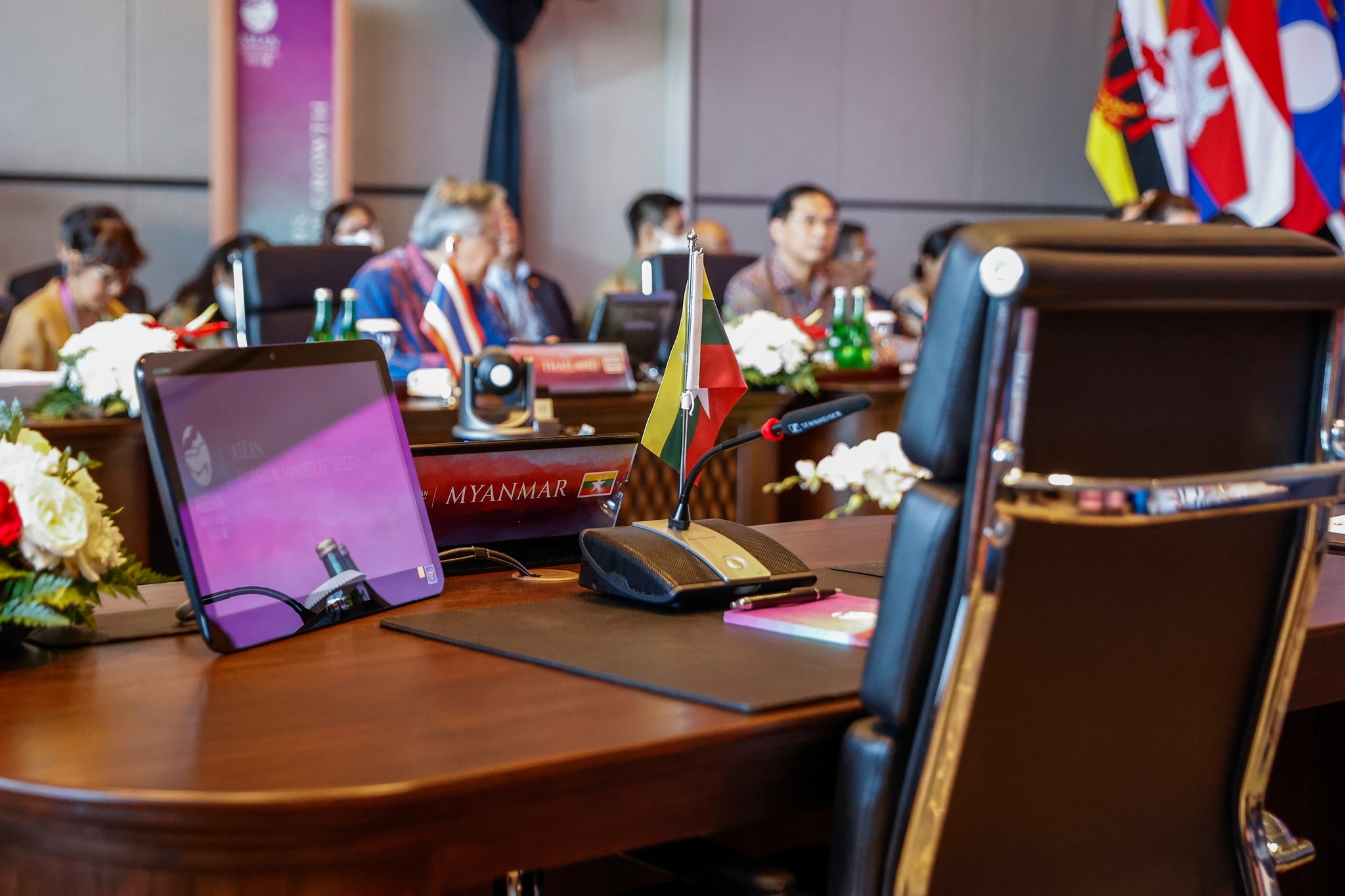
The vacant seat for the Myanmar representative at an ASEAN meeting.
"ASEAN still holds to its Five-Point Consensus. If those points are followed, Myanmar can get back on the ASEAN track. I haven't heard them explicitly say they are working on the Five-Point Consensus yet, though they have mentioned reconciling with ASEAN. A key part of the ASEAN plan is 'inclusive political dialogue,' which is also a core component of the NCA. Therefore, implementing the NCA aligns perfectly with ASEAN’s goals. There are two overlapping areas: inclusive political dialogue and humanitarian aid. If these can be carried out freely, it kills two birds with one stone—fulfilling both the NCA and the ASEAN consensus. This country could realistically achieve this within the 100-day plan," Colonel Khun Okkar said.
Despite the emergence of a transitional government, political analysts point out that ASEAN will likely only fully readmit Myanmar once President U Min Aung Hlaing demonstrates concrete reforms.
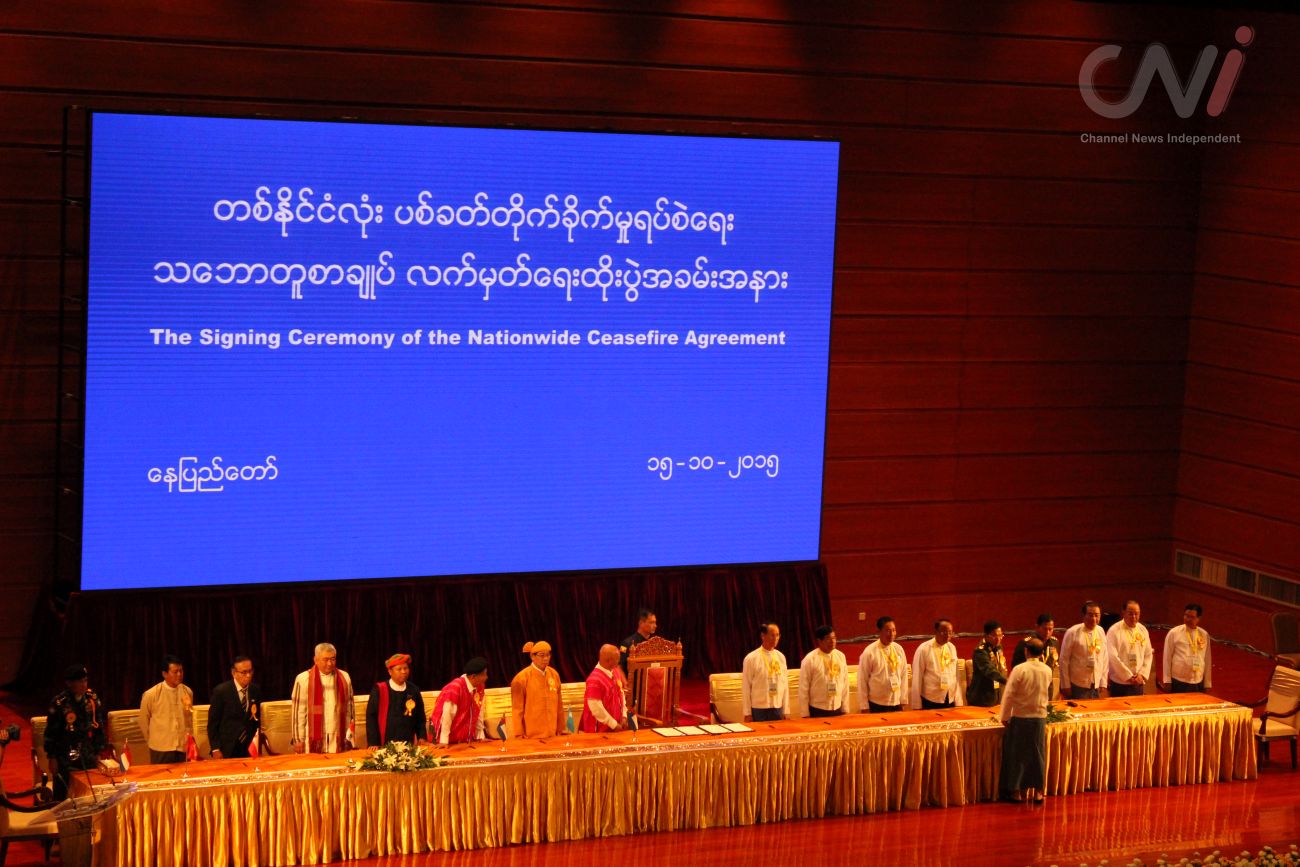
The NCA consists of 7 chapters and 33 sub-articles. It is viewed by many as the only viable exit strategy for amending the rigid 2008 Constitution and as the framework for building a democratic and federal union.
U Thein Tun Oo, Director of the Thayninga Institute for Strategic Studies, suggested that reconnecting with ASEAN through the NCA would be a "by-product" or secondary benefit of internal peace.
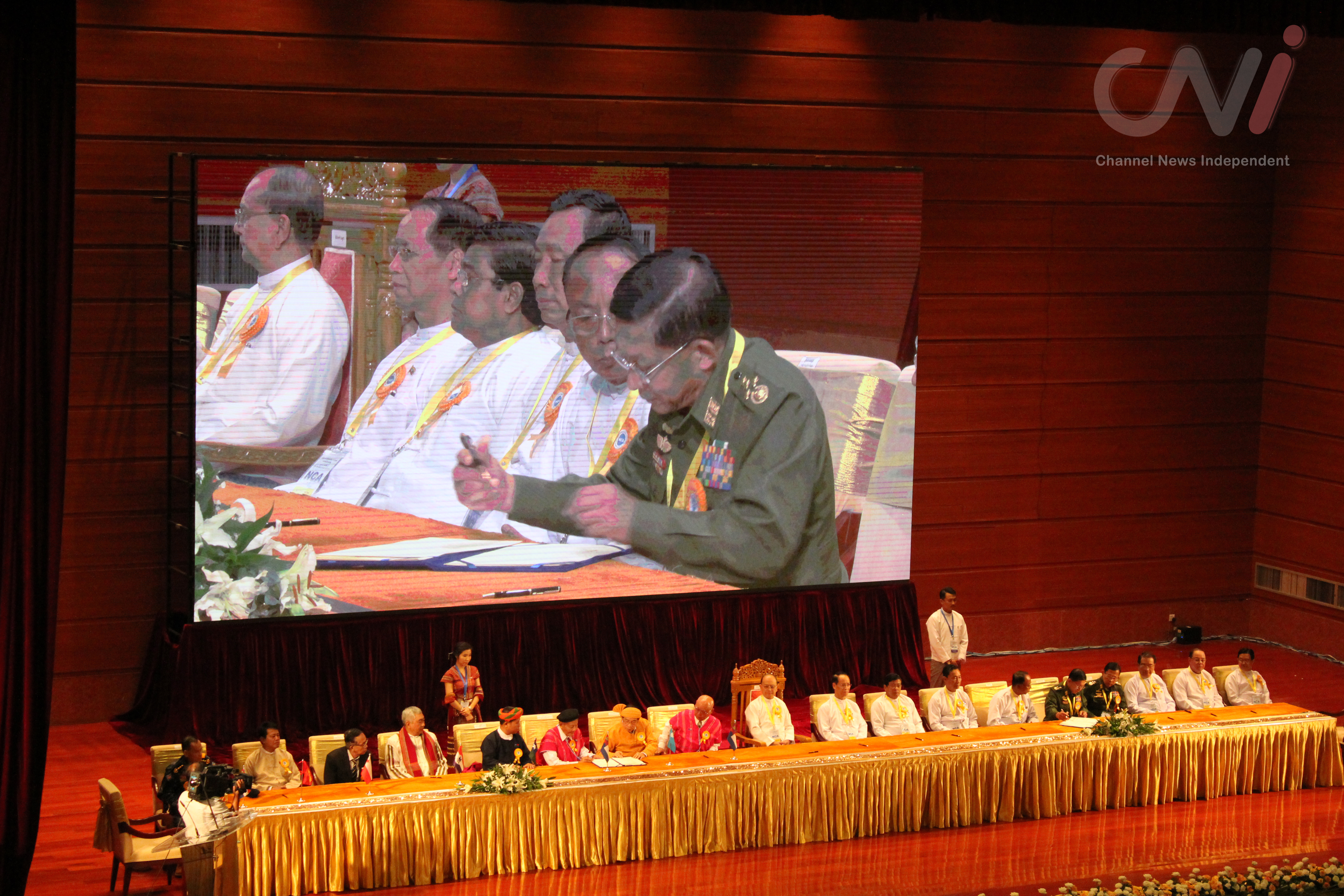
U Min Aung Hlaing signing the NCA.
"Since the Five-Point Consensus was released, Myanmar has stated it would work on points that are feasible and aligned with the country's current situation. Some actions may overlap with previous efforts or be collaborative in nature. If the other side is satisfied with these steps, a reunion might happen. However, it's important to remember that Myanmar is a sovereign state. It must move forward with policies that suit its own context. We shouldn't assume Myanmar must follow every ASEAN whim just to rejoin. Reconnecting with ASEAN because of successful NCA implementation is a secondary benefit. I don't think the NCA is being rushed just to satisfy ASEAN—the focus must remain on the NCA itself. Once the NCA is implemented successfully and peace is achieved, the other issues will resolve themselves," U Thein Tun Oo said.
The NCA is the foundational political agreement between the Myanmar government, the military, and Ethnic Armed Organizations (EAOs), serving as the cornerstone of the national peace process.
- By CNI
- Category: English Section
- Hits: 379
CNI News
April 25, 2026
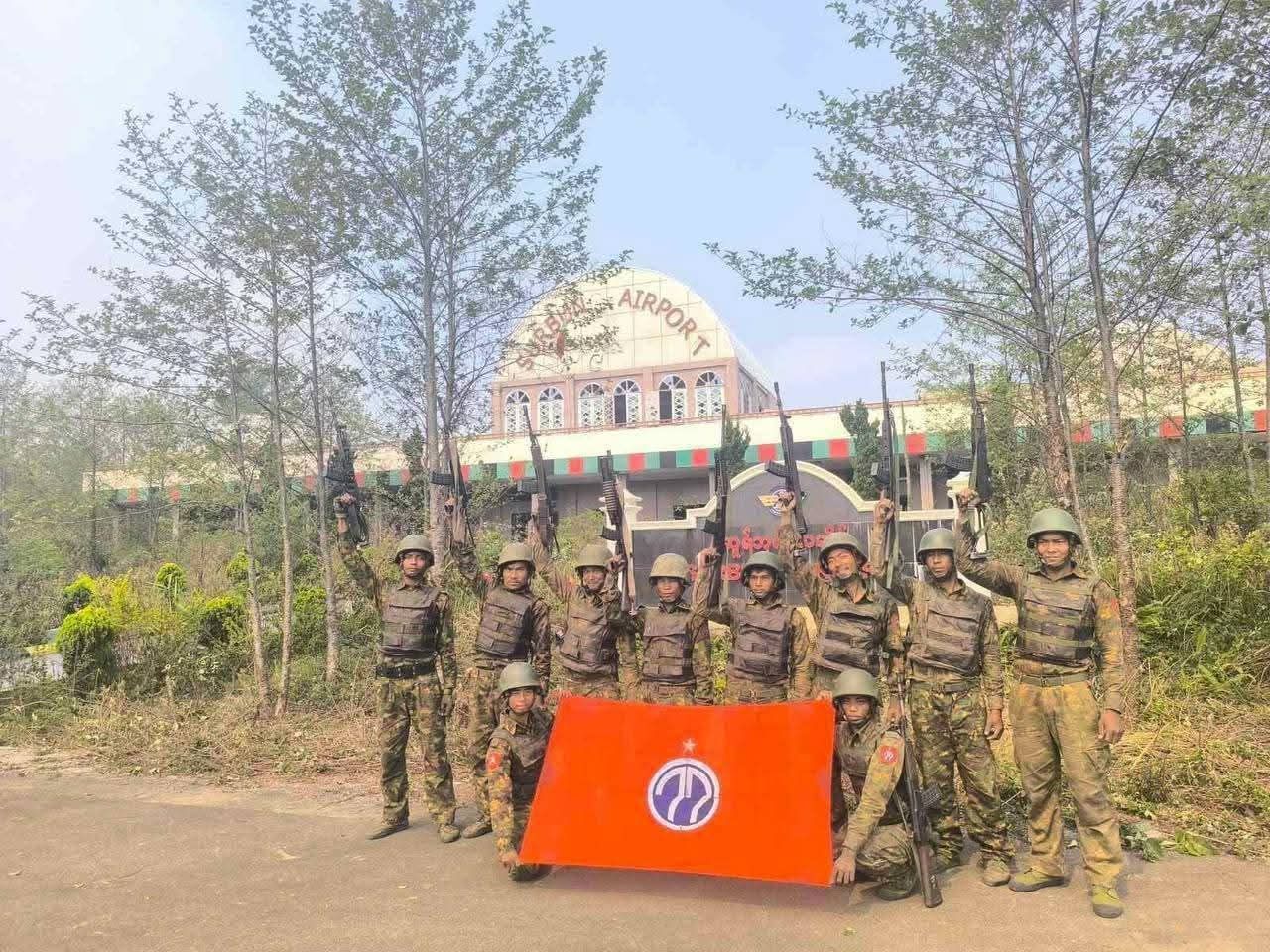
The Myanmar military reportedly regained control of Falam Town in Chin State today, April 25, 2026.
Currently, photos have emerged showing the military’s control of Surbung Airport in Falam.
The Chin Brotherhood and allied forces had previously captured Falam, located in northern Chin State, on April 7, 2025.
Following that, the Myanmar military launched a counter-offensive, leading to the reported recapture of the town on April 25, 2026.
Page 14 of 352
Connect with us