
English Edition
- By CNI
- Category: English Section
- Hits: 267
CNI News
February 26, 2026
In light of the political landscape that may emerge under Myanmar’s upcoming new government, the Shanni people should prepare through political and military consultation, said Sai Htay Aung, Chairman of the Tai-Leng (Shanni) Nationalities Development Party (TNDP), in an interview with CNI News.
He said: “I believe political and military matters should be discussed and prepared in order to reach a solution. We cannot achieve our ultimate goal simply by fighting, given our strength. Therefore, we will have to resolve matters politically. To gain political advantage, there must be repeated meetings and discussions — understanding what their objectives are and what ours are. Previously, things were only spoken about on paper and verbally. But now, when it comes to actual implementation, we must examine the political situation and prepare what we are going to say at the right time. As a party, we have prepared to implement four work plans.”
In the 2025 general election, the TNDP (also known locally as the Red Tiger Party) contested in Kachin State and won one Shan ethnic parliamentary seat, along with one seat in the Amyotha Hluttaw (Upper House) and two seats in the State Parliament through the proportional representation (PR) system — totaling four seats.
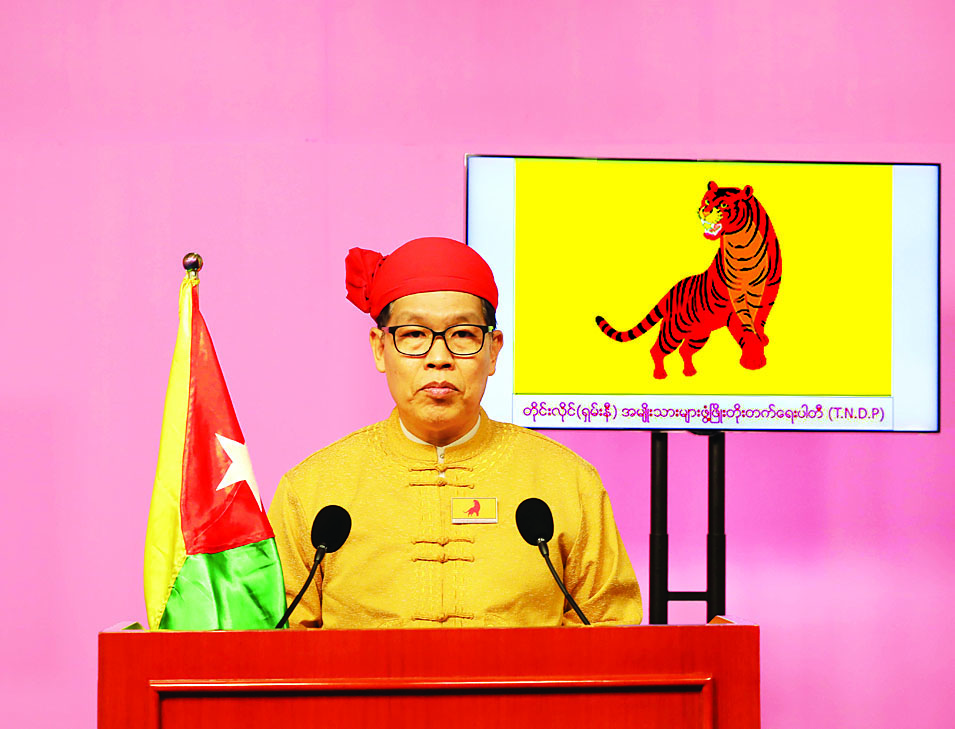
Sai Htay Aung, Chairman of the TNDP (also known locally as the Red Tiger Party)
Similarly, the SSP Party (locally called the Tiger King Party) contested in Sagaing Region and won one Shan ethnic seat along with seats in the Pyithu Hluttaw (Lower House), Amyotha Hluttaw (Upper House), and the Regional Parliament — totaling four seats.
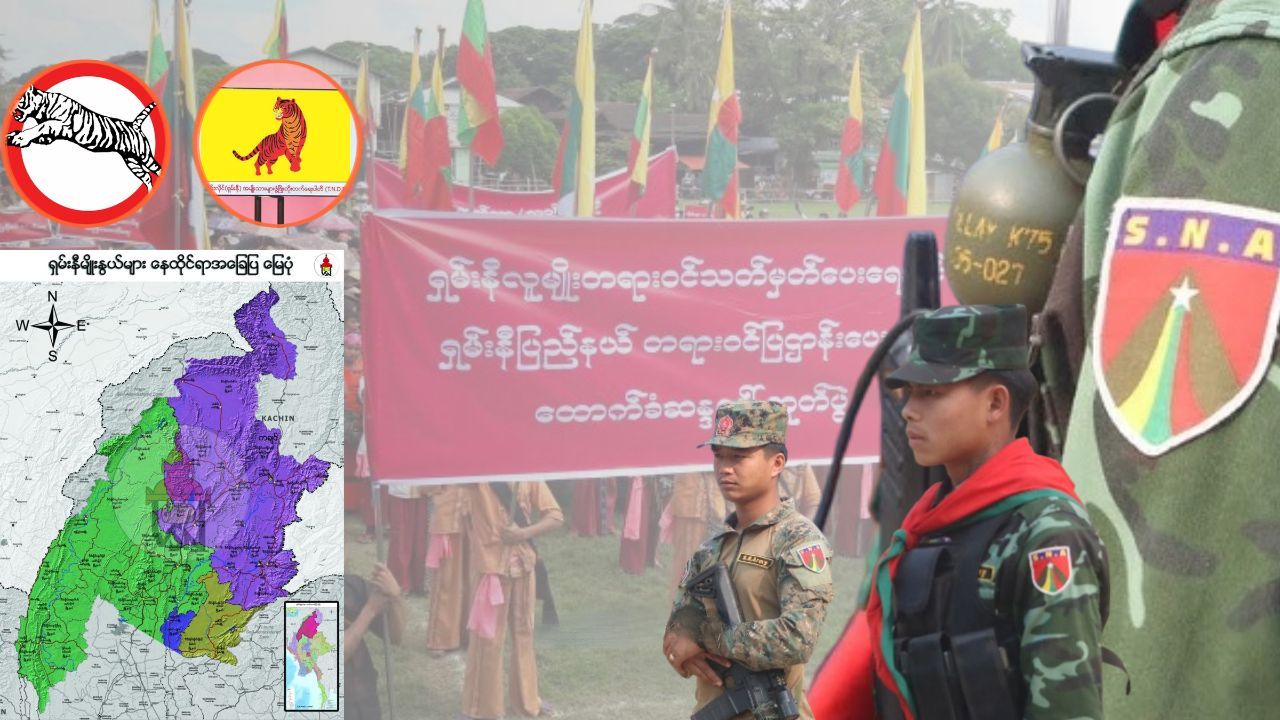
The main political objective of the Shanni people is either to obtain a separate Shanni State or to gain a Shanni Self-Administered Division.
They seek to combine areas formerly ruled by Shanni Sawbwas, including Hkamti, Homalin, Kale, and Tamu in upper Sagaing Region, as well as Mohnyin, Mogaung, Bhamo, and Myitkyina in Kachin State, into a single self-administered state.
According to Section 6 of the 1947 Constitution, districts such as Myitkyina, Mohnyin, and Bhamo — considered Shanni areas — were incorporated into Kachin State without the consent of the Shanni people, despite their opposition.
Similarly, other Shanni areas — including Kale, Hkamti, Mawlaik, Kathar, and Tamu districts — were incorporated into Sagaing Region following the drafting of the 1974 Constitution.
Currently, since their territories are divided between Kachin State and Sagaing Region, political and military observers believe the Shanni people are in a politically marginalized position.
To implement their political and military objectives, the Shanni Nationalities Army (SNA) was formed in 1989. It has frequently clashed with the Kachin Independence Army (KIA) over territorial control and ethnic affairs.
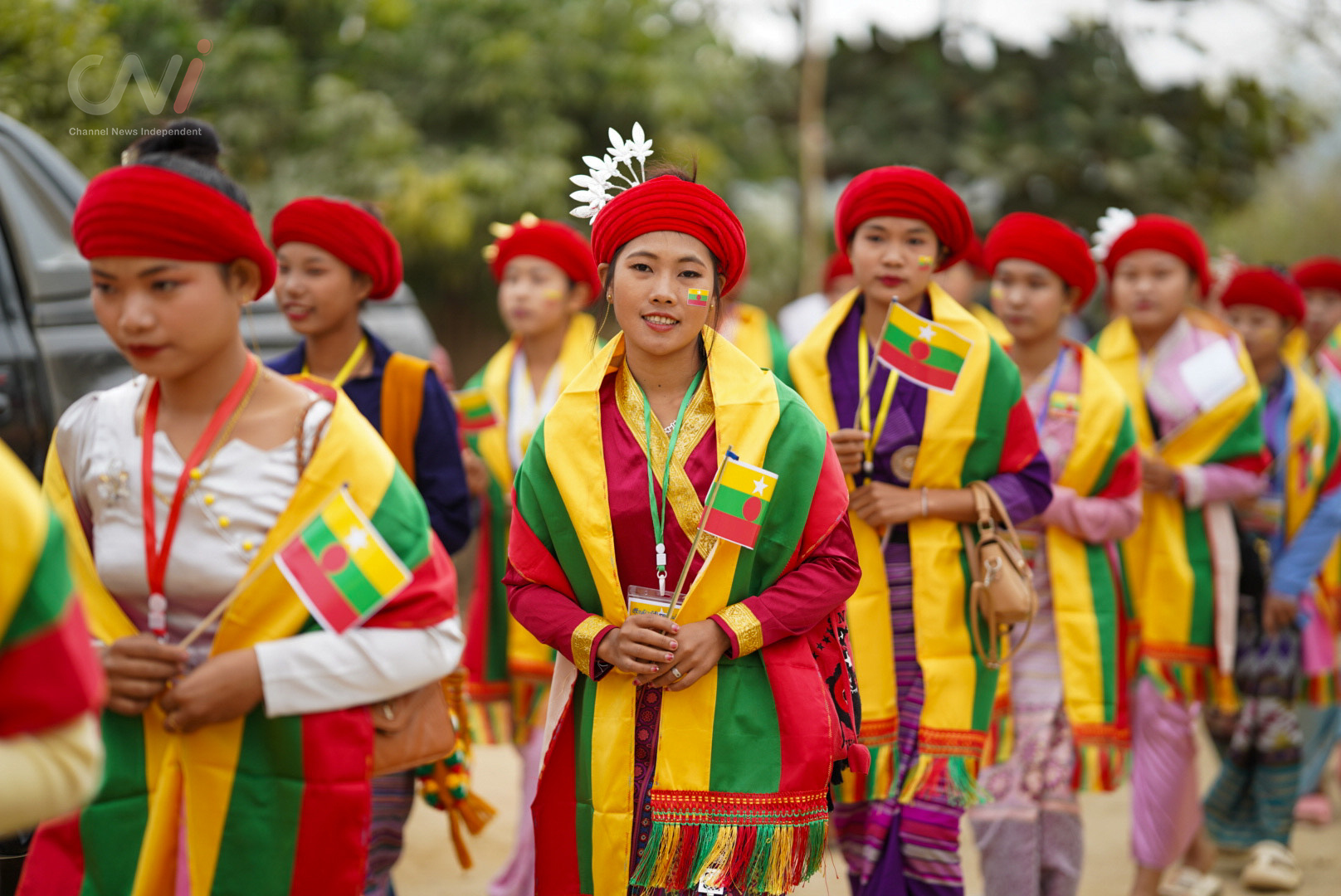
Shanni nationalities seen
After the political changes in Myanmar since 2021, the role of the SNA has expanded, and it has increased its territorial control.
Sai Htay Aung stated that the Shanni political issue cannot be resolved through military decision alone and that political strength must be prepared in advance.
He added: “If we speak about political objectives, implementation is necessary. Militarily, no matter what method is used, even forces stronger than the SNA cannot achieve final military victory. Therefore, political resolution is the only way forward. Armed struggle exists to support political decisions. Once a genuine political resolution is achieved, there would be no need to hold weapons. The same applies to the KIA. Even if they are strong and fight, it doesn’t mean they will get all the territories they fight for. When political decisions are made, especially if the government relies on the 2008 Constitution, it may only result in loss of lives without achieving their goals. For the SNA, it is time to firmly prepare to stand strong on the political platform. Now that our two Shanni parties have reached both the Pyithu Hluttaw and Amyotha Hluttaw, what will we do? From our side, we will strive to fulfill the promises we made to the public during the campaign.”
Political and military observers note that Shanni politics is a crucial component of peace in northern Myanmar.
The Shanni population is estimated at around one million people living across Kachin State and Sagaing Region. They have formally demanded statehood during the 21st Century Panglong Conference (Union Peace Conference).
The SNA is also working to regain Shanni State by consolidating districts in Sagaing Region — Mawlaik, Kale, Hkamti, Kathar, and Tamu — along with Bhamo, Myitkyina, Mohnyin districts and Mogaung area in Kachin State.
- By CNI
- Category: English Section
- Hits: 650
CNI News
February 26, 2026
The public in Kutkai Township, Northern Shan State, is facing significant hardships due to competing administrations between the Ta'ang National Liberation Army (TNLA) and the Myanmar National Democratic Alliance Army (MNDAA), according to Lwe Pakyaingza, a spokesperson for the Ta'ang Women's Organization (TWO), in an interview with CNI News.
According to local residents, disputes over regional administration and friction between the TNLA and MNDAA began on February 13, 2026. These tensions have reportedly escalated to a point where they are beginning to take on the characteristics of an inter-ethnic conflict. Although Kutkai has been under the TNLA control following "Operation 1027," MNDAA troops have also entered and established positions within the town.
Following scuffles between the two armed groups, locals reported that the MNDAA has tightened security at the entrances and exits of Hsenwi, specifically targeting and inspecting members of the Ta'ang ethnic group.
Lwe Pakyaingza of the TWO told CNI News that while the issue originated between the two armed groups, it is now targeting civilians and shifting toward an ethnic conflict.
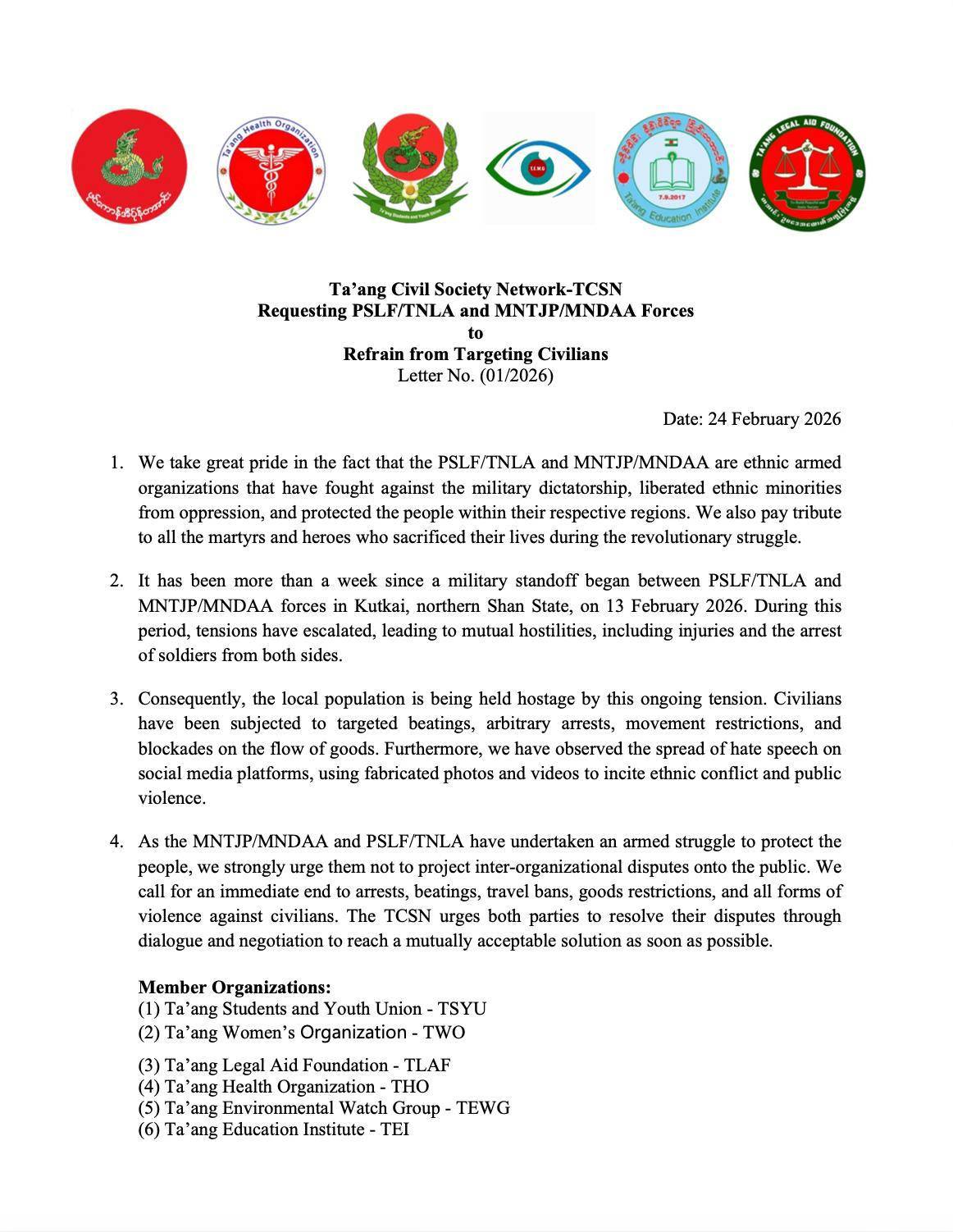
Statement issued by Ta'ang organizations regarding the conflict between TNLA and MNDAA.
"The problem is shifting toward the public, and as a civil society organization, we find this unacceptable," she said. "When there is administrative rivalry in a single town, friction and tensions are bound to happen on the ground. Sometimes, lobbyists organize and incite further tension. We see provocations both on the ground and on online platforms to escalate military tension."
She further warned that if these provocations lead to ethnic-based restrictions and travel bans, it will heighten conflict between the communities. "It is better for the groups to resolve their issues between themselves. The conflict between the armed groups is not a conflict between the local people or the ethnic groups. However, if it takes the form of a conflict between two ethnicities, the situation will become harder to control and tensions will likely worsen."
A local resident in Kyaukme, Northern Shan State, told CNI News that the conflict stems from an unfair or unclear division of territory following Operation 1027.
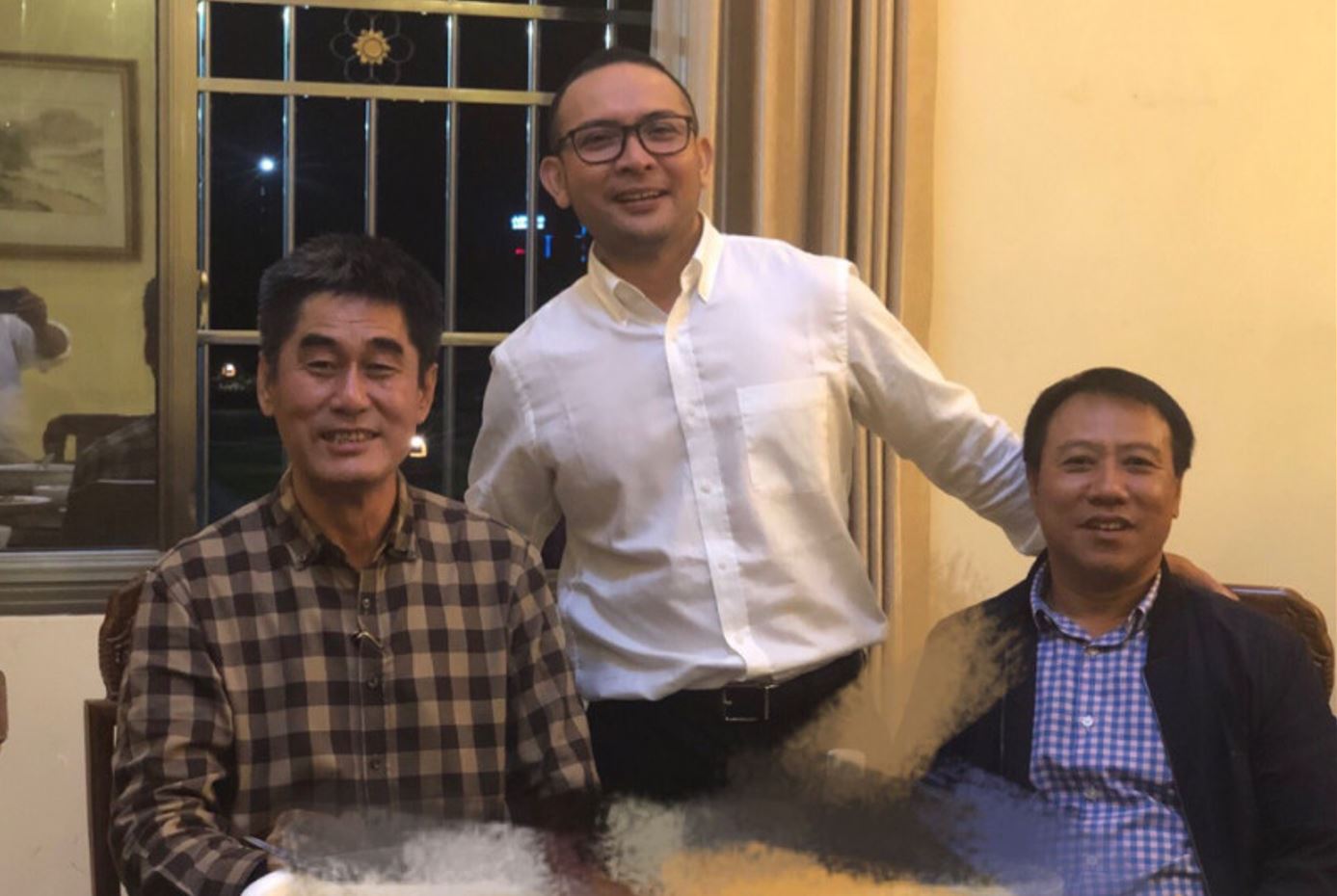
Leaders of the AA, MNDAA, and TNLA.
"During Operation 1027, they acted as the Three Brotherhood Alliance. However, after the operations, the territorial boundaries were not divided fairly or clearly. This lack of clarity has led to the current overlapping issues. It’s quite evident that the failure to properly delineate seized territories after Operation 1027 is causing these problems," the resident explained.
Ta'ang civil society organizations pointed out that most locals currently find it extremely difficult to distinguish between true and false information due to poor access to news sources and internet connectivity. This environment makes it easy for provocateurs to incite anger, leading to fears that the situation could devolve into a communal conflict.
Despite being members of the Brotherhood Alliance (MNDAA, TNLA, and AA), the MNDAA and TNLA have frequently experienced territorial disputes and internal clashes in Northern Shan State.
- By CNI
- Category: English Section
- Hits: 281
CNI News
February 26, 2026
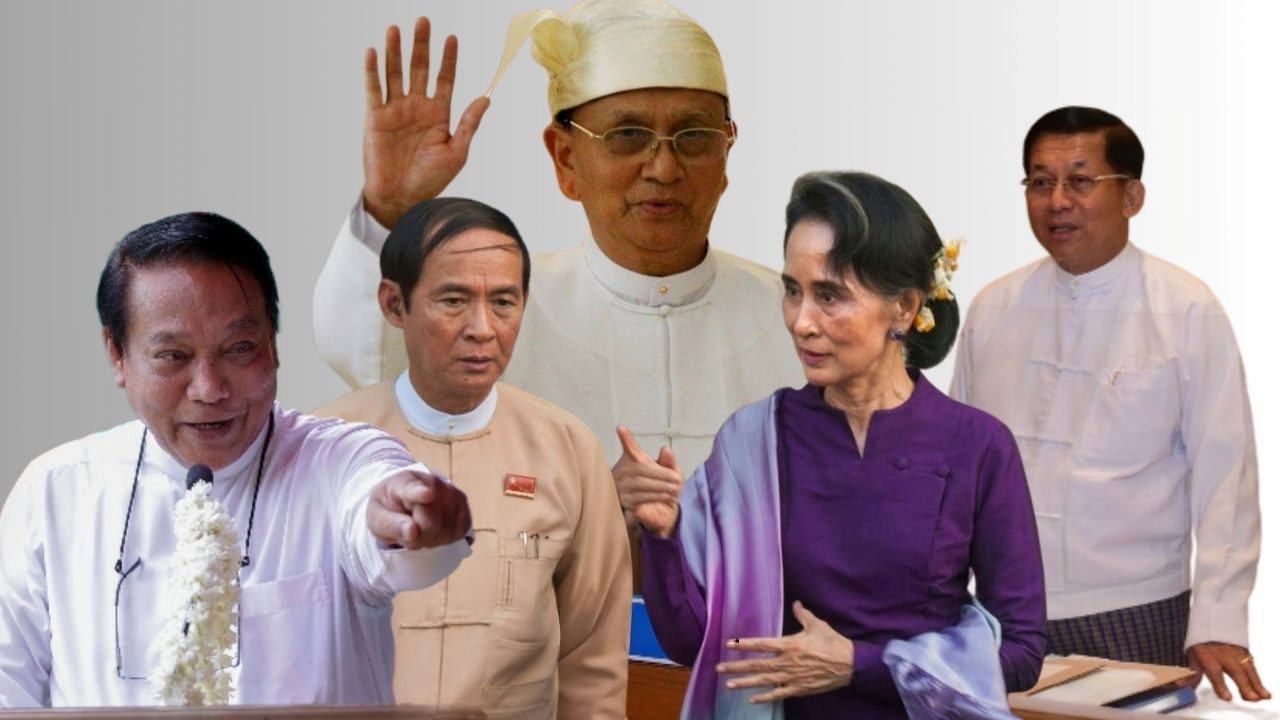
Ethnic Armed Organizations (EAOs) are reportedly receiving financial support from certain major foreign countries and providing terrorist training and weapons to revolutionaries, according to Vice Chairman of the State Security and Peace Commission, Vice Senior General Soe Win.
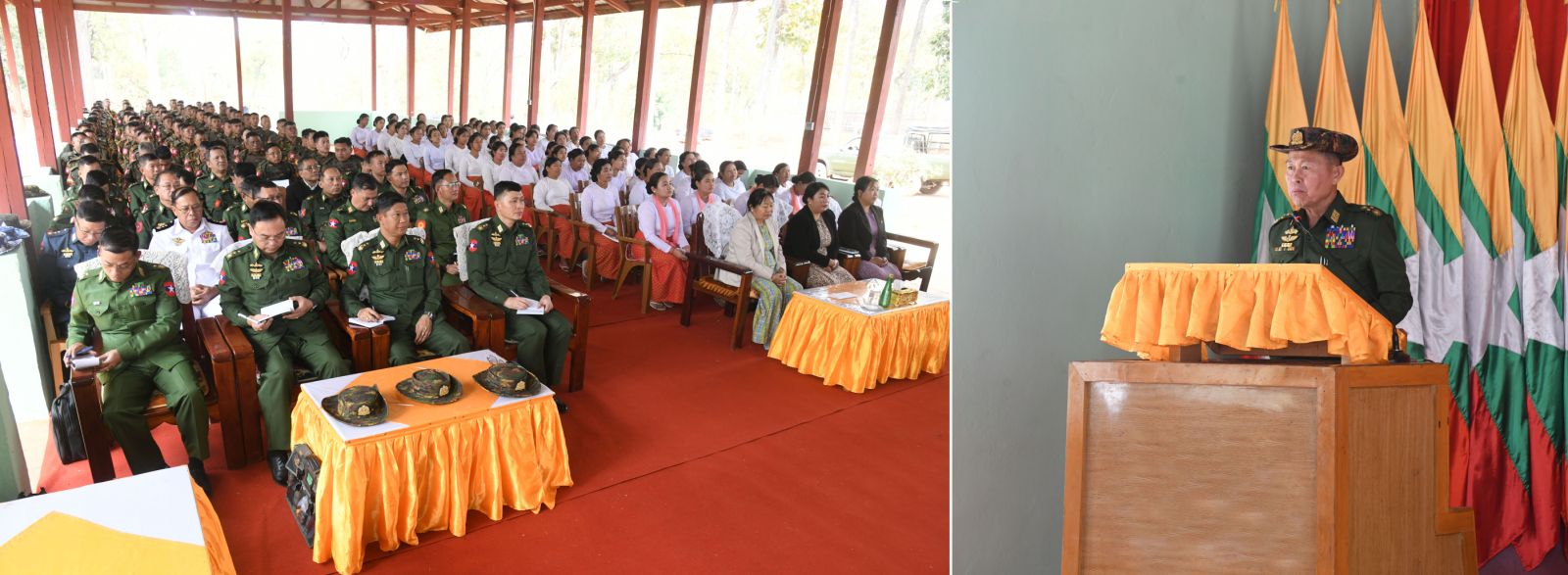
He made the remarks on February 24, 2026, during visits to local military units in Naung Wo, Kyaingkham, and Mongpyin in Shan State, where he met with officers, soldiers, and their families.
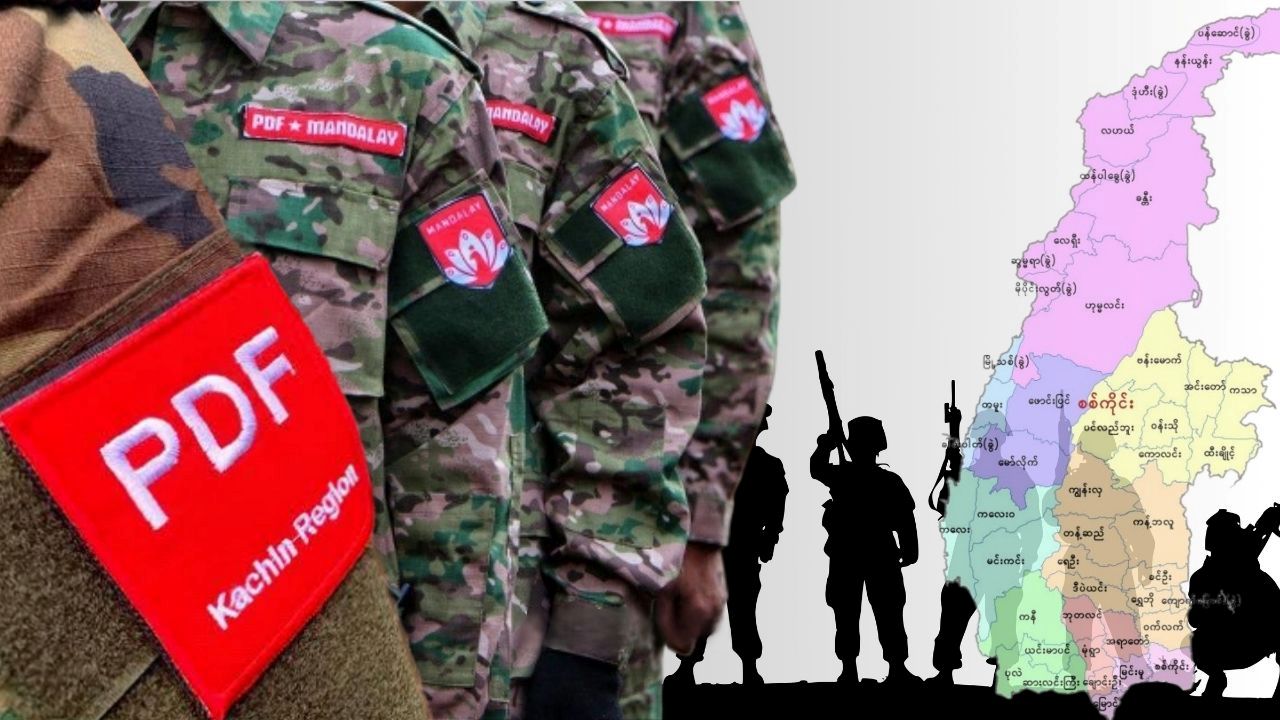
Vice Senior General Soe Win said: “Some EAOs that have signed the Nationwide Ceasefire Agreement (NCA) and some that have not signed it are accepting and sheltering youths and certain civil servants who fled to border areas due to political developments, under the pretext of humanitarian assistance. They are receiving financial support from certain major foreign countries, providing terrorist training, equipping them with weapons, and encouraging them to carry out terrorist acts. Due to instigation and agitation by internal and external organizations that do not desire stability and peace, as well as destructive media, various terrorist groups have emerged, including the so-called People’s Defense Force (PDF), which is under the illegal CRPH-NUG. These groups have been carrying out terrorist acts. Therefore, the Tatmadaw, together with members of the Myanmar Police Force and peace-loving citizens, is suppressing them in accordance with the law.”
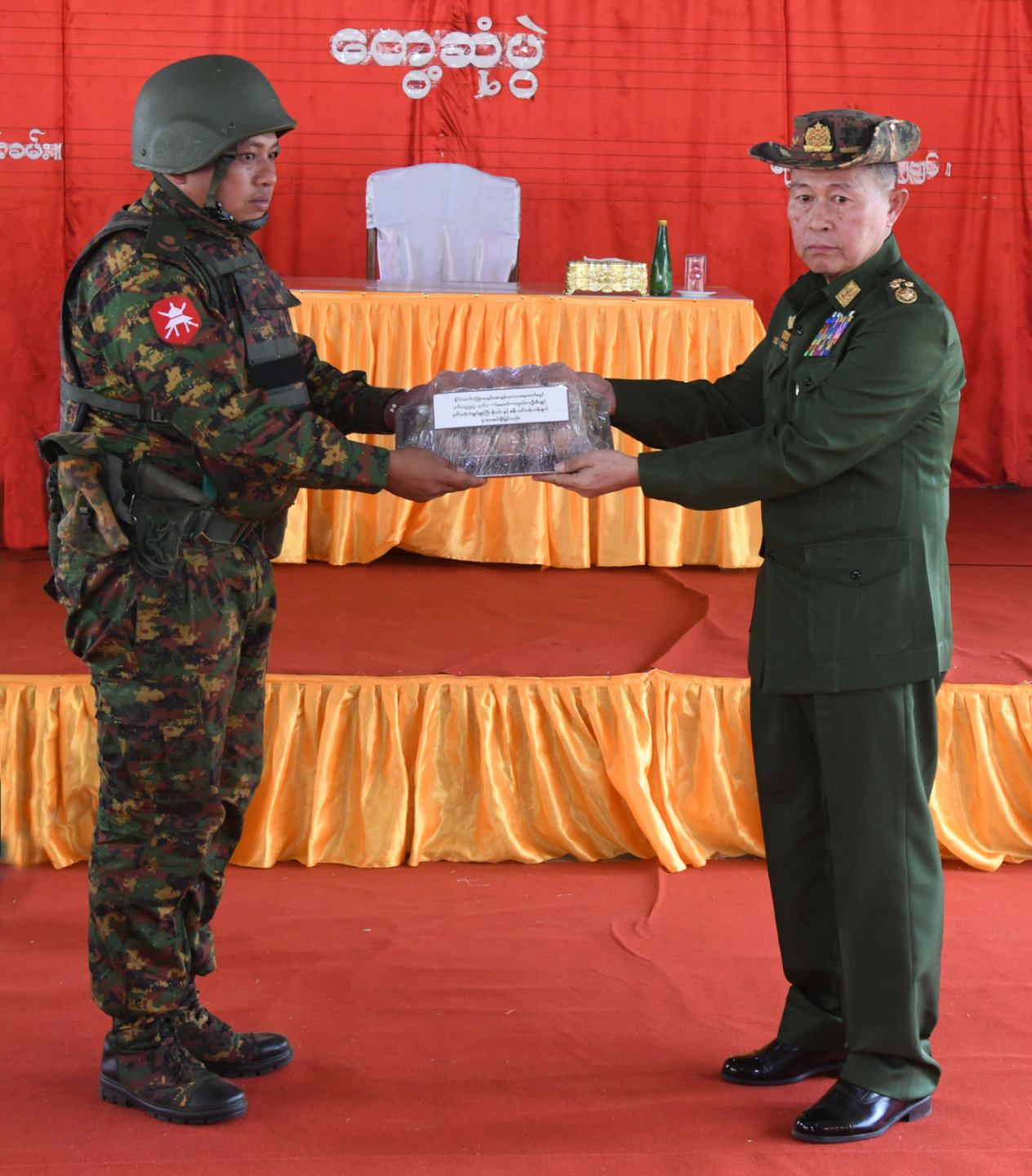
Vice Senior General seen
On February 1, 2021, the Myanmar military (Tatmadaw) overthrew the NLD government, claiming that disputes over the voter lists in the 2020 general election had not been resolved and that the government was attempting to form an administration without addressing those issues.
Subsequently, some NLD party leaders, Members of Parliament, pro-democracy activists, armed groups, and youths organized and launched armed resistance to overthrow the Myanmar military.
The armed revolution has been led by groups including the Kachin Independence Army (KIA), the Karen National Union (KNU), the Ta’ang National Liberation Army (TNLA), the Arakan Army (AA), the Myanmar National Democratic Alliance Army (MNDAA), the Chin National Front (CNF), and the All Burma Students’ Democratic Front (ABSDF), which have been providing military training and weapons to young people.
Currently, intense armed clashes are taking place across Myanmar. Around four million people have been displaced, and more than 100,000 homes and buildings have been destroyed by fire.
- By CNI
- Category: English Section
- Hits: 305
CNI News
February 25, 2026
Military and political analysts told CNI News that if leadership positions within Myanmar’s government are composed solely of ethnic Bamar individuals, the peace process could be delayed.
They pointed out that throughout successive governments in Myanmar’s history, the key leadership roles of the state have largely been dominated by the Bamar ethnic majority.
Colonel Khun Okkar, Chairman of the Pa-O National Liberation Organization (PNLO-NCA/S), which is a signatory to the Nationwide Ceasefire Agreement (NCA), told CNI News that it would not be appropriate for a single Bamar ethnic party that won the majority of seats to govern alone. Instead, ethnic leaders should be included according to their respective regions, and power should be shared.
He said: “I have advised this since the time when Daw Aung San Suu Kyi was leading. Even if a single Bamar nationalist party wins the majority and forms the government, it would not work well. Why? Because a national unity government is needed. Even if one party wins, when forming the government, there should be understanding and ethnic leaders should be included according to their respective regions, with administrative power shared. That would be better.
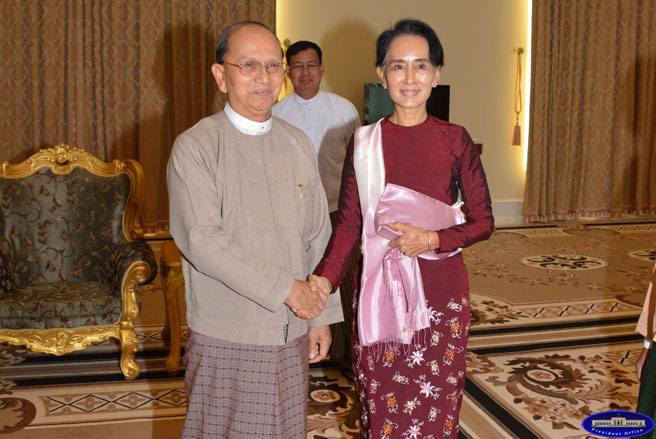
Party and two government leaders seen together
But until now, this has not been implemented. If only the winning party governs alone, it will not be easy to govern for long. Problems with ethnic groups will arise. Therefore, it would be better to start practicing power-sharing now. Without power-sharing, peace may be delayed. Negotiations could fail.
If we are to establish a federal system representing all ethnic groups, the government itself must be structured as a federal government. Therefore, a national unity government that includes all ethnic groups is the best option. That is our advice. Since we do not yet know what form will emerge, we must wait and see.”
Analysts noted that since more than half of Myanmar’s population is Bamar, it is natural that Bamar individuals often dominate government bodies. However, despite Bamar leadership positions within governments, genuine ethnic unity has not yet been achieved.
A political analyst told CNI News that during the era of Myanmar kings, Shan Sawbwas were granted authority to govern Shan State, while the kings handled foreign defense and taxation. He said this arrangement resembled a federal system, and because of that autonomy, ethnic minorities did not feel that they were being directly ruled by the Bamar.
Therefore, unless ethnic groups are granted genuine self-administration and federal rights, conflicts and grievances will continue, he said.
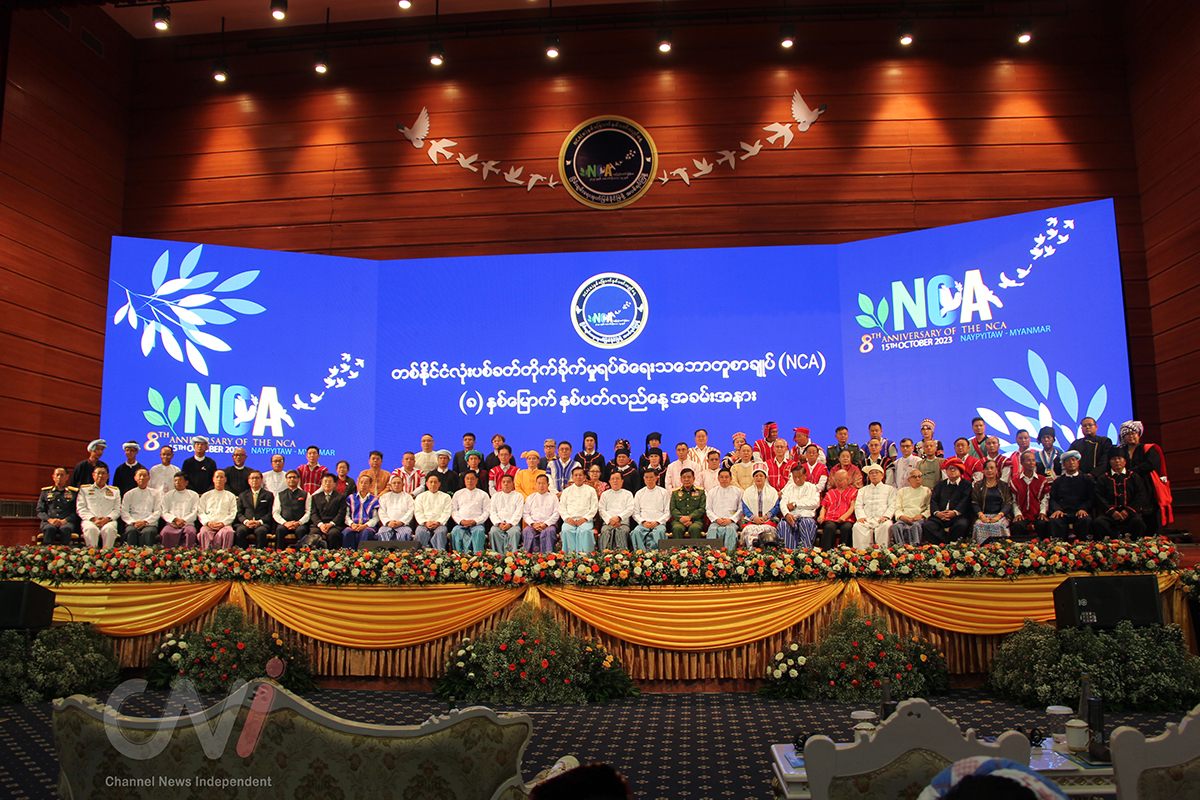
Government and armed group leaders seen together
He further explained: “If we truly practice a federal system, even at the grassroots level — such as ward administrators and township administrators — they must be elected by the people. If township administrators are appointed by the Ministry of Home Affairs, and Bamar officials are assigned who report to the ministry — and if the Home Affairs Minister is someone appointed by the military — then even though there are Shan State or Kayah State governments on paper, actual administration is still controlled by Bamar officials and centrally appointed ministers.
Likewise, state chief ministers are not elected by their respective state parliaments but are nominated by the President from the ruling party nationwide. That is not federalism.
What I mean is that at the top level, there may be a Bamar-majority government representing the country. But unless ethnic groups receive genuine self-administration and federal rights at the lower levels, conflicts and dissatisfaction will continue. That must be understood.”
Military and political observers also pointed out that if ministers assigned to various departments are weak, central control will become stronger.
Political parties have emphasized that in order to resolve the ongoing armed conflicts and political crisis in Myanmar, the incoming government must form a national unity government.
The Myanmar military, during its five-year period of administration, has stated that it intends to move toward a political system based on democracy and federalism.
- By CNI
- Category: English Section
- Hits: 429
CNI News
February 24, 2026
Military and political analysts are weighing in on how the surrender of Bo Nagar, leader of the Burma National Revolutionary Army (BNRA), might reshape the military landscape in the Sagaing Region.
Looking at the BNRA’s operational areas—surrounded by Myaing to the south, Chin State to the west, Kani to the north, and Yinmarpin to the east—analysts suggest that Bo Nagar may have surrendered to the military (Tatmadaw) due to a complete logistical blockade imposed by NUG-PDF forces.
Political analyst Dr. Aung Myo told CNI News that if members of the BNRA remaining in Pale Township align with the military, it would have a massive impact, potentially signaling the "collapse of the revolution" on the western bank of the Chindwin River in Sagaing Region.
"Battles could intensify before the rainy season. Even during the rains, they will remain fierce because, unlike Kayin State, the dry zone of Upper Myanmar rarely has impassable mud. Furthermore, as the Chindwin River rises, it becomes easier for counter-insurgency columns to maneuver. Therefore, the state is likely to ramp up its crackdown on revolutionary groups," Dr. Aung Myo stated.
He added that while Sagaing-based groups rely on the KIA to the north and Chin and Rakhine forces to the west, Bo Nagar was a core figure. If his followers in his stronghold between western Yinmarpin and Pale join forces with the military, the revolutionary momentum in areas like Yinmarpin and Myaing could be severely compromised.
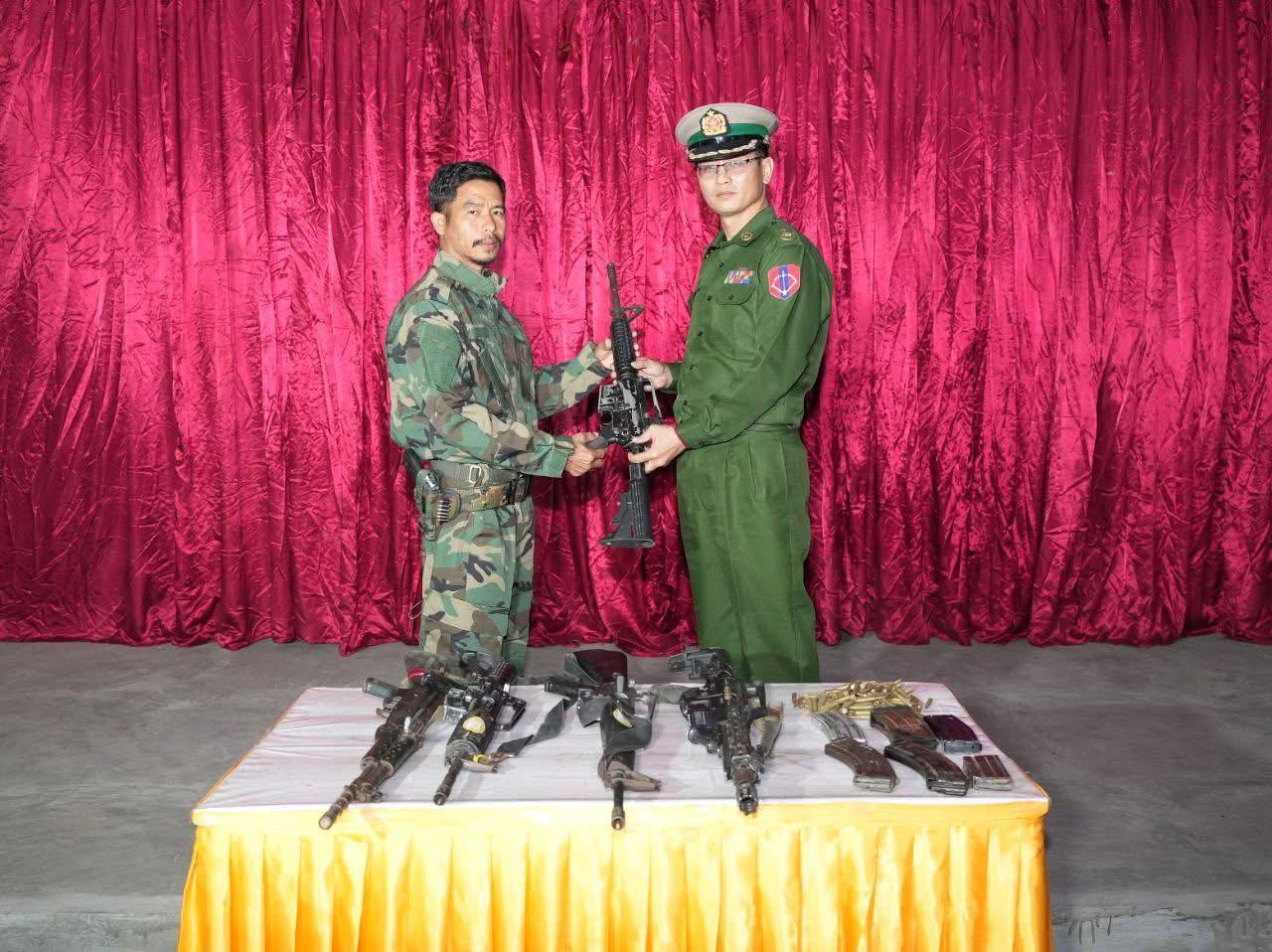
Bo Nagar during his surrender/entry into the legal fold.
A Complex Battlefield Sagaing is the largest of Myanmar's seven regions, bordered by Magway, Mandalay, Shan State, Chin State, Kachin State, and India. It remains a strategic prize that both Ethnic Armed Organizations (EAOs) and the Myanmar military are competing to control.
The region currently hosts a diverse array of armed actors, including:
NSCN (at least six Naga armed factions),Shanni Nationalities Army (SNA),Meitei Armed Groups,Kachin Independence Army (KIA),Arakan Army (AA),All Burma Students' Democratic Front (ABSDF),Karen National Union (KNU),Chin National Front (CNF).
Zomi Revolutionary Army (ZRA/ZRO),Kuki National Army-Burma (KNA-B),NUG-aligned People’s Defense Forces (PDFs),People's Liberation Army (PLA-Communist),96 Soldiers (led by Ko Zeya Lwin),Chin National Defence Force (CNDF),Local Defense Forces (LPDFs), Pro-military Militia (PST/PTSC) and Pyu Saw Htee groups.
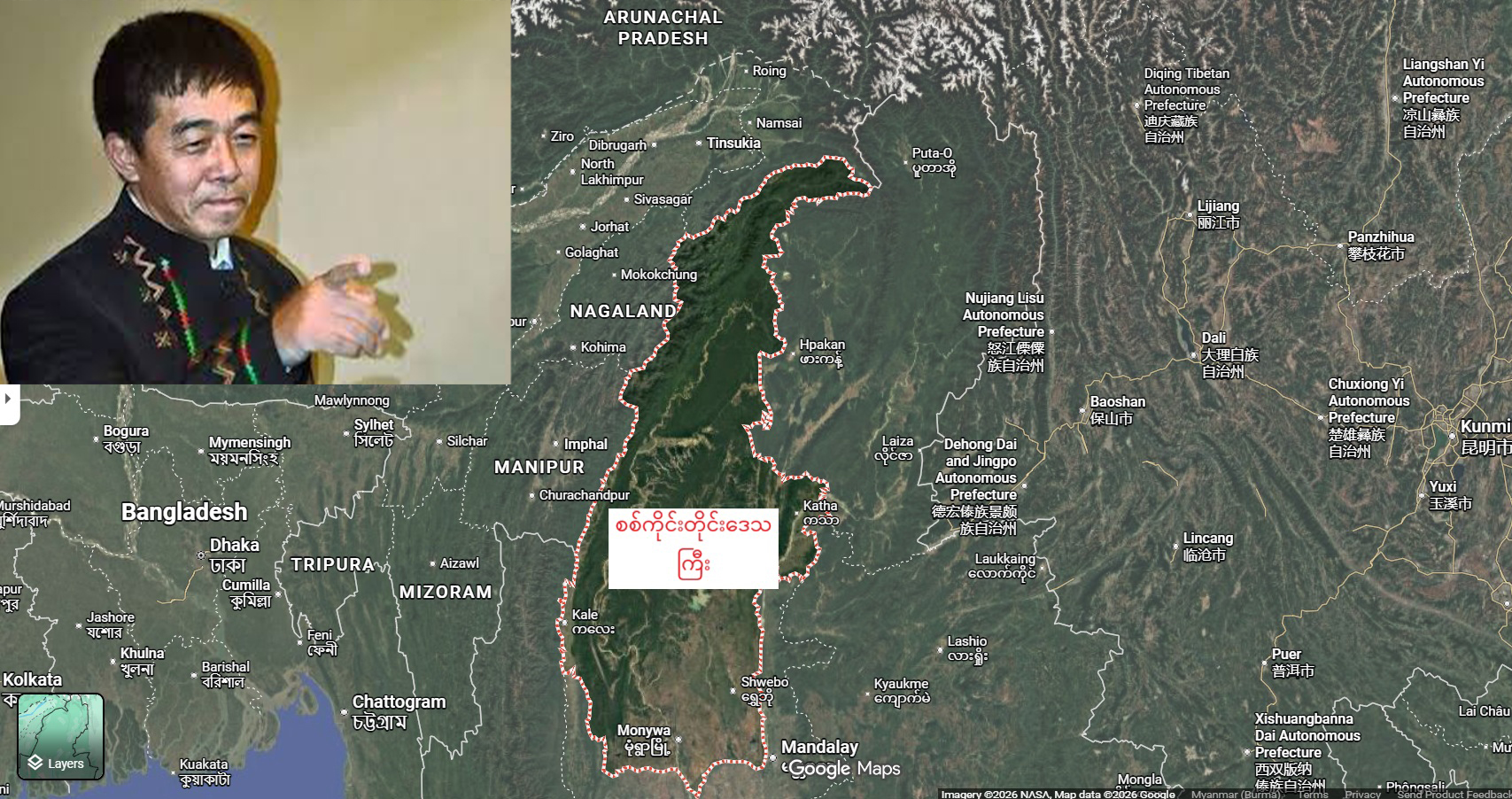
Sagaing Region and KIA leader Lieut. Gen. Gun Maw.
The Road Ahead: Peace or Continued Conflict?
U Thein Tun Oo, Executive Director of the Thayninga Institute for Strategic Studies, told CNI News that the intensity of future fighting depends on the choices made by the remaining armed groups.
"The areas where Bo Nagar operated will likely become quiet. The question is whether other groups will follow his path toward peace. If they do, there is a strong hope for rehabilitation in Sagaing Region, coinciding with the emergence of a new government. If they maintain their belief in armed struggle, area clearance operations will persist," he explained.
On February 18, 2026, Nay Pyi Taw officially announced that BNRA leader Naing Lin (aka Nagar) and his family members entered the "legal fold" along with weapons and ammunition. Military and political observers currently speculate that the Myanmar military may reorganize Bo Nagar’s remaining forces into a pro-government militia.
- By CNI
- Category: English Section
- Hits: 265
CNI News
February 24, 2026
Political parties and observers are suggesting that the incoming government should appoint Chief Ministers from local ethnic parties in certain regions and states as a trust-building measure, even if Section 261 of the Constitution has not yet been amended.
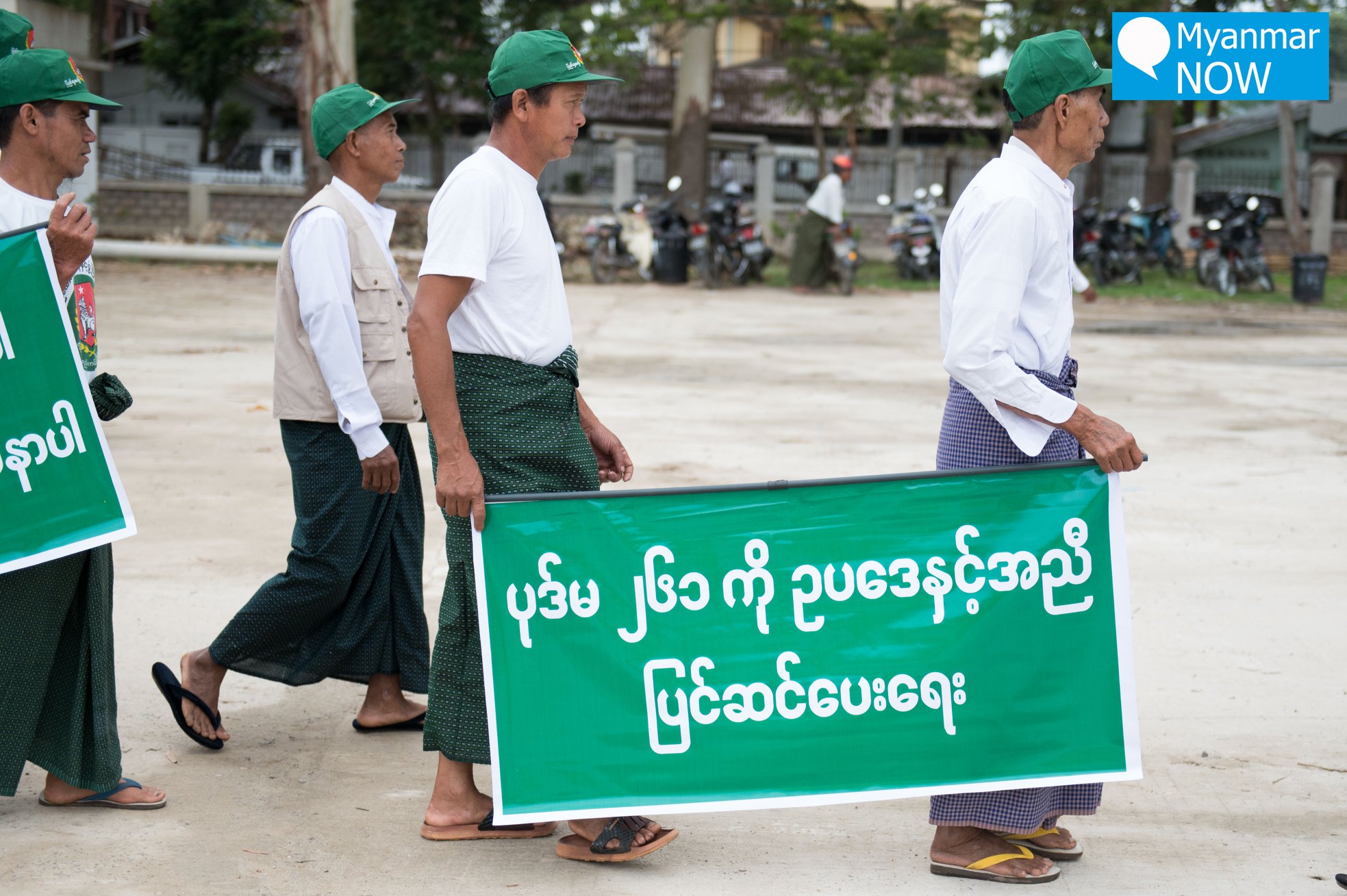
Under Section 261 of the 2008 Constitution, the President has the direct authority to select and appoint the 14 Chief Ministers of the country’s Regions and States. Critics point out that this provision contradicts the aspirations of ethnic parties—who desire for the representative of the majority winning party in a specific region to be appointed—and argue that direct presidential appointment lacks democratic and federal characteristics.
If amending Section 261 proves unfeasible within the next five years, analysts suggest that instead of appointing only ruling party members or military personnel, the President should build trust by selecting individuals from winning local ethnic parties to lead their respective regional governments.
Dr. Aye Maung, Chairman of the Arakan Front Party (AFP), told CNI News that the actual implementation of an amended Section 261 might only occur after the next five-year term.
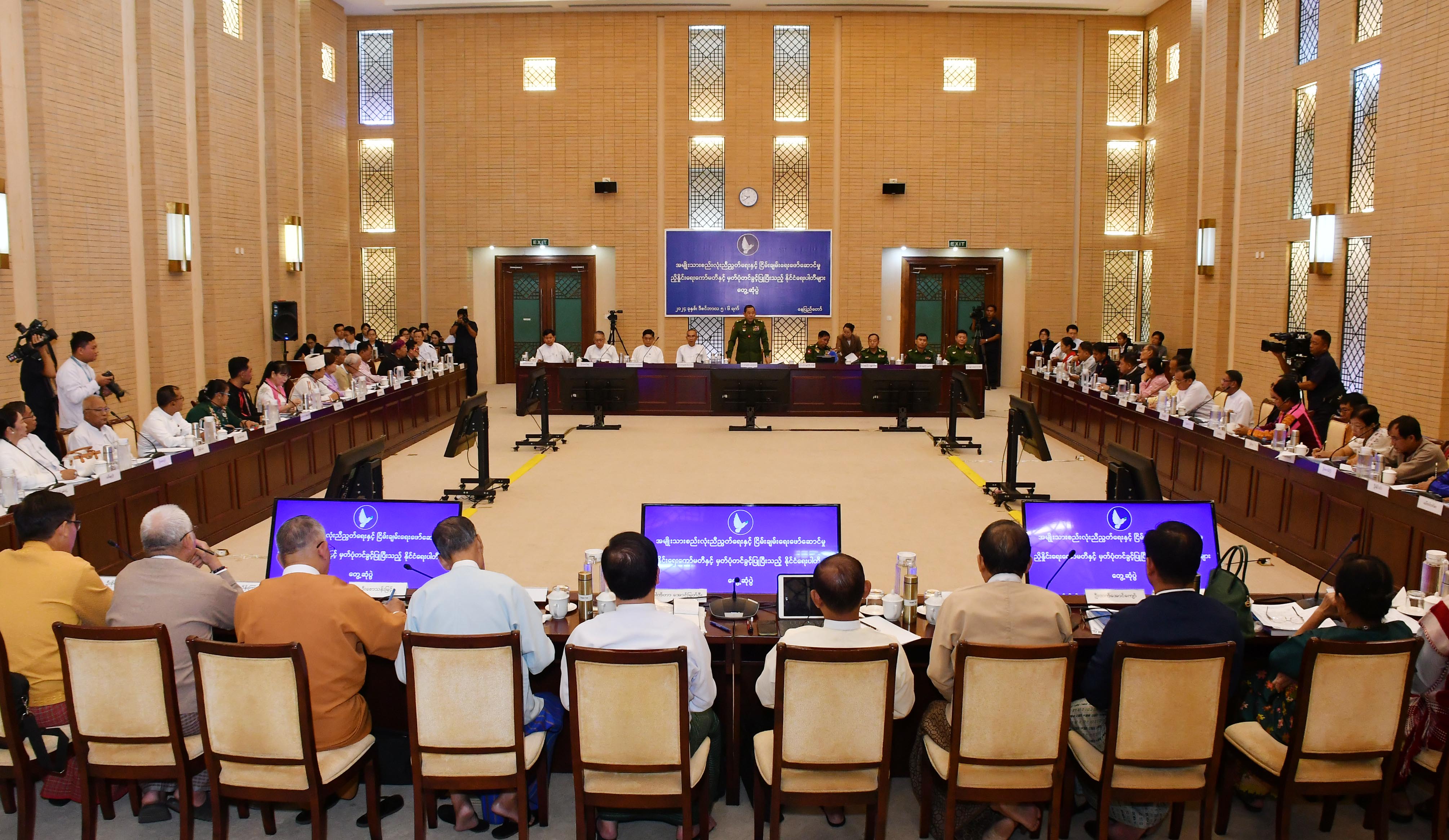
Discussions between political parties, armed groups, and the NSPNC.
"Legislative provisions arising from an amended Section 261 will likely only materialize in the five-year term following this one. Regardless of the current wording of Section 261, if the USDP intends to implement the points we have already agreed upon, the President could confirm individuals proposed by the majority in the Regional/State Parliaments as Chief Ministers. By approving a suitable person nominated by the winning local parties, the head of state can set a political precedent even before the Constitution is formally amended," Dr. Aye Maung said.
While the National Solidarity and Peacemaking Negotiation Committee (NSPNC) and a working group of political parties have preliminarily signed 43 points for constitutional amendment, a guarantee to amend Section 261 is not yet included. Furthermore, the future of these points is unclear as key signatories like U Ko Ko Gyi, Dr. Aye Maung, and Sai Aik Pao lost their election bids, while Dr. Aung Myat Oo did not contest.
U Thein Tun Oo, spokesperson for the Union Solidarity and Development Party (USDP), told CNI News that all necessary amendments, including Section 261, could be considered during the upcoming five-year term.
"It is uncertain if the Constitution can be amended within the first year, as there are many nation-building tasks to attend to. However, the USDP has never said it wouldn't amend it; we have always supported changes made in accordance with the law. I believe we will move toward amendments by considering all necessary issues over the next five years. If Section 261 is deemed necessary to change, it will be changed. Laws must adapt to the times. If the timing is right during the next administration, it will happen," he explained.
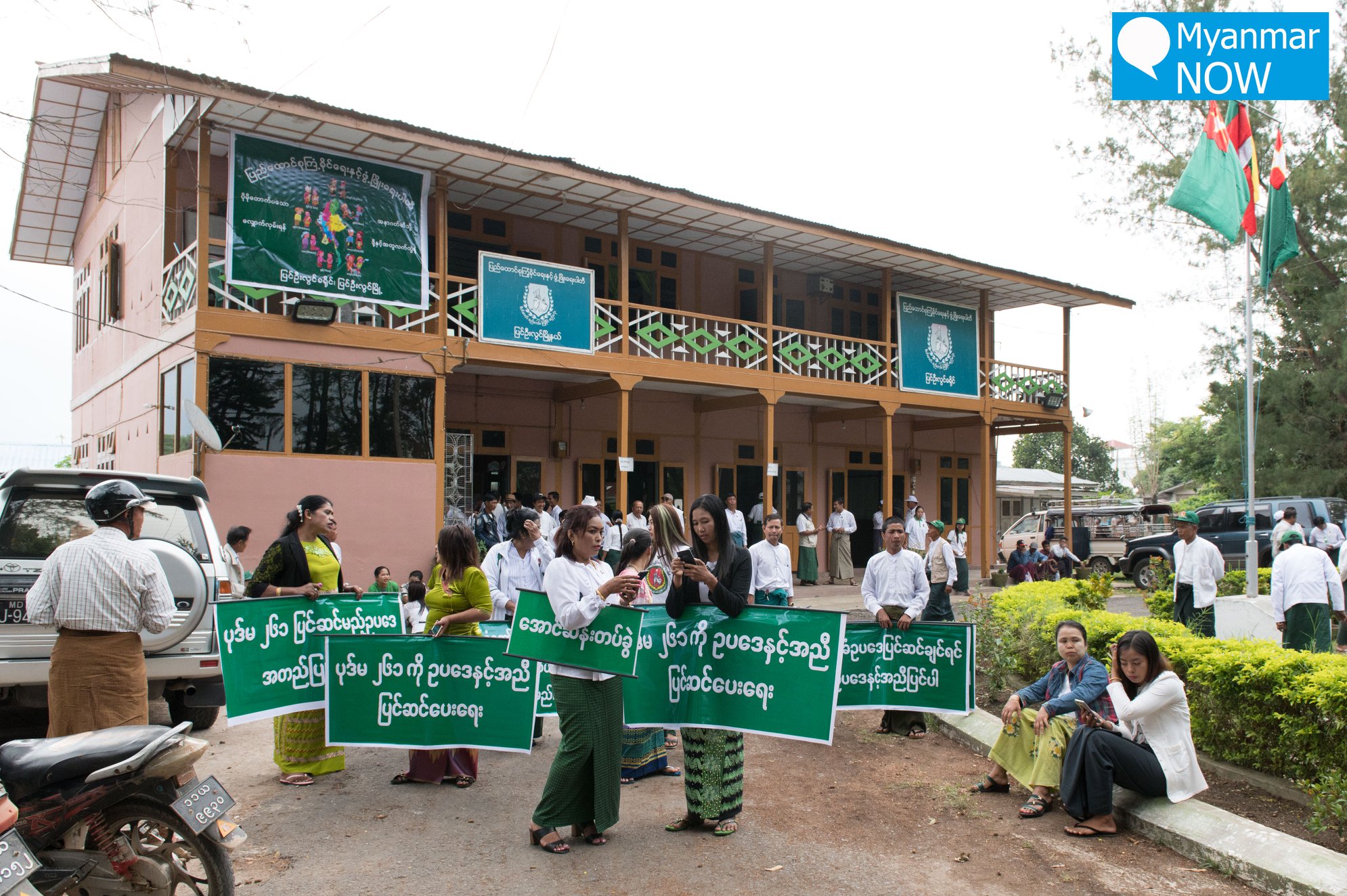
USDP demonstration calling for Section 261 amendment in 2019 (Photo: Myanmar Now).
Historically, the issue of Section 261 has seen shifting stances: during U Thein Sein’s USDP administration, the NLD pushed for the amendment while the military and USDP blocked it. Conversely, during the NLD administration led by Daw Aung San Suu Kyi, the USDP and military supported the amendment, but the NLD opposed it.
Sai Htay Aung, Chairman of the Tai-Leng (Shanni) Nationalities Development Party (TNDP), emphasized that amending Section 261 is essential for a federal system.
"If Myanmar is to move toward federalism, Section 261 must be amended. Doing so involves about 30 related sections that must be changed in tandem. Whether this happens depends on the landscape of the new Parliament. In previous terms, we saw one side propose it and the other oppose it. It will all depend on the parliamentary dynamics," he said.
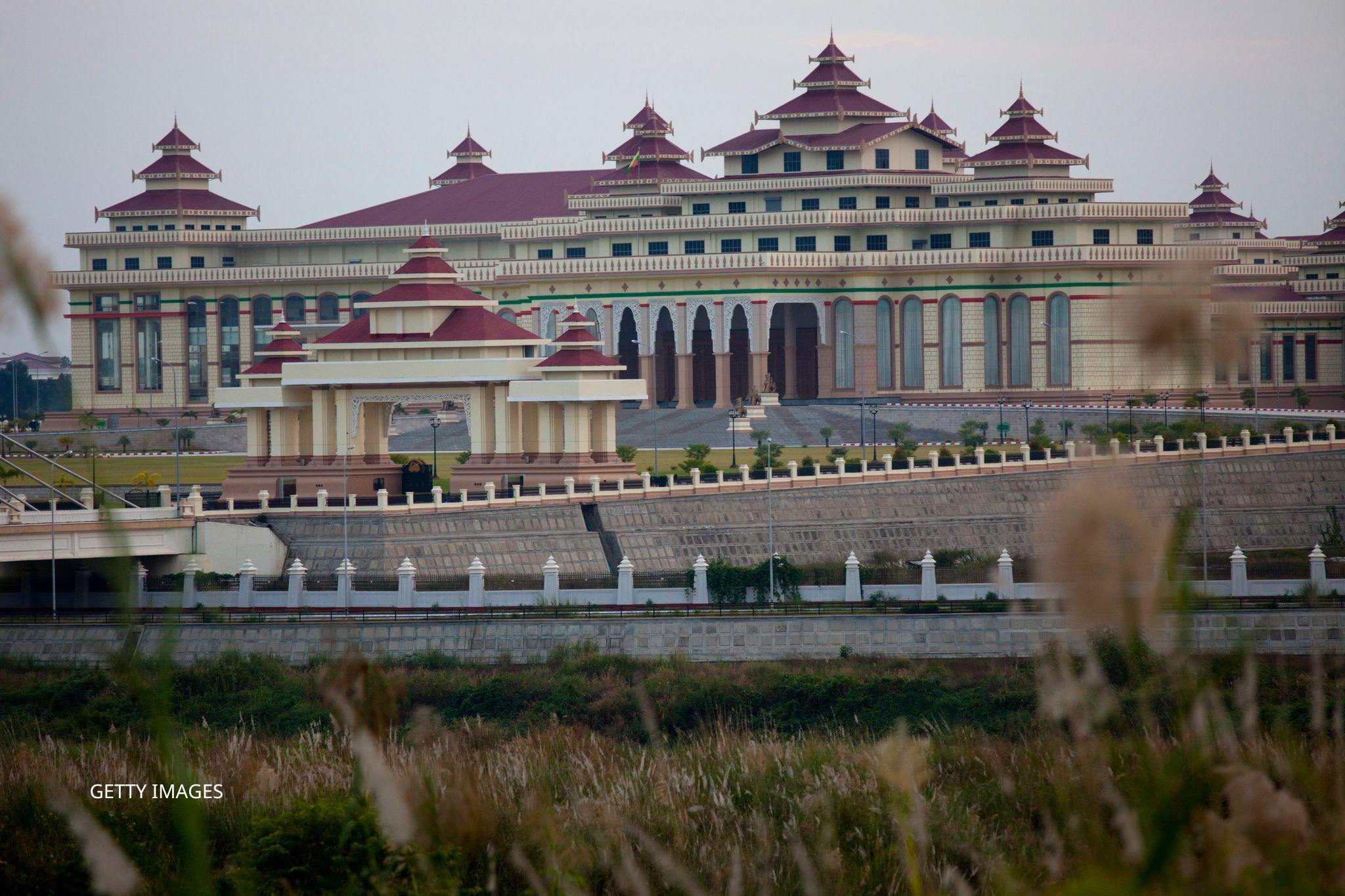
Following the general elections held in three phases from late 2025 to January 2026, the new Parliament is scheduled to convene in late March, with the new government expected to form in April.
- By CNI
- Category: English Section
- Hits: 572
CNI News
February 23, 2026
Naypyidaw issued an announcement on February 23, 2026, regarding the dates for convening the third terms of the Pyithu Hluttaw (House of Representatives), Amyotha Hluttaw (House of Nationalities), and Region/State Hluttaws.
Speaker U T Khun Myat announced that the first regular session of the third Pyithu Hluttaw is scheduled to commence on March 16, 2026, at 10:00 AM.
Following this, U Aung Lin Dwe, Executive Secretary of the National Defence and Security Council (NDSC), announced that the first regular session of the third Amyotha Hluttaw will begin on March 18, 2026, at 10:00 AM.
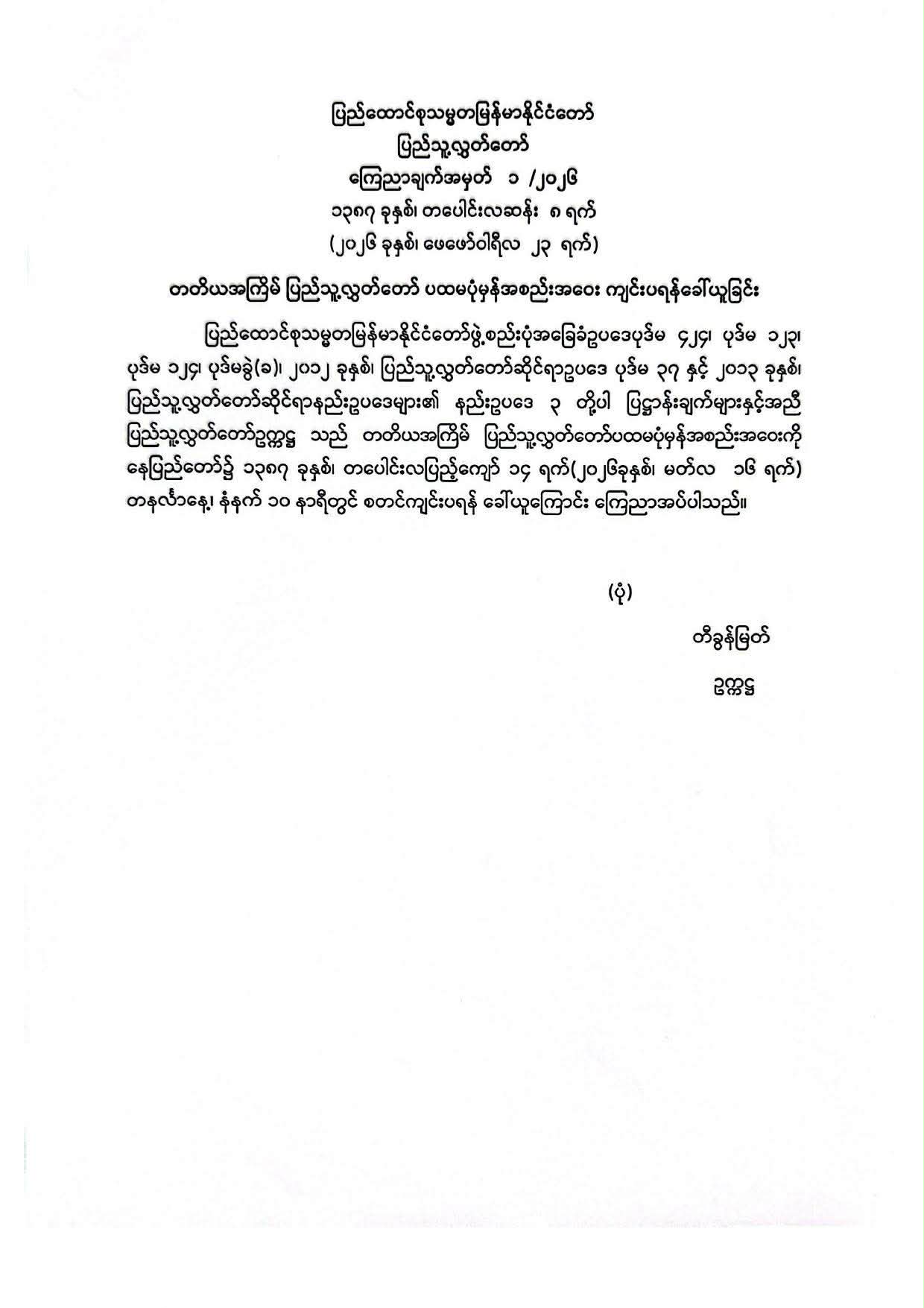
Similarly, U Aung Lin Dwe also announced that the first regular sessions of the third Region or State Hluttaws are called to commence on March 20, 2026.
The 2025 General Elections in Myanmar were held in three phases, spanning from December 28, 2025, to January 25, 2026.
With the parliamentary sessions now scheduled for the third week of March, a new government is expected to be formed in April.
- By CNI
- Category: English Section
- Hits: 530
CNI News
February 21, 2026
Political analyst U An Kaw La told CNI News that the new government, expected to be formed in April 2026, is likely to be a government characterized by "collective leadership."
Following the 2025 general elections in Myanmar—which were held in three phases from December 28, 2025, to January 25, 2026—parliament (Hluttaw) is scheduled to convene in March, with the new government to be formed in April.
U An Kaw La noted that there are indications a Union Consultative Council will be established under the next administration to ensure "Checks and Balances," leading to a collective leadership model.
"The structure of the new government emerging in 2026 will differ greatly from the 2010 and 2015 administrations, as well as the SAC (State Administration Council) model. It also differs from the Burma Socialist Program Party era," he said. "Currently, we see a framework moving toward collective leadership and checks and balances, involving the State Consultative Council alongside the Executive and the Legislature. I see this as a preparation for a more compact and 'safe' military-related government. It appears they are preparing to change the economic and diplomatic landscape into a more cohesive government model for international relations."
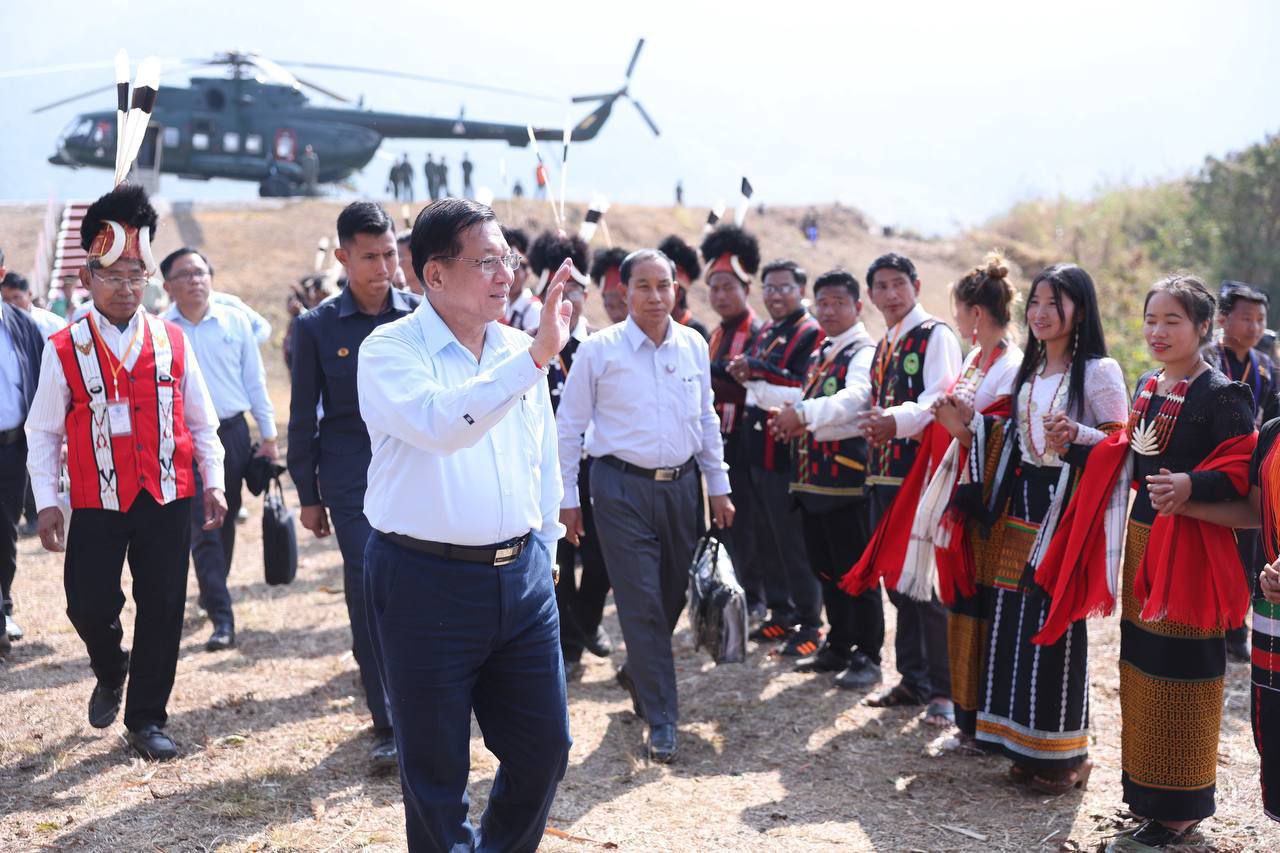
Senior General Min Aung Hlaing seen
He added, "In the current context, the traditional three branches—Legislative, Executive, and Judiciary—require a collective leadership and tighter control. I believe this approach is beneficial for Myanmar given the political and international crises the country is facing."
Collective leadership (or democratic leadership) is a style where group members participate more actively in the decision-making process.
This model can be applied to anything from private businesses to government bodies.
It is characterized by equal opportunities for participation, the free exchange of ideas, and encouraged discussion.
While it focuses on the free flow of ideas and equality within the group, a leader still exists to provide guidance and control.
However, political analyst Dr. Aung Myo told CNI News that the effectiveness of collective leadership in the new government setup will depend entirely on the leader.
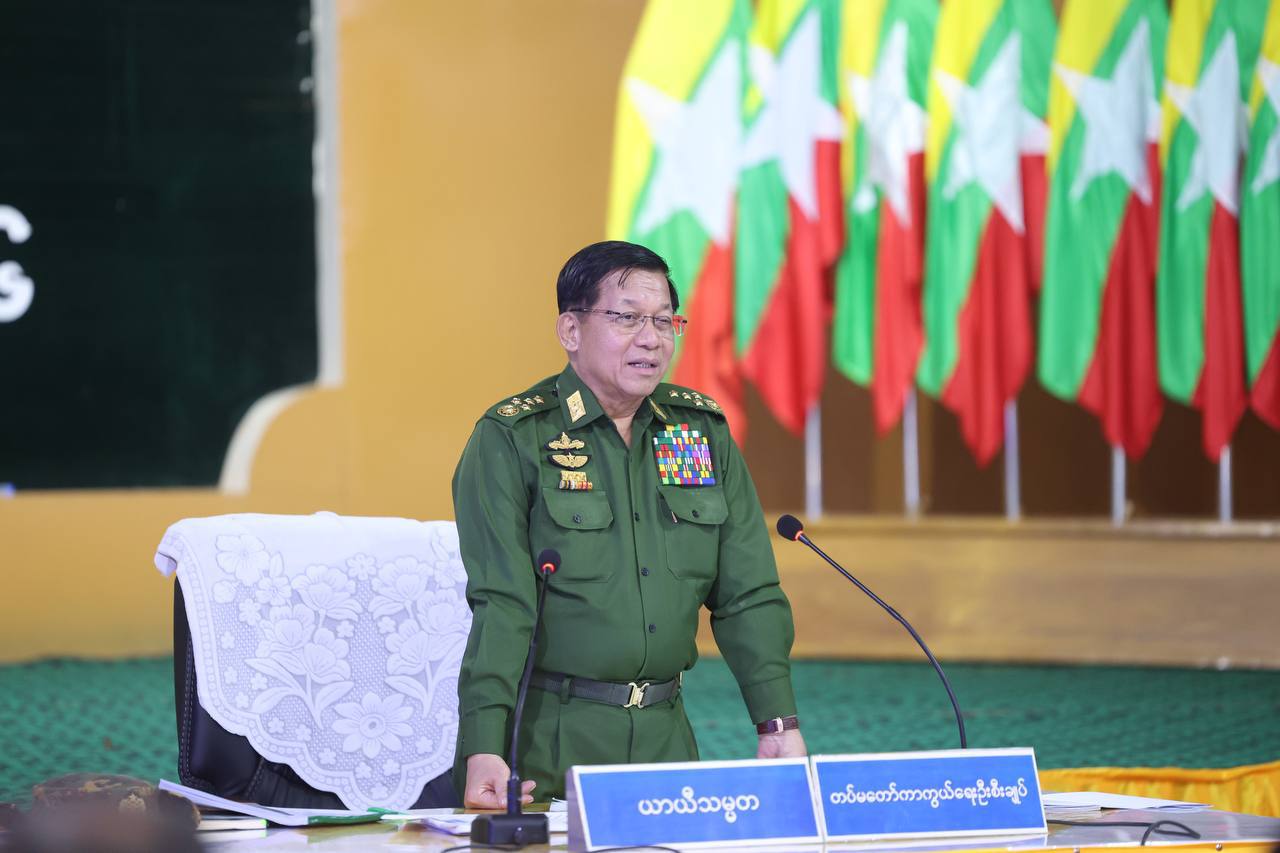
Senior General Min Aung Hlaing seen
"The current constitution is similar to an American-style system where the President holds the power. While there is a certain amount of oversight, collective leadership depends on whether the leader accepts it or not. We have to wait and see," Dr. Aung Myo said.
He further noted, "Firstly, the parliament (Hluttaw) is almost entirely composed of USDP (Union Solidarity and Development Party) members. The President will also be someone who favors the USDP. Essentially, the Executive is USDP and the Parliament is USDP. There won’t be anyone left in parliament to debate or challenge them. Rather than 'collective leadership,' it would be better if a President acts with individual reason and restraint. If there is progress to be made, it will happen more quickly this way."
Political parties have been pointing out that the incoming government should be formed as a national unity government style, using collective leadership to resolve the current crises.
They warn that if a single person or a single party leads alone without mutual checks and balances, it will be difficult to overcome Myanmar's current hardships.
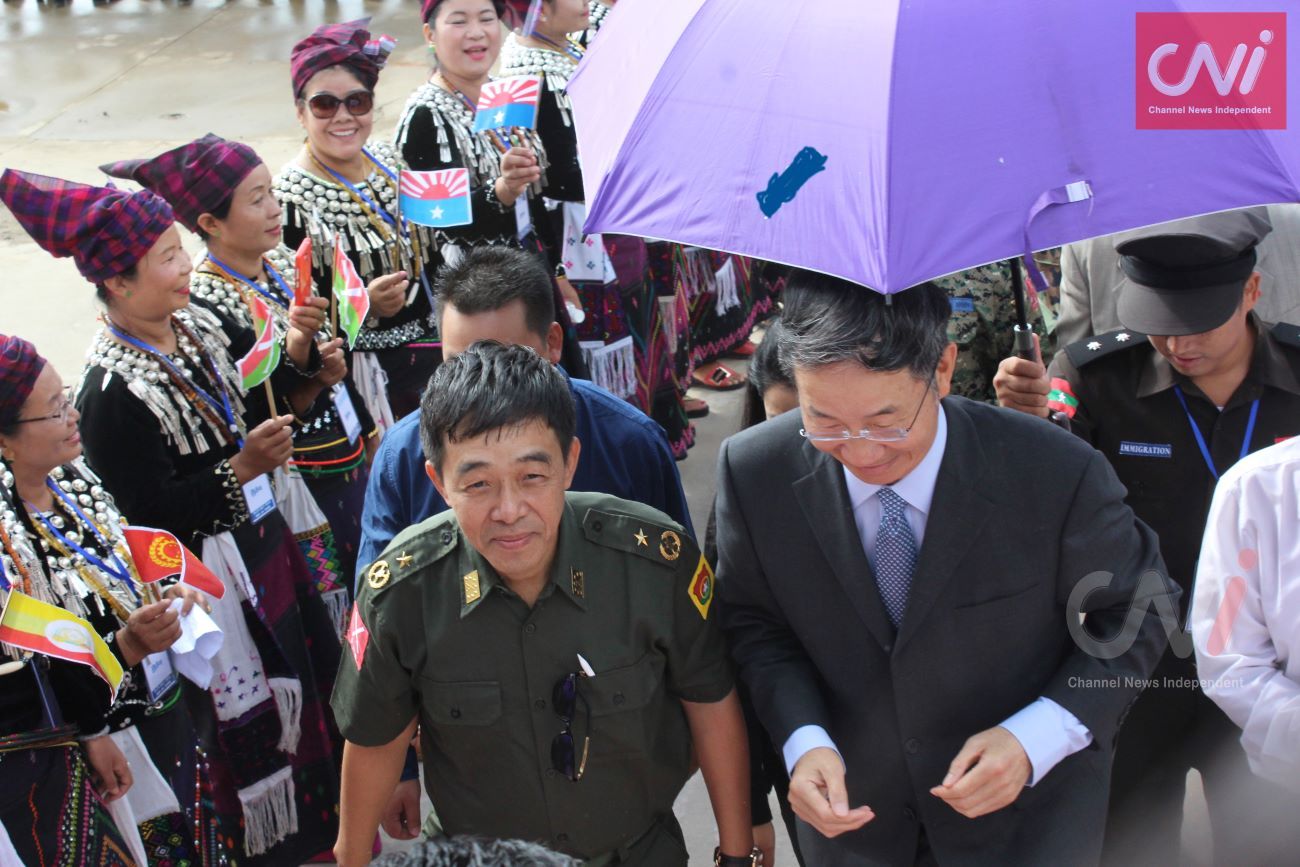
- By CNI
- Category: English Section
- Hits: 428
CNI News
February 21, 2026
While China exerts significant influence over the three ethnic armed groups in northern Shan State, its sway over the Kachin Independence Army (KIA) is not as strong as many might assume, according to China-Myanmar analyst Dr. Hla Kyaw Zaw, who spoke with CNI News.
She noted that the three northern Shan groups—the MNDAA (Kokang), NDAA (Mongla), and UWSA ("Wa")—have long-established, firm relationships with China. In contrast, the KIA does not show a tendency to blindly follow Beijing’s directives.
Dr. Hla Kyaw Zaw explained the geographical and economic differences:
Northern Shan Groups (Wa, Mongla, Kokang): These groups are heavily integrated with China economically.
China has invested significantly in them through the Mekong Valley Development initiatives. Consequently, they are largely dependent on China for everything from their economy to general survival.
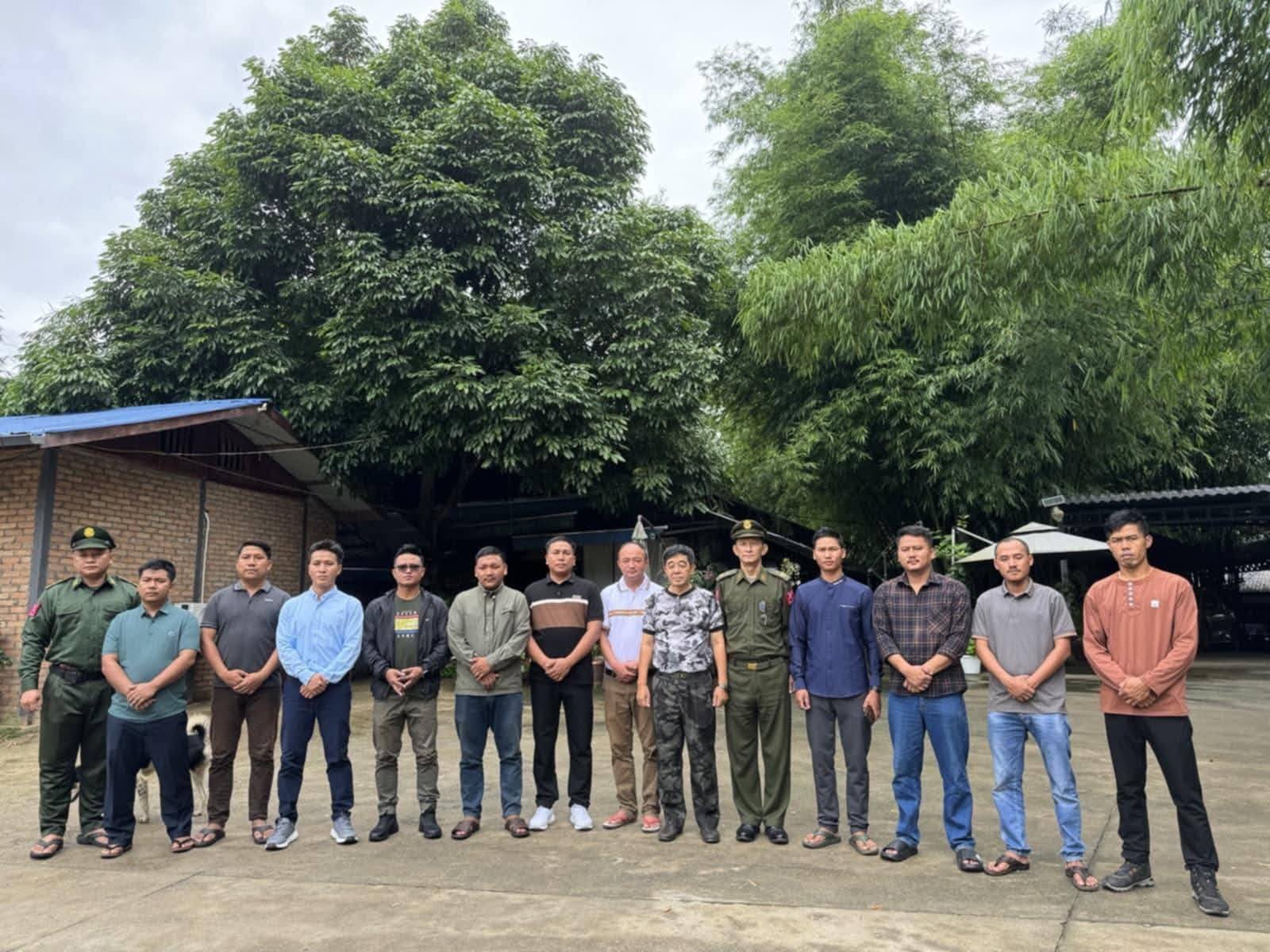
Lt. Gen. Gun Maw with the Chin Brotherhood group.
KIA: While the KIA shares a border with China, it maintains more independence in its thinking. Dr. Hla Kyaw Zaw highlighted that the KIA holds a "winning card"—Rare Earth minerals.
Since they control these resources, they have more leverage when negotiating with China compared to other groups.
"The KIA won't obey everything China says. They aren't completely tied to China economically. Because they control rare earth metals, they have more 'say' than the others," Dr. Hla Kyaw Zaw told CNI.
Military and political observers point out that the KIA is currently playing a balancing act between Western powers and China.
Sai Htay Aung, Chairman of the Tai-Leng (Shanni) Nationalities Development Party (TNDP), shared his view with CNI:
Pressure: China might have been able to pressure the KIA in the past, but the current landscape has shifted.
While China has reportedly asked the KIA not to escalate fighting, the KIA has expressed its intent to continue military operations.
Lt. Gen. Gun Maw with the Yaw PDF.
Sai Htay Aung suggested that because the KIA is receiving supplies (arms and medicine) from elsewhere, they are emboldened to stand their ground against Chinese demands.
The "West" Factor: He noted that if Western influence grows within the KIA's sphere, China will lose its ability to control the situation.
China’s Strategic Interests in Myanmar, China has massive investment projects at stake in Myanmar, including:
The Kyaukphyu Special Economic Zone (SEZ), The Myitsone Dam,High-speed rail projects (Muse-Mandalay, Ruili-Mandalay-Kyaukphyu),The Kanpaiti Economic Cooperation Zone,
Current Role of the KIA.
Currently, the KIA is a major supporter of Spring Revolution forces, providing:
Arms and ammunition. Military training and sanctuary. Operational support for joint battles in Sagaing Region and Kachin State.
Page 32 of 352
Connect with us