

CNI News
27 June 2026
Questions have been raised among political parties and parliamentarians regarding how important the Kachin Independence Army (KIA) and the Arakan Army (AA) are to the continuation and implementation of Chinese and Indian projects.
In Myanmar, the regions where China and India are implementing projects are areas where various ethnic armed organizations (EAOs) operate and where active fighting takes place.
Political analysts point out that scenarios may emerge where the government engages in negotiations with the EAOs in these project areas. They also suggest that pressure or mediation from both the Chinese and Indian governments toward the respective organizations could be witnessed.
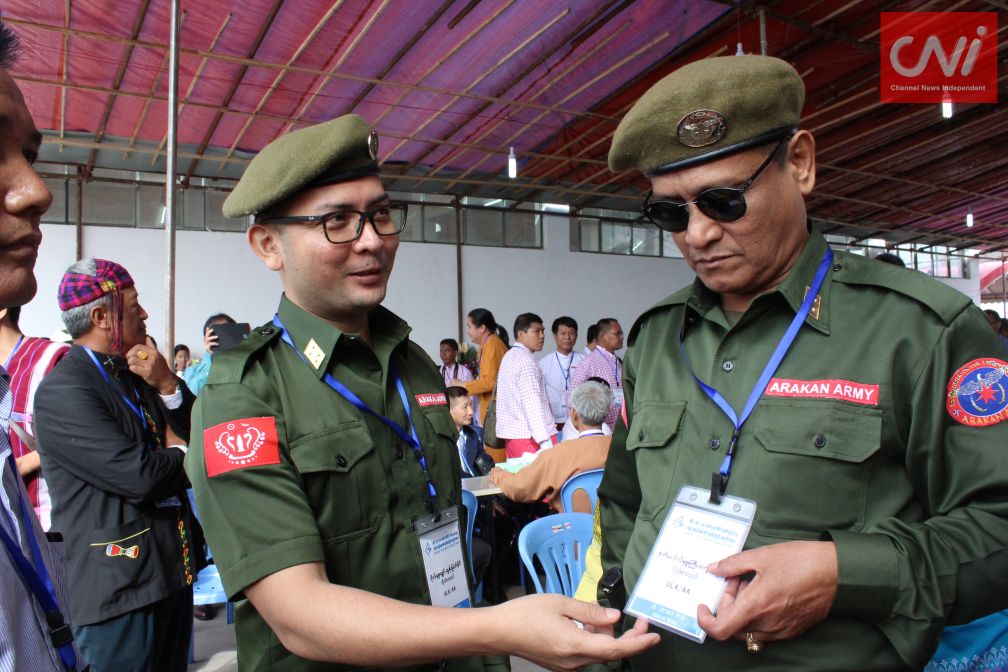
AA leaders seen together
Dr. Kyaw Swe, a Pyithu Hluttaw (House of Representatives) representative from the National Unity Party (NUP), told CNI News that under current circumstances, the KIA, which controls territories hosting the majority of Chinese projects, is more important to China. However, if the Myanmar government's authority effectively extends to Sagaing Region, the KIA will not pose a concern for India.
"The KIA is primarily more important to China. This is because we see that natural resources are being extracted mostly within KIA-controlled areas. Furthermore, China has to pass through KIA-controlled territories to obtain raw materials and resources. Another factor is jade, which the Chinese favor highly; since most jade mining blocks fall within KIA-controlled territory, the KIA is a major factor of importance for China.On the other hand, India wants a supply route for its four northeastern states. Therefore, the KIA is not that critical for them. In other words, if the Myanmar government's authority successfully reaches Sagaing Region and the Naga Self-Administered Zone, the KIA won't matter much to India anymore."
Military and political observers point out that currently, the AA largely dominates the entire route of India's Kaladan Multi-Modal Transit Transport Project, while Chin armed groups control border trade routes. Consequently, India will inevitably have to engage with these groups to continue implementing its projects.
Dr. Kyaw Swe told CNI News that the continued implementation of Indian projects primarily depends on the AA, and India might even assist in weakening the AA's strength to secure its project implementation.
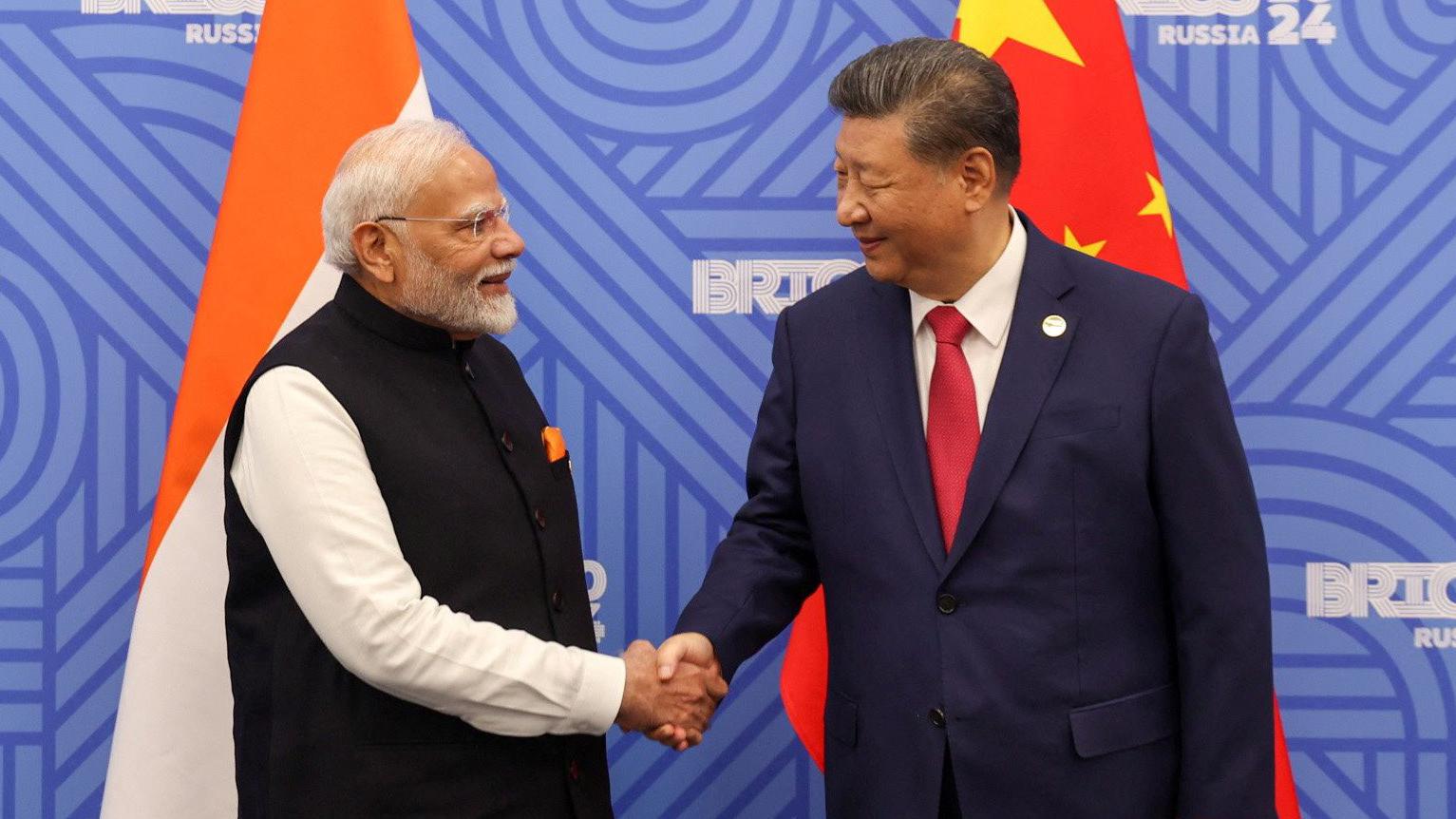
Chinese President Xi Jinping seen with Indian Prime Minister Modi
"The AA is not being important; rather, it is acting as a disruption. Because of the AA's presence, the Kaladan Multi-Modal Project has been unsuccessful. The project has ground to a halt midway because of them. As a result, the four northeastern states of India cannot export their goods, and their supply route has disappeared. I see that it might even reach a stage where India assists the Myanmar government to contain the AA and diminish its strength."
India is also preparing a project to develop the India-Myanmar-Thailand trilateral highway route, passing through Kalewa, Yar Gyi, and Monywa in the Sagaing Region.
Dr. Aye Maung, Chairman of the Arakan Front Party (AFP), told CNI News that the interests of China, India, and Myanmar are directly linked only through the central governments of the respective countries, and ethnic armed groups do not hold a position of significance for China and India.
"Myanmar is China's neighbor, and China's interests are directly linked with Myanmar's interests. Similarly, India's interests are directly linked with Myanmar's interests. Major global powers do not negotiate with mere armed organizations inside Myanmar. There might be anti-India rebels from Nagaland inside Myanmar, but they are insignificant to both India and Myanmar. Likewise, groups like the KIA are not significant to India or China; they only matter to Myanmar. The KIA is important to Myanmar, and the AA is important to Myanmar. We must view the AA or the KIA as internal matters of Myanmar's interest. For instance, saying the AA is important to India just because it occupies a place where Indian interests lie becomes a very miniscule, microscopic issue when it comes to India's nationwide interests and its foreign policy. The same applies to the KIA."
China-Myanmar affairs analysts point out that China is likely to finalize the Belt and Road projects and the Kyaukphyu Deep Sea Port project in Myanmar within the next five years.
Similarly, the Indian government aims to fully complete and implement the Kaladan Multi-Modal Project, which passes through Rakhine State and Chin State (Paletwa), by the end of 2027.