
CNI News
25 June 2026
Since China's and India's projects in Rakhine State differ not only in their markets but also in their operations, the Arakan Army (AA) can maintain smooth relations with both superpowers, military and political analysts told CNI News.
Dr. Hla Kyaw Zaw, a China-Myanmar affairs analyst, told CNI News that if the AA can systematically ensure that the projects of both China and India are not disrupted, things will be fine, and it could help the group secure a certain degree of recognition on the international stage given the current political landscape.
"Geographically, among the groups that do not need to rely heavily on China, the AA has its own population base. It also shares a border with neighboring Bangladesh. Therefore, unlike the MNDAA and TNLA, the AA does not have to blindly follow what China says. China is also practical; it handles its relations with groups it cannot fully control from a slight distance, advising them only as much as it can. The AA is capable of maintaining balanced relations with both sides. From the very beginning, there has been no conflict between the Kyaukphyu Deep Sea Port and the Kaladan River Basin projects. Each project operates independently on its own path. They are not competing for the same market. This is because China's Kyaukphyu Deep Sea Port is intended to export goods from its inland provinces like Yunnan and Guizhou to the Middle East. On the other hand, India's Kaladan Multi-Modal Transit Transport Project is meant to transit its own domestic products through Myanmar to Thailand and other ASEAN countries. There is absolutely no reason for conflict between them; they are on separate tracks. As long as the AA manages this systematically, it is fine. It is not a market rivalry. Furthermore, I recently heard that Bangladesh intends to engage in discussions with both the AA and the State Administration Council (SAC) regarding the repatriation of refugees to Rakhine State. This would mean the AA is gaining a distinct foothold on the international diplomatic stage," she said.
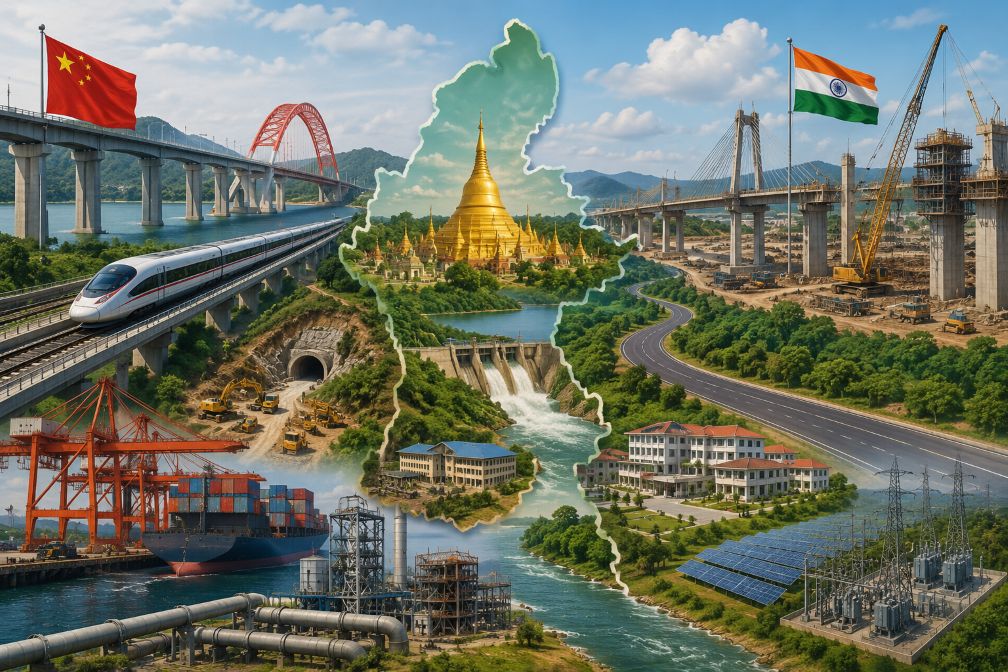
The projects being implemented by China and India in Myanmar
The two major strategic projects in Rakhine State are China's Kyaukphyu Deep Sea Port and Special Economic Zone (SEZ), and India's Kaladan Multi-Modal Transit Transport Project.
Currently, the AA not only commands military dominance over a vast amount of territory but also manages local stability and the administrative machinery, operating effectively like a governing body.
Since China is a powerful neighbor that wields significant influence over the Northern Alliance groups, the AA has officially declared that it will protect Chinese economic interests and will not disrupt them. Similarly, military and political analysts note that China understands the practical necessity of dealing directly with the AA—the force exercising actual control on the ground—to ensure the safety of its investments.
On the other hand, since the AA controls Paletwa and northern Rakhine areas where India’s Kaladan project is located, the Indian government is in a position where it must inevitably negotiate with the AA to move the project forward. In tandem, the AA has publicly stated that its doors are always open to building relations with India.
Kachin politician U Gwan Gaung Aung Kham told CNI News that instead of relying entirely on either China or India, the AA is more likely to employ a strategy that balances between the two heavyweights.
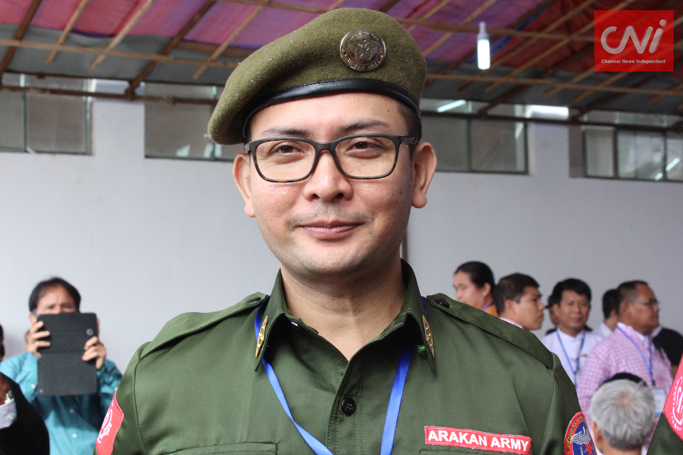
AA Leader General Twan Mrat Naing
"The AA's geopolitical positioning naturally dictates this approach. China is set on executing the Kyaukphyu Deep Sea Port. Politically, the Rakhine people will have to engage and deal with China regarding this project. On the other hand, since India's Kaladan project also coexists, they will have to maintain engagement with India as well. Therefore, success will depend heavily on how skillfully the AA can politically navigate its engagement with both nations.Typically, whether it is India or China, they prefer to engage more officially with the sitting government. However, the AA's situation is unique compared to others. It is highly possible that both China and India will come forward to engage with them directly. Rather than viewing this as a potential misstep, it all comes down to how effectively their diplomatic stance can yield positive outcomes for them," he said.
Military and political analysts assess that since both projects can bring job opportunities and local economic development to the Rakhine people, the AA is more likely to prioritize showcasing peace and stability rather than disrupting the projects, using this as leverage to gain political capital.
Meanwhile, Myanmar President U Min Aung Hlaing visited India from May 30 to June 3, 2026, where he held talks with Indian Prime Minister Narendra Modi. He subsequently visited China from June 15 to 19, 2026, for a meeting and discussions with Chinese President Xi Jinping.