
CNI News
22 June 2026
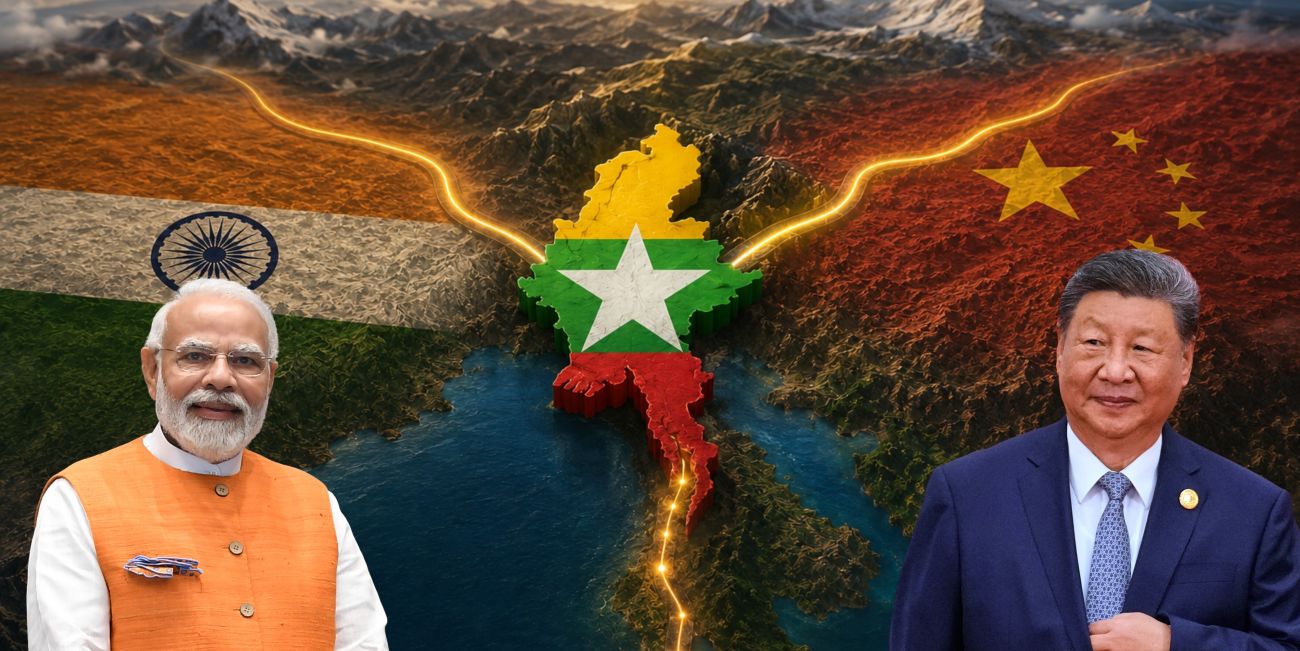
A political analyst told CNI News that Myanmar serves as the most critical geopolitical convergence point for its two giant neighbors, China and India.
Consequently, both nations maintain a pragmatically aligned policy: they will engage and maintain workable relations with whichever government comes to power in Myanmar, as neither power can afford to sideline the country.
A political analyst explained: "For its long-term strategic interests, China wants to forge a route through Myanmar directly to the Indian Ocean. Securing this corridor safeguards its energy transport and national security, while drastically shortening trade routes to distribute goods through Myanmar to Africa, the Middle East, and onward to Europe. Therefore, China simply cannot leave Myanmar out of its economic calculus.On the flip side, while India prefers to limit its engagements with China due to historical friction, it strongly dislikes seeing Chinese influence expand right up to its borders. However, India's own strategy relies on traversing Myanmar to link up with Thailand first, and then expanding infrastructure into Southeast Asia—including Cambodia, Vietnam, and Laos. Furthermore, India’s strategic partnership with the United States to counter China could eventually pull in military and security cooperation. At its core, this is about countering China. Because Myanmar occupies such a pivotal position in regional geopolitics, both superpowers maintain a policy of befriending whoever rules the country to keep things running smoothly."
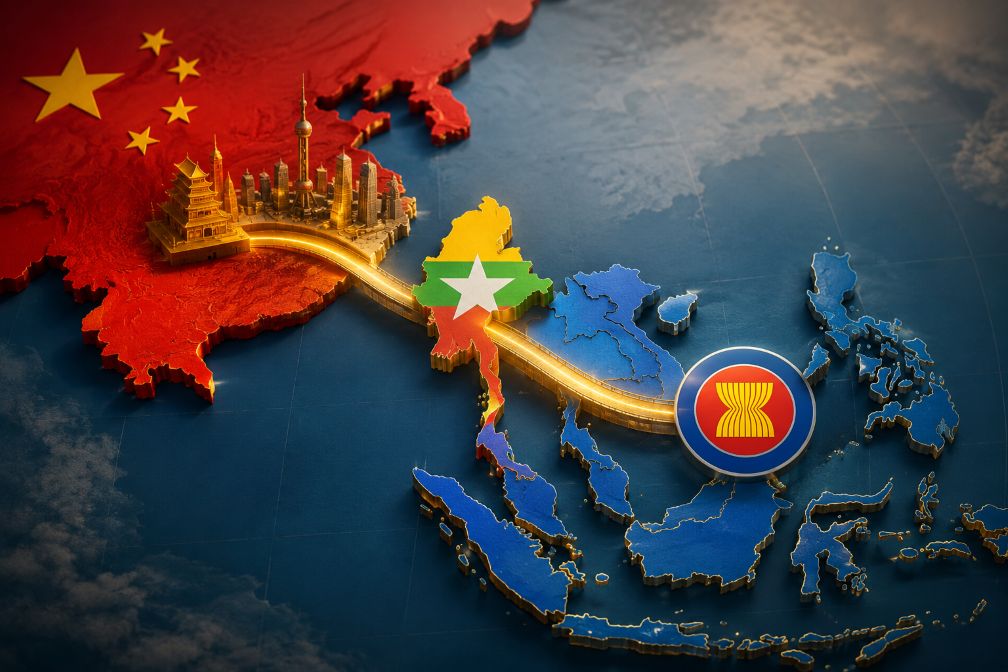
A graphic representation demonstrating the connectivity between China, Myanmar, and ASEAN.
Analysts emphasize that the bulk of China’s energy imports currently pass through the Strait of Malacca. In the event of a conflict or a naval blockade, this reliance could choke off China's economic lifeline.
To mitigate this vulnerability, the oil and natural gas pipelines stretching from Kyaukphyu in Rakhine State to Kunming, China, offer Beijing a direct overland gateway to the Indian Ocean. This bypass effectively alleviates its "Malacca Dilemma."
Furthermore, the China-Myanmar Economic Corridor (CMEC) remains a cornerstone of this strategy. The Kyaukphyu Deep Sea Port acts as a strategic asset that directly connects landlocked Yunnan Province to the Indian Ocean. Political observers point out that Myanmar's coastline and territorial waters are vital for China to project both civil and military maritime influence across the Indian Ocean.
For India, Myanmar represents an indispensable gateway to counterbalance Chinese dominance and sustain its own economic growth. In India's push to integrate with the Association of Southeast Asian Nations (ASEAN) markets, Myanmar functions as a literal land bridge. The India-Myanmar-Thailand Trilateral Highway stands as a prominent example of this land-route connectivity.
Another critical initiative is the Kaladan Multi-Modal Transit Transport Project, which links Kolkata to the Sittwe Port in Rakhine State, and runs up the Kaladan River to connect with India's landlocked Mizoram State. This strategic corridor offers a faster, more secure commercial and security link to India’s northeastern frontier.
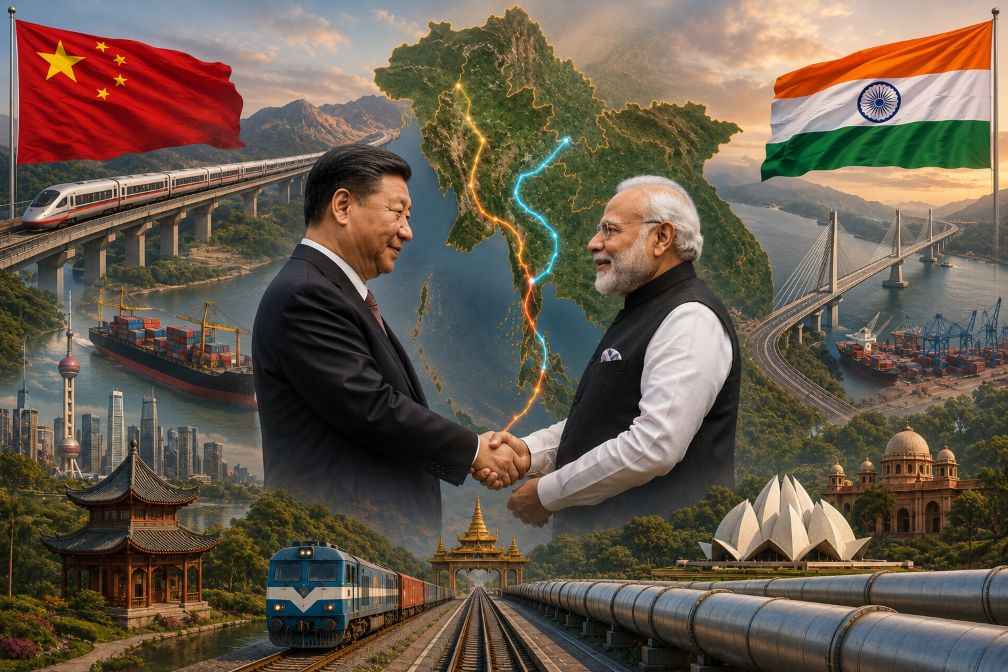
Strategic infrastructure projects in Myanmar highlighted between Indian Prime Minister Narendra Modi and Chinese President Xi Jinping.
Beyond maritime anxieties regarding China’s naval presence in the Indian Ocean, New Delhi heavily relies on cooperation from the Myanmar military to monitor and flush out insurgent factions operating along India’s remote northern borders.
U Nyo Ohn Myint, an advisor to the Myanmar Narrative Think Tank, highlighted the immense value of multilateral cooperation between Myanmar and its powerful neighbors to CNI News: "The Strait of Malacca, nestled between Singapore, Malaysia, and Indonesia, spans over 900 kilometers. Both China and India share a deep-seated anxiety regarding what would happen if this primary East-West trade route were ever closed.Looking at the broader picture, India is backing the India-Myanmar-Thailand Trilateral Highway because India’s total trade volume with ASEAN stands at around $200 billion USD, whereas bilateral trade between India and Myanmar alone is just around $2 billion USD. If the Malacca shipping lanes were blocked, up to 50% of India’s trade routes to East Asia and ASEAN could be paralyzed. The People's Republic of China views the problem through an identical lens. If that shipping lane shuts down, where will they go? Given their strained ties with Western nations and allies like Australia, navigating such a crisis would be incredibly complex, making an alternative route through Myanmar vital. This is why building a cargo railway corridor from Kunming to Kyaukphyu is an absolute necessity. This rail link will foster mutually beneficial cooperation between India, Myanmar, and the wider region, making it an exceptionally vital development."
Amidst these geopolitical maneuvers, Myanmar President U Min Aung Hlaing recently concluded key diplomatic missions, visiting India from May 30 to June 3, 2026, and China from June 15 to June 19, 2026, where he held high-level talks with Chinese President Xi Jinping and Indian Prime Minister Narendra Modi.