
CNI News
22 June 2026
Domestic and international political circles are increasingly raising questions as to why ethnic armed organizations (EAOs) in Myanmar share a common ambition to achieve a political status similar to that of the "Wa."
Under Myanmar's 2008 Constitution, six autonomous regions were designated, comprising one self-administered division and five self-administered zones. The "Wa" region was designated as the sole self-administered division.
Military and political analysts point out that the "Wa" was granted self-administration due to specific factors: its location on the Chinese border, its financial power, manpower, military strength, and its ability to securely defend its own territory. Such a tightly knit and compact consolidation is not seen in other regions and states.
A political analyst told CNI News that if those who drafted the 2008 Constitution had possessed a far-sighted and firm objective, the country would be in a much better position today.
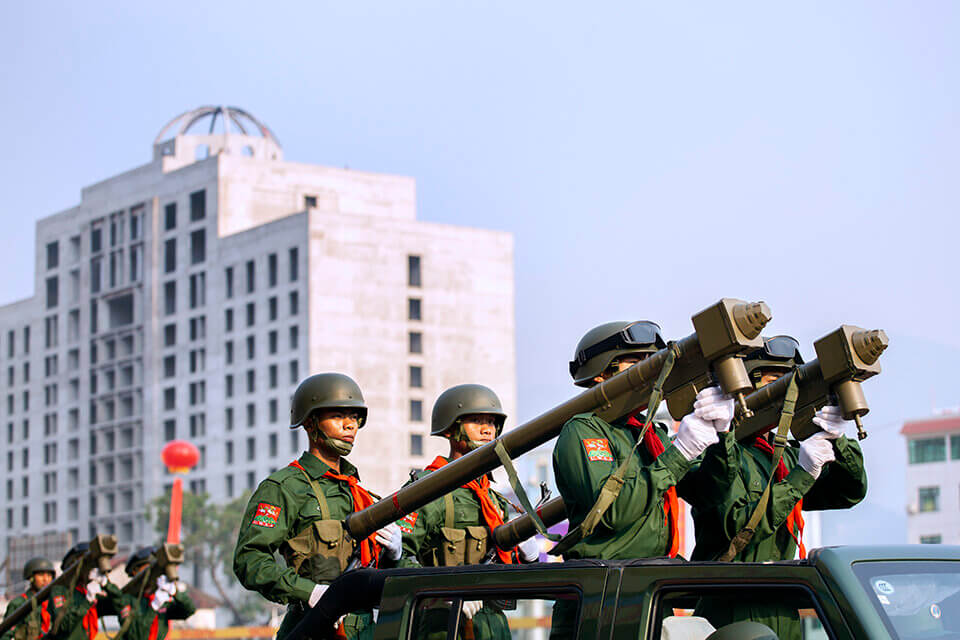
UWSA forces showcasing an anti-aircraft weapon system.
"When the 2008 Constitution was being drafted at the Nyaung Hnapin National Convention, the drafters lacked a firm objective—namely, that the constitution must serve as a foundation for multi-party democracy, bring internal peace, and transition domestic armed organizations into a single unified military.If such an objective had existed—and here I am primarily referring to Senior General Than Shwe—things would be different. At that time, the Wa force was the strongest, and the territory they administered was completely separate from the central administrative machinery and military forces. If Than Shwe and his colleagues had possessed the vision and foresight to realize that the separate existence of the Wa would pose a structural risk to the future of a constitutionally governed country, they would have negotiated properly to include them in the constitutional framework instead of rushing to force the 2008 Constitution through. A truly visionary leader would have ensured their inclusion."
Currently, although the Wa region is designated as a Self-Administered Division under Article 56(f) of the 2008 Constitution, the central government exercises no authority over it. The United Wa State Army (UWSA) governs the region entirely independently.
The UWSA manages its own affairs across all sectors, including military, political, judicial, healthcare, education, economic, customs, and immigration departments.
As a result, some EAOs are using the UWSA as a benchmark to demand a similar political status, while other armed groups are actively building such autonomy on the ground.
Another political analyst explained to CNI News that because the Wa has successfully established an entirely separate territory, other ethnic armed groups have come to admire it and are demanding identical privileges.
"The Wa army (UWSA) operates completely independently and remains separate. Furthermore, in the fallout of the current armed conflicts, they have provided weapons, ammunition, and necessary financial assistance to other ethnic armed organizations, so we can see the impact of their leverage. Beyond just being able to provide aid, other ethnic groups deeply admire the fact that the Wa can live completely free from the central government's constitutional authority. Because they admire this, they say, 'We want to be like the Wa, and that is the path we will take.'"
Military and political observers argue that simply granting self-administered status will not resolve the conflicts, as there are many distinct differences between the position of the Wa and other ethnic armed groups.
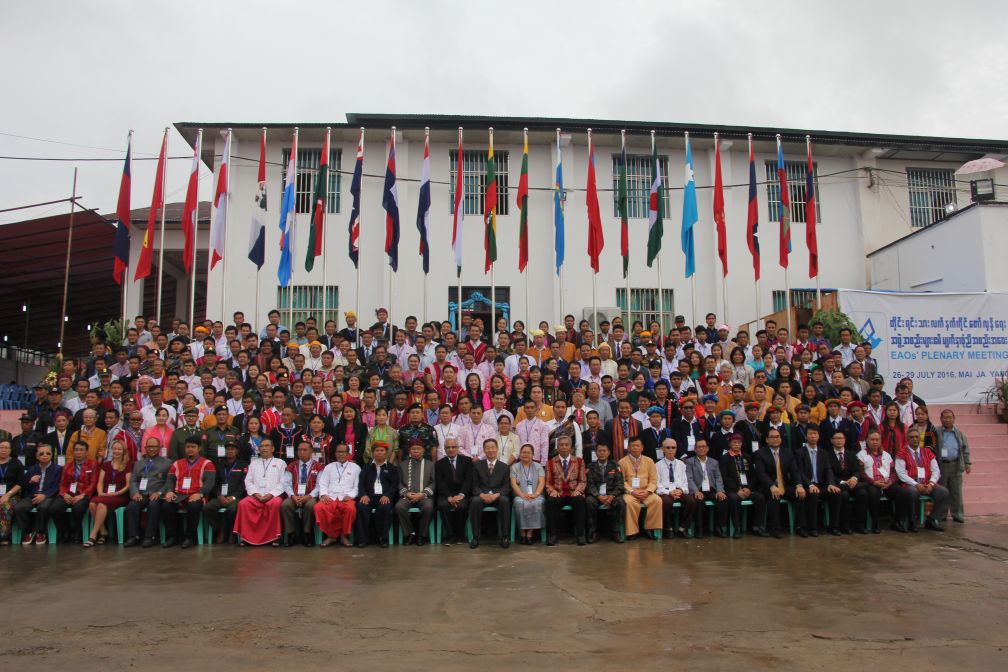
various ethnic armed organization leaders.
Political analyst Dr. Myo Set Thway told CNI News that replicating the Wa model elsewhere is geographically and strategically impractical.
"The Wa holds nearly 100 percent control over its entire regional administration, alongside the right to expand its military force, possess arms, and manage its own finances. Naturally, other ethnic armed organizations want that same deal. The question we must consider is whether it can or should be given.
Why was it given to the Wa in the first place? Was it because it was unavoidable, or because it was appropriate? By granting this to a place like the Wa region, which is entirely landlocked, they cannot significantly interfere with Myanmar's maritime foreign policy. However, look at Rakhine. If the Arakha Army (AA) operates entirely at its own whim across the whole Rakhine coastline, our country's maritime trade would be restricted to just Tanintharyi and Ayeyarwady. Therefore, the strategic calculations are completely different. You cannot view the Wa and Rakhine through the same lens. Likewise, could you grant this to the KIA? They may be landlocked, but their territory contains massive amounts of minerals and natural resources critical to the entire nation. Would you hand over total discretionary authority over those resources? These various factors must be weighed differently."
The current self-administered zones and divisions designated under the framework include: Kokang Self-Administered Zone: Konkyan and Laukkai townships in Shan State.
Palaung (Ta'ang) Self-Administered Zone: Namhsan and Mantong townships in Shan State.
Danu Self-Administered Zone: Ywangan and Pindaya townships in Shan State.
Pa-O Self-Administered Zone: Hopong, Hsiseng, and Pinlaung townships in Shan State.
Naga Self-Administered Zone: Lahe, Leshi, and Nanyun townships in Sagaing Region.
Wa Self-Administered Division (UWSA): Hopang, Mongmau, Panwai, Narphan, Matman, and Pangsang (Pangkham) townships in Shan State.
Looking ahead, the AA has explicitly stated that its minimum political objective is to secure a "Wa-style" political status and move toward a confederation. Meanwhile, the KIA has noted that as the political landscape moves past 2025, ethnic armed groups will look beyond standard federalism and begin demanding much more.