
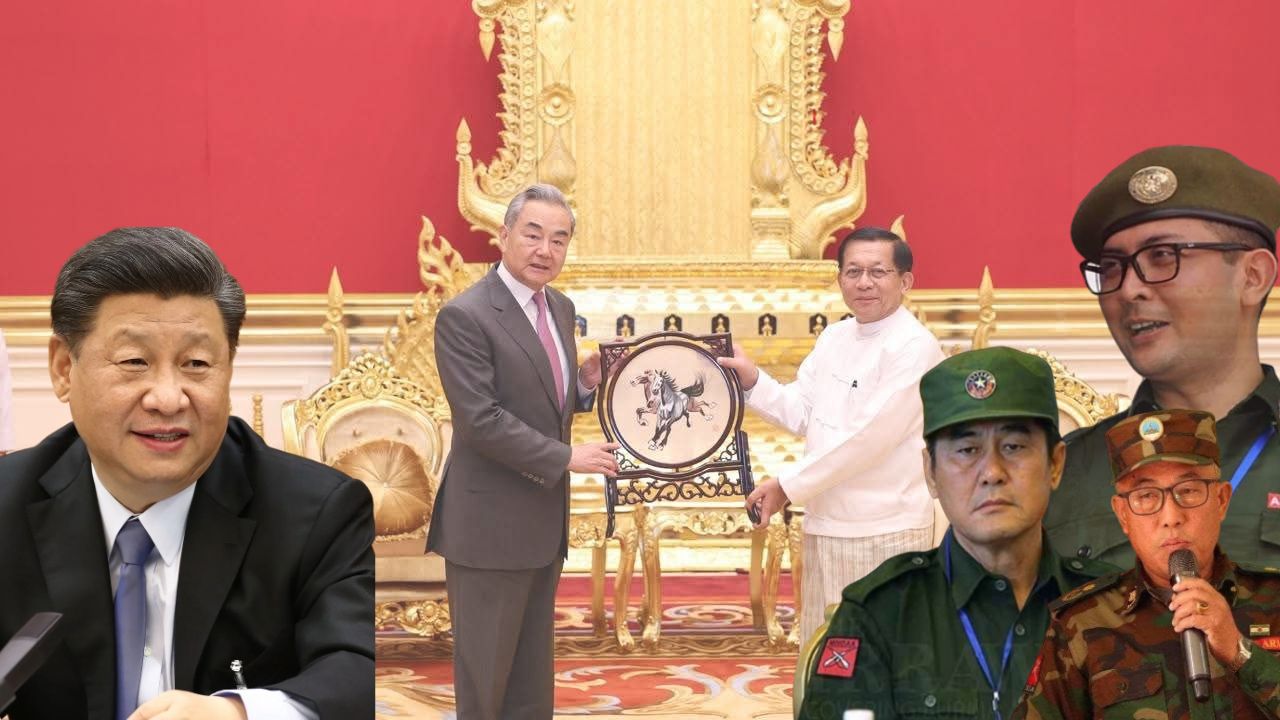
CNI News
June 2, 2026
China-Myanmar analysts and political observers point out that the Chinese government is now in a position where it can effectively control and manage both the Myanmar government and ethnic armed organizations (EAOs).
A political analyst told CNI News Agency that the government, the military, and ethnic armed groups cannot afford to ignore China's stance, suggesting that Beijing is handling Myanmar through political maneuvering.
"Operation 1027 partly aimed to crack down on online scams (cyber-crime syndicates) that were harming Chinese interests, which is why China subtly gave the green light to the Three Brotherhood Alliance's offensive," the analyst said. "However, the Three Brotherhood Alliance achieved unexpected victories, capturing Lashio and Mogok, while the Arakan Army (AA) managed to seize almost the entire Rakhine State. China likely didn't expect them to achieve that level of success."
"Even so, China seemed worried that the military government might collapse. That is why they stepped in to pull the strings. In this situation, China has reached a point where it can firmly control both sides—the ethnic armed groups and U Min Aung Hlaing. China doesn't want to deal with the Myanmar government too harshly; it just wants to use political tactics to show, 'You can't escape from under my thumb.' When Operation 1027 brought the Myanmar government to the brink of collapse, China told its proxies to back off and ease up, thereby earning the gratitude of the Myanmar government.What this means is that China has placed both sides in its debt, allowing Beijing to pull the strings on both ends. In this current dynamic, if either the ethnic armed groups or the military government tries to defy China, Beijing will react with much harsher measures because it has the power. China is more powerful than India; it is even talking about moving from the world's second-largest power to the first. During a meeting with Trump, China bluntly stated, 'I am a rising power, and you are a declining power.' In this landscape, whether the Myanmar government aligns with India or the United States, China will continue to pursue its goals to secure its access route to the Indian Ocean."
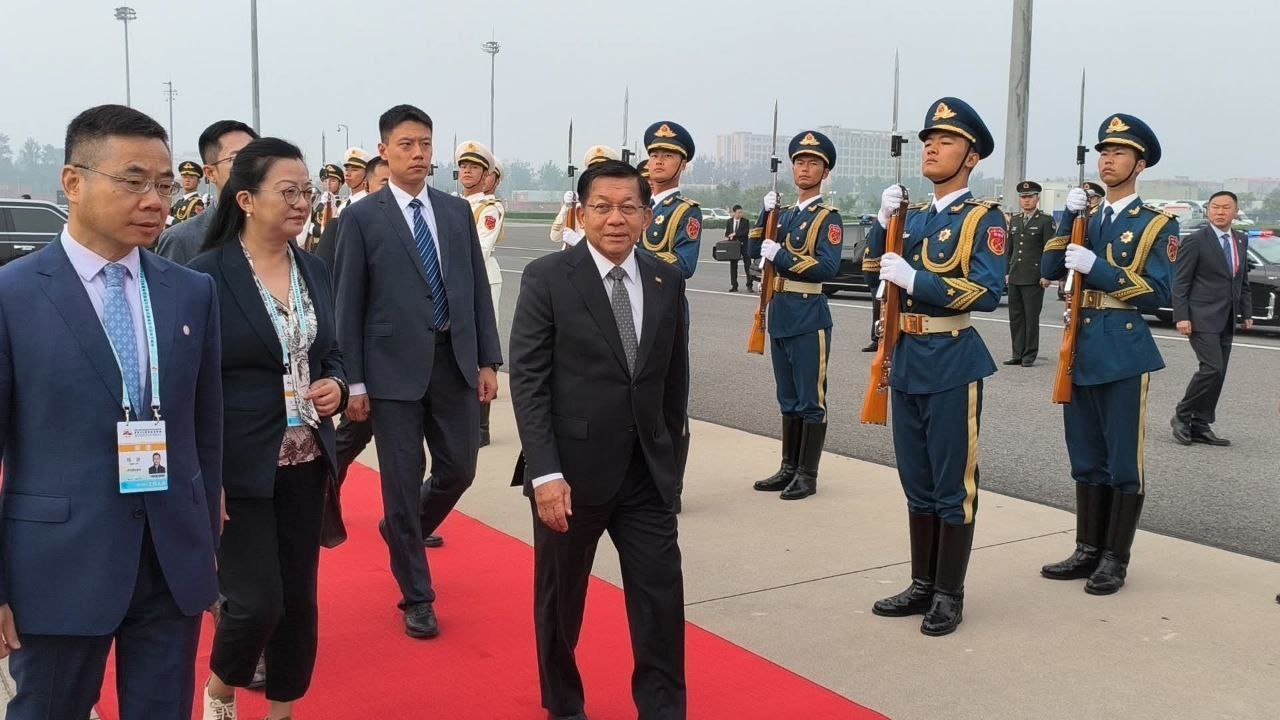
President U Min Aung Hlaing during his visit to China.
Military and political analysts also highlight that while China wishes for peace in Myanmar, it is simultaneously playing both sides. They point out that Beijing is likely to maintain its involvement in Myanmar's internal affairs by leveraging its influence over ethnic armed groups. Furthermore, they note that China is highly likely to exploit Myanmar for its own interests.
China's investment projects in Myanmar include a wide range of initiatives, such as: The Kyaukphyu Special Economic Zone (SEZ), The Myitsone Dam, An elevated railway project, The Kanpiketi Economic Cooperation Zone, The Muse-Mandalay electric railway, The Ruili-Mandalay-Kyaukphyu expressway, Various China-Myanmar bilateral trade routes.
Dr. Hla Kyaw Zaw, a China-Myanmar affairs analyst, told CNI News Agency that all of Myanmar's economic lifelines are within the grasp of the Chinese government and that Myanmar is entirely dependent on China.
"China holds all of Myanmar's economic lifelines. Therefore, the ethnic nationalities cannot survive without relying on China. Especially for the ethnic groups in the north bordering China, they can only conduct business if China keeps the border gates open," Dr. Hla Kyaw Zaw said.
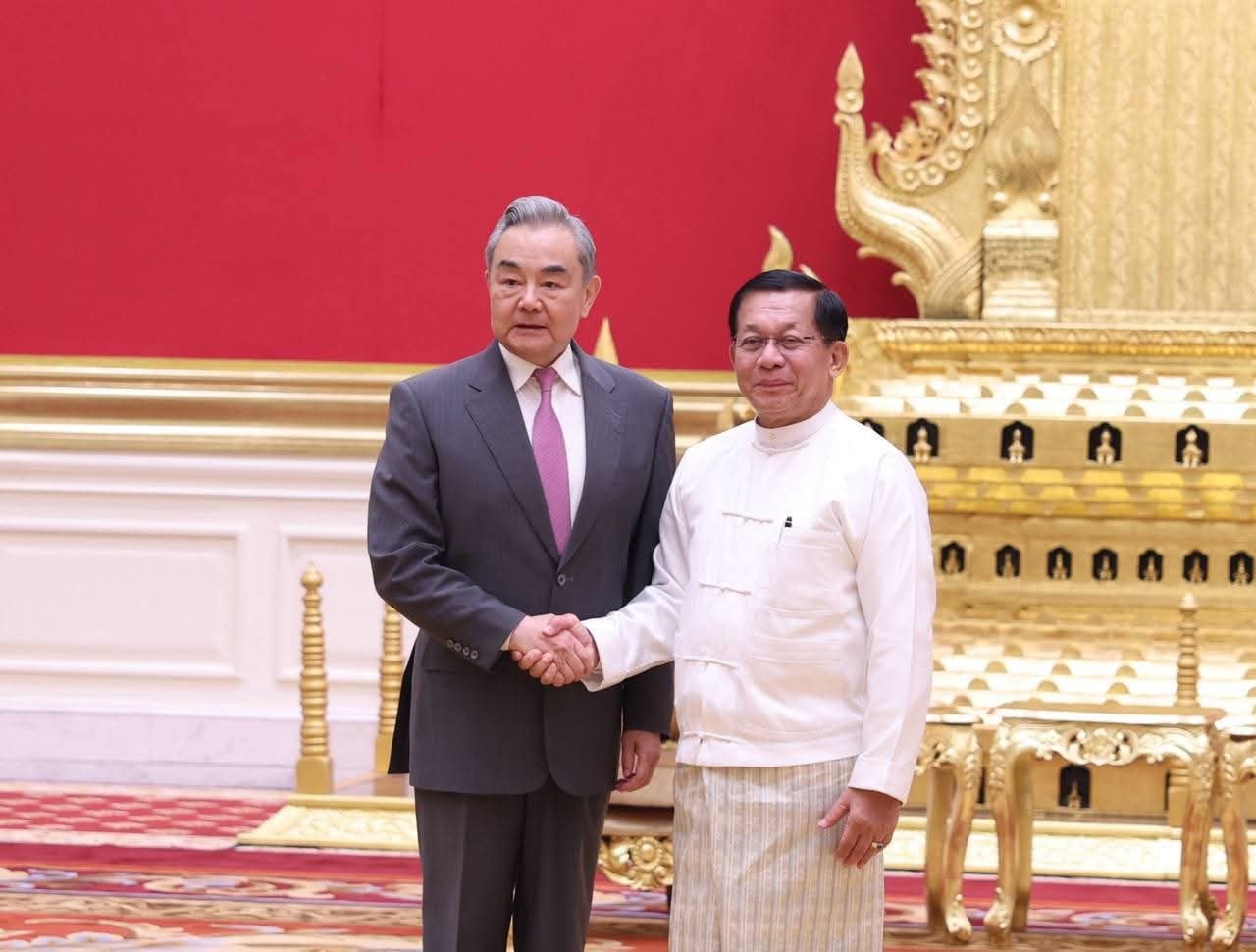
Chinese Foreign Minister Wang Yi meeting with President U Min Aung Hlaing.
"Similarly, the Myanmar military government is worried about having few powerful supporting nations, so they are clinging tightly to China. It is true that the Myanmar military government relies on China, given the massive scale of Chinese investments. Even if he (President U Min Aung Hlaing) goes to India, India will not invest to the same extent as China; India's interests are not that vast. When it comes down to actual economics and interests, he has to rely on China. All the key stakeholders in Myanmar are dependent on China in one way or another."
The Chinese government possesses the power to exert influence over, control, and deploy as needed the United Wa State Army (UWSA) operating in northern Shan State, as well as the three northern alliance groups: AA, TNLA, and MNDAA.
Recently, on April 25, 2026, President U Min Aung Hlaing and Chinese Foreign Minister Mr. Wang Yi held a meeting in Nay Pyi Taw.
During the meeting, they discussed China's steadfast support for Myanmar's sovereignty, territorial integrity, and stability, as well as Beijing's backing for national peace, ethnic reconciliation, and social harmony.
Similarly, during two meetings with Chinese President Xi Jinping over the past five years, Xi urged President U Min Aung Hlaing to guarantee the security of Chinese projects, investments, companies, and citizens within Myanmar.