
CNI News
June 2, 2026
Military and political analysts are sharing their assessments on whether Myanmar can establish a global trade route using China's economic power.
Analysts point out that while Myanmar can utilize China's economic strength, technology, and infrastructure capabilities, it is impossible to successfully build the nation by relying entirely on China alone.
Sai Htay Aung, Chairman of the Tai-Leng (Shanni) Nationalities Development Party (TNDP), told CNI News that while China's massive growth could have been a source of strength for Myanmar if it were a truly good neighbor, China's actions do not reflect good neighborliness, thereby posing a danger to Myanmar.
He stated, "If China were truly a good neighbor, we could harness and use its massive strength to our advantage. But in my view, China is not a good neighbor. This is because they only want to extract our country's natural resources. They have barely served this country's interests, and we haven't seen them do anything for our development. Myanmar fell under British rule in 1886. Today, Myanmar could become a modern-day colony of China. Look at Venezuela—its people are facing severe crises due to Chinese debt issues. We can advance and upgrade Myanmar by playing a smart diplomatic game between the West and the EU. I don't see our country developing solely on Chinese power; we don't see a win-win approach there."
China is a global economic superpower and also plays a role in certain areas of Myanmar's peace process.
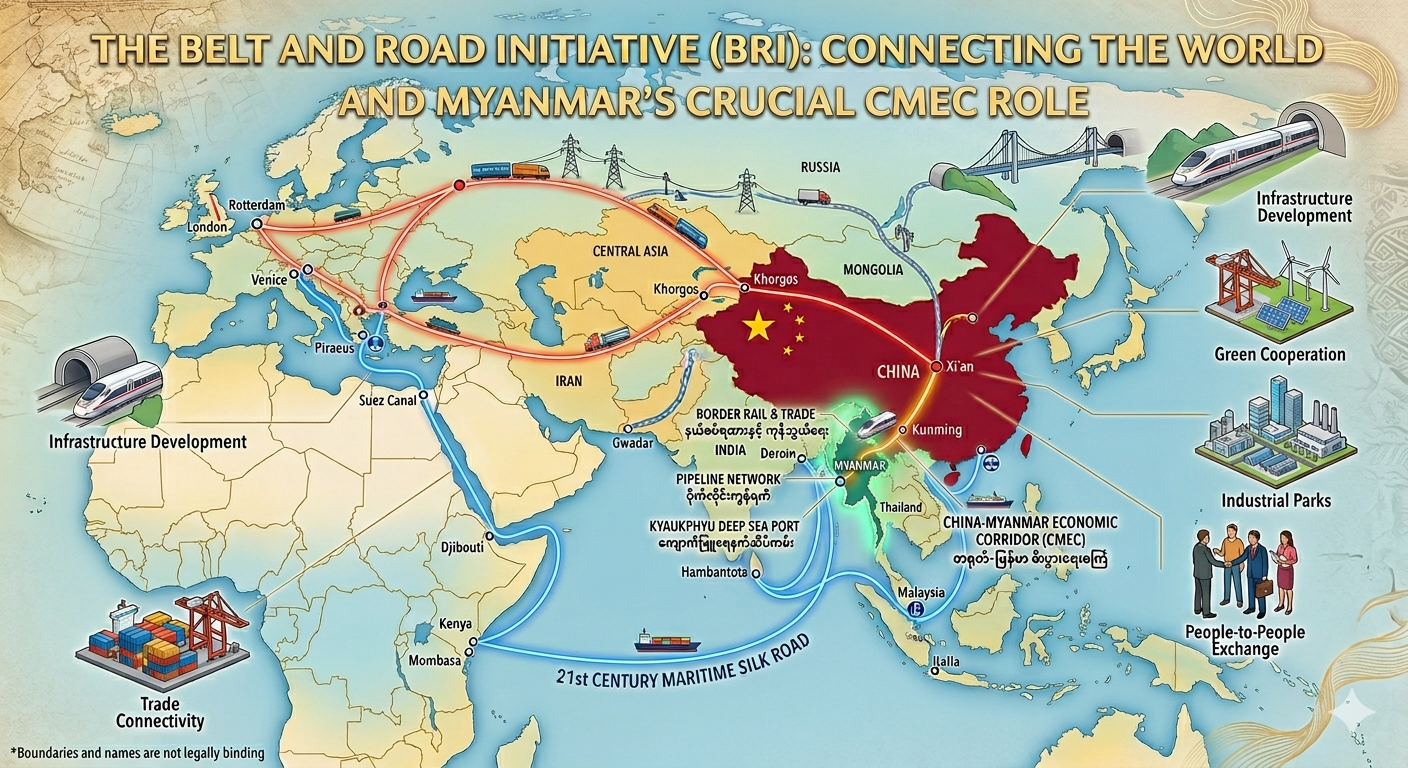
The route of China's BRI project.
However, military and political analysts point out that over-reliance on China economically and politically could weaken Myanmar's independence in policy-making and subject it to Chinese influence. They also warn that implementing large-scale projects with Chinese loans without careful calculations could lead to an inability to repay in the long run, harming the national interest—as seen in several other nations.
They assess that China's influence over Myanmar's border stability and ethnic armed organizations (EAOs) acts as a double-edged sword in Myanmar's peace process.
On the other hand, business executives believe that China-Myanmar Economic Corridor (CMEC) projects—such as the Kyaukphyu deep-sea port, railways, and transportation networks—can boost Myanmar's transport and trade sectors.
Furthermore, Chinese investment and technology could greatly assist Myanmar in achieving electrification, developing renewable energy (solar and hydropower), and building digital technology infrastructure.
Similarly, China serves as the largest border market for Myanmar’s agricultural, livestock, and marine products.
Dr. M. Kawn La, a political analyst, expressed a different perspective to CNI News, stating that Myanmar can indeed build the nation using China’s power because China's Belt and Road Initiative (BRI) is a global trade route.
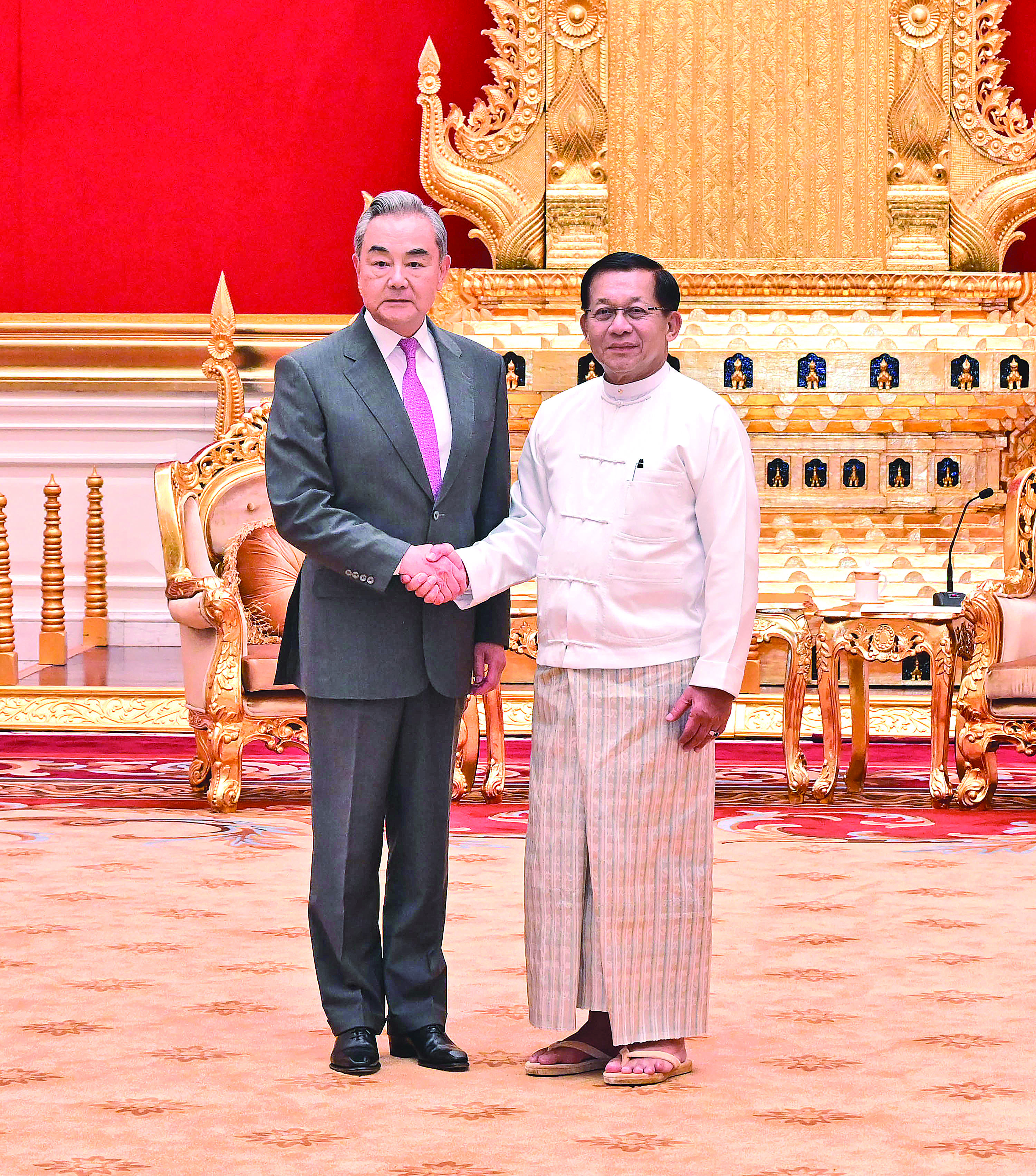
Chinese Foreign Minister Wang Yi and Myanmar President U Min Aung Hlaing seen together.
He said, "The Chinese BRI project is a path we inevitably have to take. These are signed contracts and agreed-upon deals; the Kyaukphyu project, for instance, has already begun implementation. These are things that must be executed. However, we must be careful not to harm our citizens and our national sovereignty. If managed correctly, the BRI will place us right within global trade routes. We can build our country using China's power. For example, let's look at Bangladesh. Bangladesh engages heavily in economic and opportunity-building projects with China. At the same time, they signed military agreements allowing the US Navy to dock and resupply at Matarbari, Bangladesh's only deep-sea port. This shows that a country has the right to exercise its diplomacy and pursue its goals as it sees fit. Therefore, it is appropriate for our country to proceed with the BRI under signed agreements. Once signed, we must execute them properly. We must prepare appropriate and correct strategies to ensure we enter global trade routes."
Following the formation of the new government led by President U Min Aung Hlaing in Myanmar, Chinese Foreign Minister Mr. Wang Yi visited in April and spoke regarding the implementation of bilateral projects.
Additionally, in May, the Chinese Ambassador to Myanmar, Ms. Ma Jia, and her delegation met with the Vice Presidents to discuss the implementation of the China-Myanmar Economic Corridor, bilateral cooperation projects, and the promotion of trade and investment sectors.
Similarly, it is learnt that arrangements are underway for President U Min Aung Hlaing to visit China and hold talks with Chinese President Xi Jinping.