
CNI News
June 20, 2026
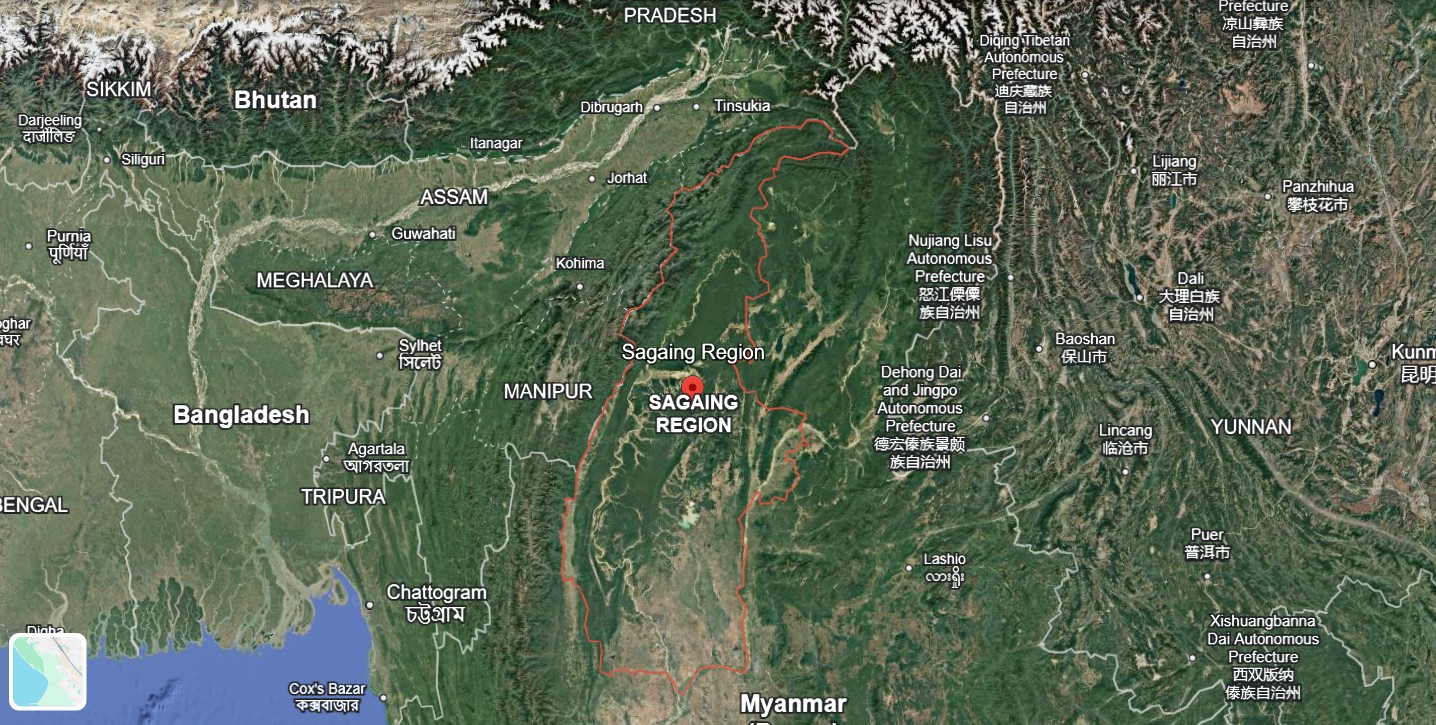
Dr. Hla Kyaw Zaw, a China-Myanmar affairs analyst, told CNI News that if instability persists in Myanmar's Sagaing Region—where armed conflicts are currently raging—not only India but also China could face significant difficulties.
Military and political analysts point out that instability in Sagaing Region poses major challenges and security risks to India's northeastern region, threatens trade, and creates potential safe havens for anti-India insurgent groups.
Similarly, analysts highlight that Sagaing Region is a pivotal hub for the China-Myanmar Economic Corridor (CMEC) and the Belt and Road Initiative (BRI), while also hosting major Chinese projects and investments. Therefore, instability in Sagaing would likewise present serious complications for China.
Dr. Hla Kyaw Zaw suggested that ceasefires and peace talks might emerge to stabilize Sagaing Region, given that its instability troubles both neighboring giants.
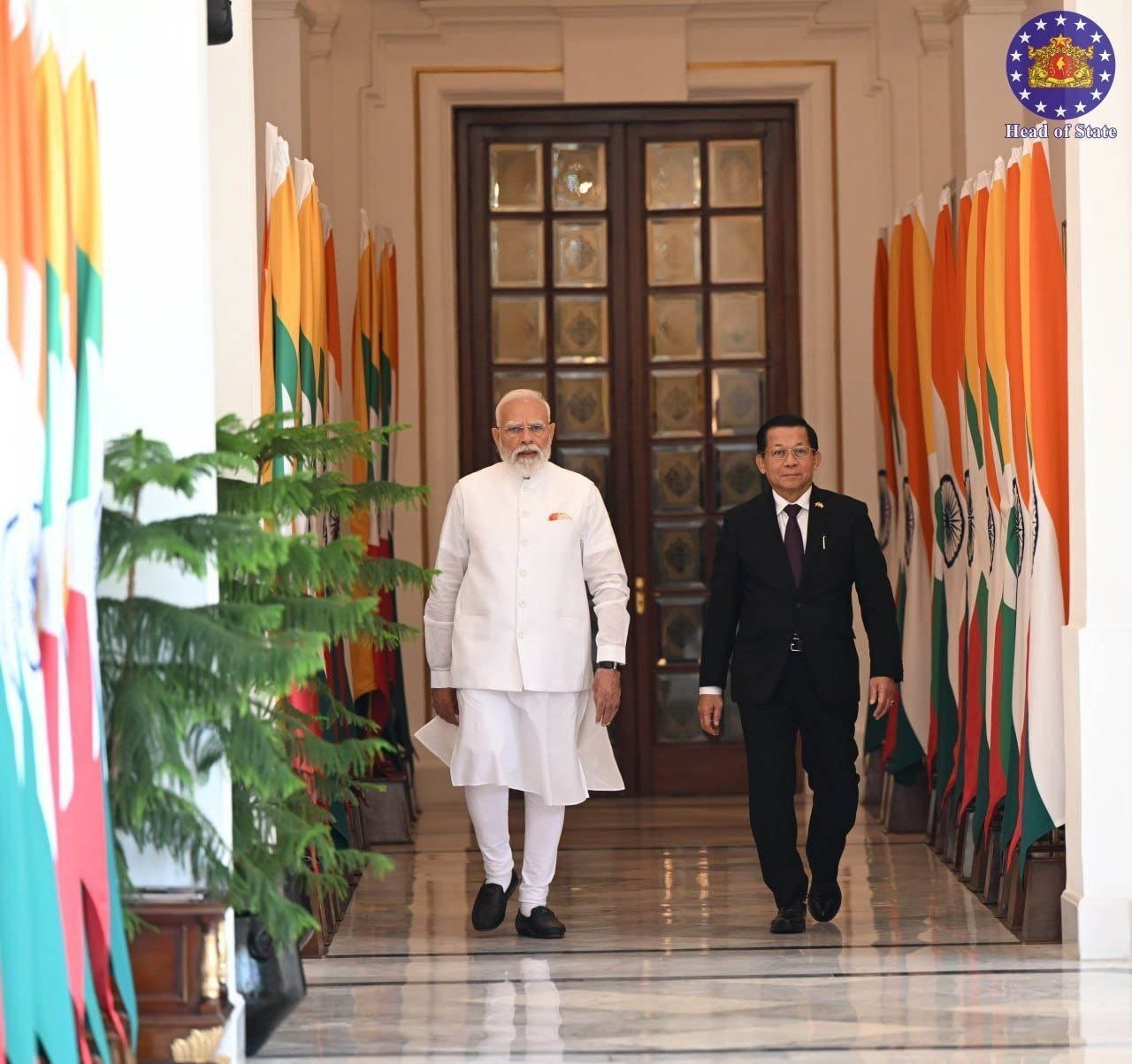
Myanmar President U Min Aung Hlaing and Indian Prime Minister Narendra Modi
"If Sagaing is unstable, China will definitely face difficulties. China has to route through Sagaing Region to reach its Kyaukphyu deep-sea port project. Therefore, if Sagaing is unstable, it’s not just India—China will be in trouble too. This means they have to make Sagaing stable.
To achieve stability, they will have to call major ceasefire talks. Whether the [Chinese and Myanmar governments] want to talk to the NUG or not, they will have to consider doing so. This is because Indian Prime Minister Modi explicitly stated that to return to the path of democracy, inclusive dialogues involving all groups must be held. China has also been applying continuous pressure regarding this. When [U Min Aung Hlaing] is invited to China as a state guest, China will present certain facts, and U Min Aung Hlaing will likely have to provide reciprocal commitments. What are those commitments? To achieve what they call 'Tiger Myanmar Economy Quality'—bringing Myanmar's economy up to Asian Tiger status—sustained peace is indispensable. That is why I anticipate that ceasefires and negotiations will emerge."
Currently in Sagaing Region, armed forces led by the KIA are executing the "Triple-K" operation (Kanbalu-Kawlin-Katha), aiming to liberate Myanmar's northwestern region by connecting Kachin State, Sagaing Region, Chin State, and Rakhine State.
Consequently, intense fighting is taking place among the Myanmar Military, Shanni Nationalities Army (SNA), Zomi Revolutionary Army (ZRA/ZRO), Arakha Army (AA), Chin National Front (CNF), and the joint KIA-PDF forces.
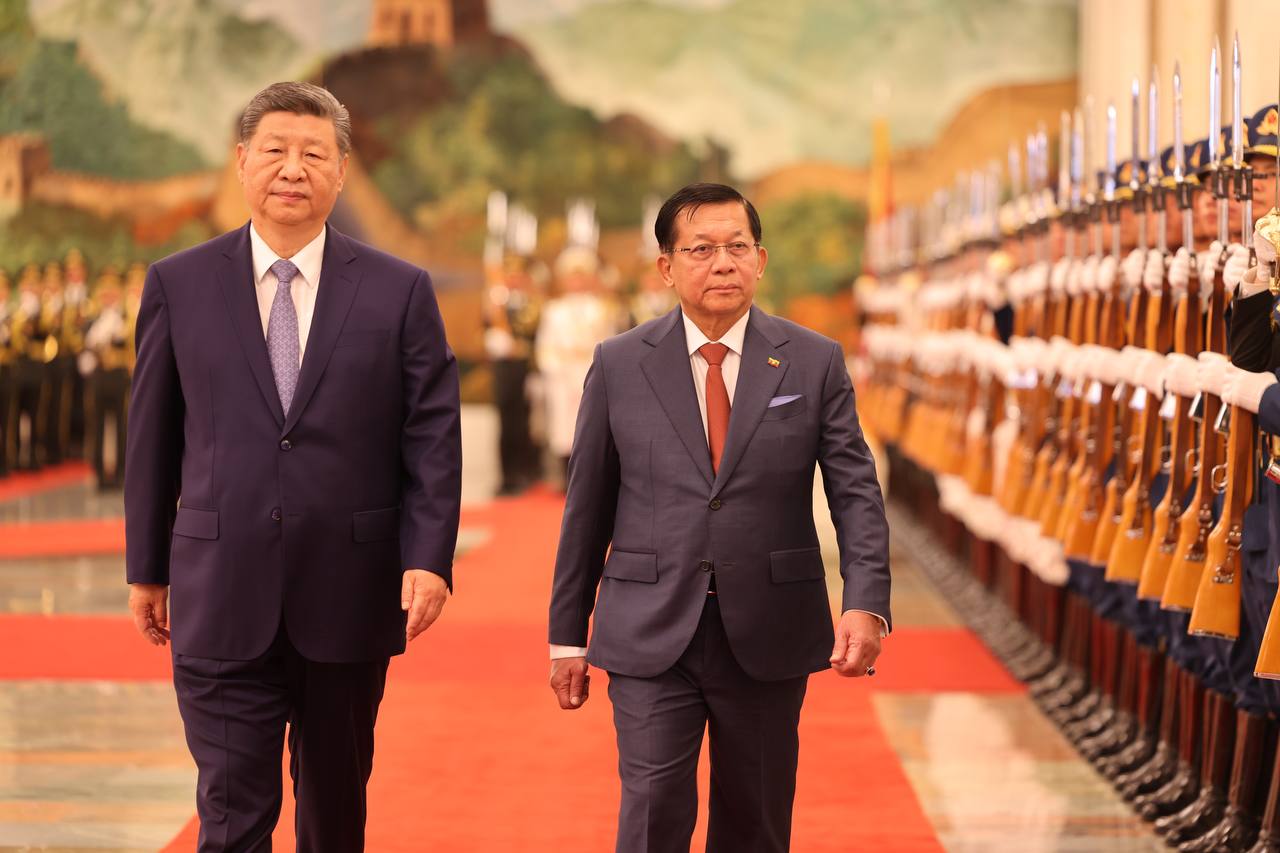
Myanmar President U Min Aung Hlaing and Chinese President Xi Jinping.
Sai Htay Aung, Chairman of the Tai Lai (Shanni) Nationalities Development Party (TNDP), told CNI News that because a myriad of armed groups operate within Sagaing, the government faces a complex dilemma regarding who they should actually negotiate with for peace.
"Sagaing Region holds major Chinese investments. For instance, the Letpadaung Copper Project just across the river from Monywa is a massive Chinese operation. Secondly, the key trade route between China and India—the Kalay-Tamu-Monywa highway—has been disrupted, which severely impacts the flow of goods. Since the trade routes of these two major powers are affected, China's economic interests are bound to suffer. We can see that the unrest in the country is disrupting Chinese projects. Honestly, achieving peace without fighting is the absolute best outcome. Building trust only after fighting leaves deep emotional trauma on people. Since multiple factions are operating inside Sagaing right now, it creates a practical dilemma for the government when they reconsider entering peace talks—they have to wonder which group they should actually negotiate with."
Presently, an array of armed actors are operating in Sagaing Region, including the Kachin (KIA), Shanni (SNA), Rakhine (AA), Kuki (KNA), various PDFs, Naga armed groups, and Kathe (Meitei) insurgent groups.
Amidst these developments, Myanmar President U Min Aung Hlaing visited India from May 30 to June 3, 2026, and China from June 15 to June 19, 2026, where he held bilateral discussions with Indian Prime Minister Narendra Modi and Chinese President Xi Jinping.