
CNI News
June 3, 2026
Amidst the current global political landscape, military and political analysts are questioning just how crucial Myanmar has become to China.
US control and influence over Venezuelan oil pipelines and the Strait of Malacca play a vital role in global finance, energy security, and geopolitical strategies. China's primary vulnerability is that most of its oil and energy imports from the Middle East must pass through the Strait of Malacca.
In this context, Myanmar serves as a land-based shortcut for China to directly access the Indian Ocean (Bay of Bengal) without relying on the Strait of Malacca.
Political analyst Dr. M Kawn La told CNI News that Myanmar plays a vital role in securing China’s energy needs.
"The US and China mainly focus their discussions on the Taiwan issue; other matters aren't as significant. Rather than mutual economic opportunities, Taiwan is their primary talking point. Similarly, Russian President Putin's recent visit to Beijing to meet Xi Jinping focused more on the construction of the Power of Siberia 2 oil pipeline than anything else. Frankly speaking, China is preparing to secure liquefied natural gas (LNG) from Russia for its energy security. Russia, having lost its European market, is shifting its focus to sell primarily to China. In our country, offshore gas fields M-15 and M-10 are slated to produce natural gas in 2027. There is also a plan to extract natural gas near Dawei from what is the world's second-largest pipeline project, containing trillions of cubic feet. This connects directly to the Bangkok-Kunming gas pipeline project. Therefore, Myanmar plays a vital role in China's efforts to build its energy security. Consequently, in this geopolitical bipolarization and the competition between the US and China, Myanmar is entangled in China's sphere, finding itself playing an important role on the world stage. Regarding energy security, while the gas extraction project from M-15 near Dawei is important, the Kyaukphyu-Kunming pipeline project stands at the forefront," Dr. M Kawn La said.
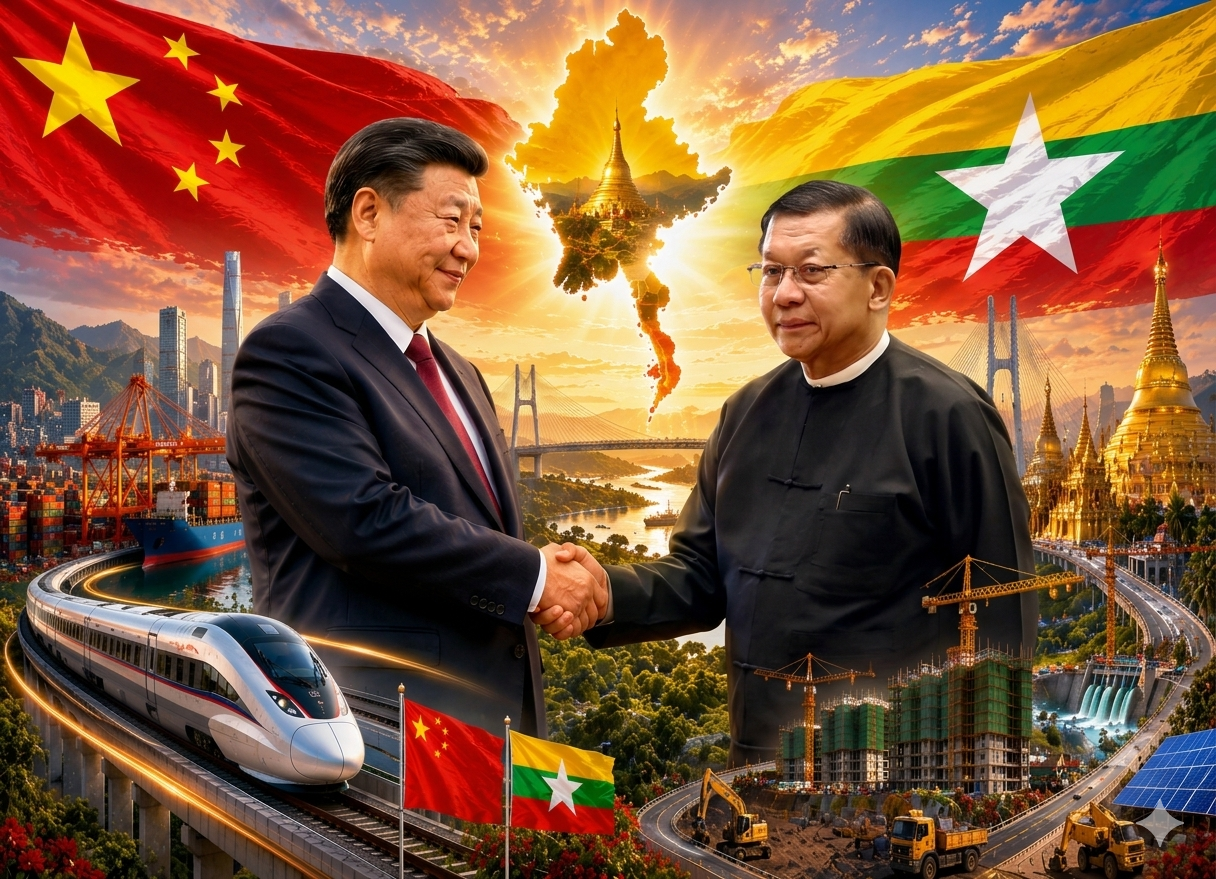
Myanmar President U Min Aung Hlaing seen meeting with Chinese President Xi Jinping.*
Military and political analysts point out that Myanmar is situated in a location as vital as a lifeline for China in terms of geopolitics, economics, and strategic security. As global dynamics shift and competition among superpowers intensifies, Myanmar's importance to China continues to escalate.
While all of China's political fluctuations and movements indirectly impact Myanmar, Dr. M Kawn La emphasized to CNI News that Myanmar is inevitably entangled in China’s strategic energy landscape as it competes with the United States.
"All of China’s political fluctuations and maneuvers have a trickling ripple effect on Myanmar. Following the construction of the Kyaukphyu-Kunming natural gas pipeline, they are now going to implement the Kyaukphyu Deep-Sea Port. In Myanmar, we have two excellent opportunities: the Kyaukphyu and Dawei (Special Economic Zones). They are located outside the Strait of Malacca, serving as an alternative option if a crisis occurs in the Malacca Strait. Kyaukphyu is the main alternative. However, looking at current world events, the US involvement in Bangladesh's Matarbari Deep-Sea Port is creating indirect pressure on Myanmar’s Kyaukphyu Deep-Sea Port. Therefore, Myanmar is automatically locked into China's energy security strategy. It is unavoidable. Especially in this bipolarization and competition with the US, Myanmar is inevitably involved. I believe we need to look at this broadly and manage it to achieve the best possible outcome," he said.
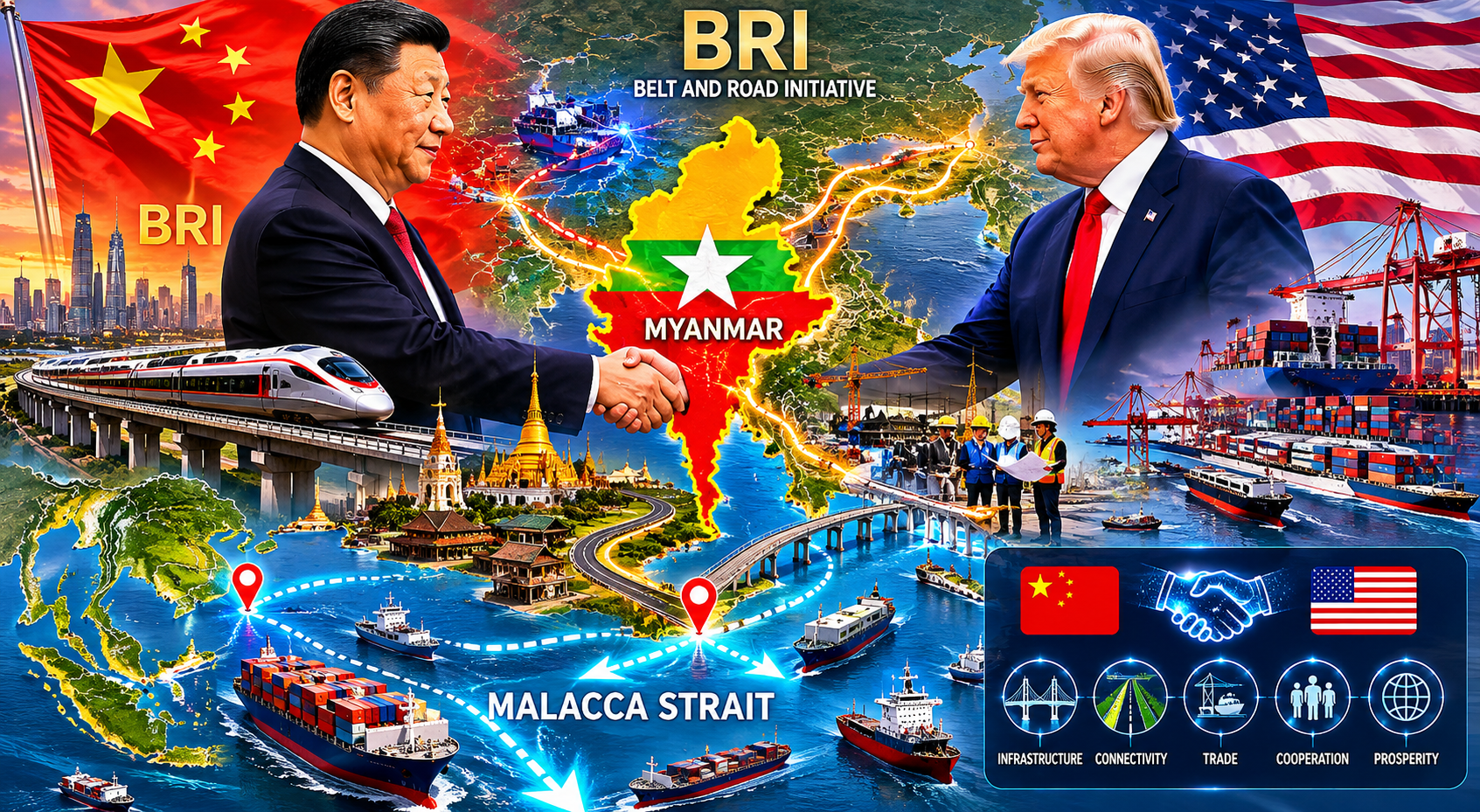
A depiction of the US-China strategic landscape and the significance of Myanmar.*
The oil and natural gas pipelines stretching from Kyaukphyu in Rakhine State off the Myanmar coast all the way to Yunnan Province in China serve as indispensable strategic infrastructure for China's energy security. Furthermore, Myanmar is a pivotal hub in China's global Belt and Road Initiative (BRI).
On the global stage, the United States is attempting to contain China through its Indo-Pacific Strategy, collaborating with allies such as India, Japan, and Australia.
Military and political analysts point out that maintaining a strong sphere of influence in Myanmar not only helps China hedge against US containment but also allows Beijing to directly counter-balance its regional rival, India, right from the frontline.