
CNI News
May 29, 2026
The Shanni (Tai Leng) Nationalities Development Party (SNDP) Chairman, Sai Htay Aung, told CNI News that a proposal will be submitted to Hluttaw (parliament) to officially recognize the Shanni people as an ethnic group in order to attain a Shanni Self-Administered Zone.
During the former President U Thein Sein's administration, the Mongwun ethnic community in the Tarmoenye area of Kutkai, northern Shan State—previously widely known as Mongwun (Chinese)—was granted official documentation legally reclassifying them as Mongwun (Bamar).
Currently, Shanni is not included among the 135 officially recognized ethnic groups in Myanmar. Therefore, to obtain a self-administered zone, it is necessary to recognize "Shanni" as an official ethnic name. Among the 135 ethnic groups, they are recognized as "Tai Leng" or "Tai Lyan." "Tai Leng-Tai Lyan" means Tai (Shan) - Leng/Lyan (Red), which directly translates to "Shanni" (Red Shan) in the Burmese language.
Under Section 6 and Section 8 of the 1982 Citizenship Law, the state government holds the authority to either recognize or revoke the official designations of ethnic groups.
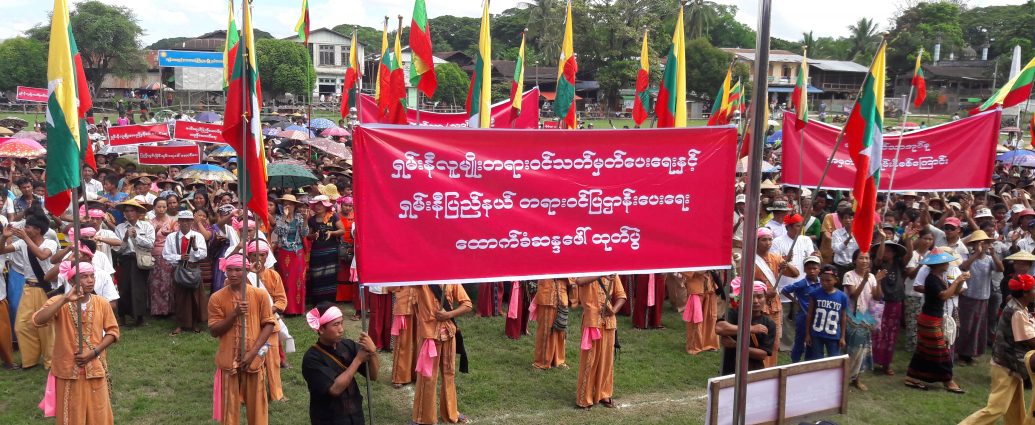
Shanni people protesting to demand official recognition.
Consequently, to bring about a Shanni Self-Administered Zone, a proposal to officially obtain the Shanni name will be submitted to the parliament, Sai Htay Aung, Chairman of the Shanni (Tai Leng) Nationalities Development Party, told CNI News.
He stated: "When the 2008 Constitution was being drafted, there was a principle laid down by the National Convention known as the '104-point principle.' According to that principle, to claim self-administration, an ethnic population must exceed 50 percent in a single township. If there are two contiguous townships meeting this criteria, they have the right to submit a proposal to demand a self-administered zone. In accordance with that convention principle, the Naga, Kokang, Wa, Pa-O, Palaung, and Danu peoples obtained their self-administered zones. The difference between them and us is that the Shanni are not yet registered as an official ethnic group. The people exist, but the name is not on the official list. When trying to get registered, some want it to be 'Tai Lyan,' some prefer 'Tai Leng,' some want 'Shanni,' and others prefer 'Tai Lyan.' Because of these differing views, our main task is to choose a name that can register the largest possible population list and submit it to the parliament. If the parliament approves it, our next step will be to analyze which townships have our highest population densities and demand self-administered zones for those areas. Our party has decided to submit the name 'Shanni,' but we will consult with our people again on this."
In 2023, the Shanni National Council (SNNC) was formed to establish a state or a self-administered zone for the Shanni ethnic people.
Furthermore, the Shanni Nationalities Army (SNA) is actively engaged in an armed movement in Kachin State and the upper Sagaing Region to achieve self-determination and self-administration for the Shanni people.
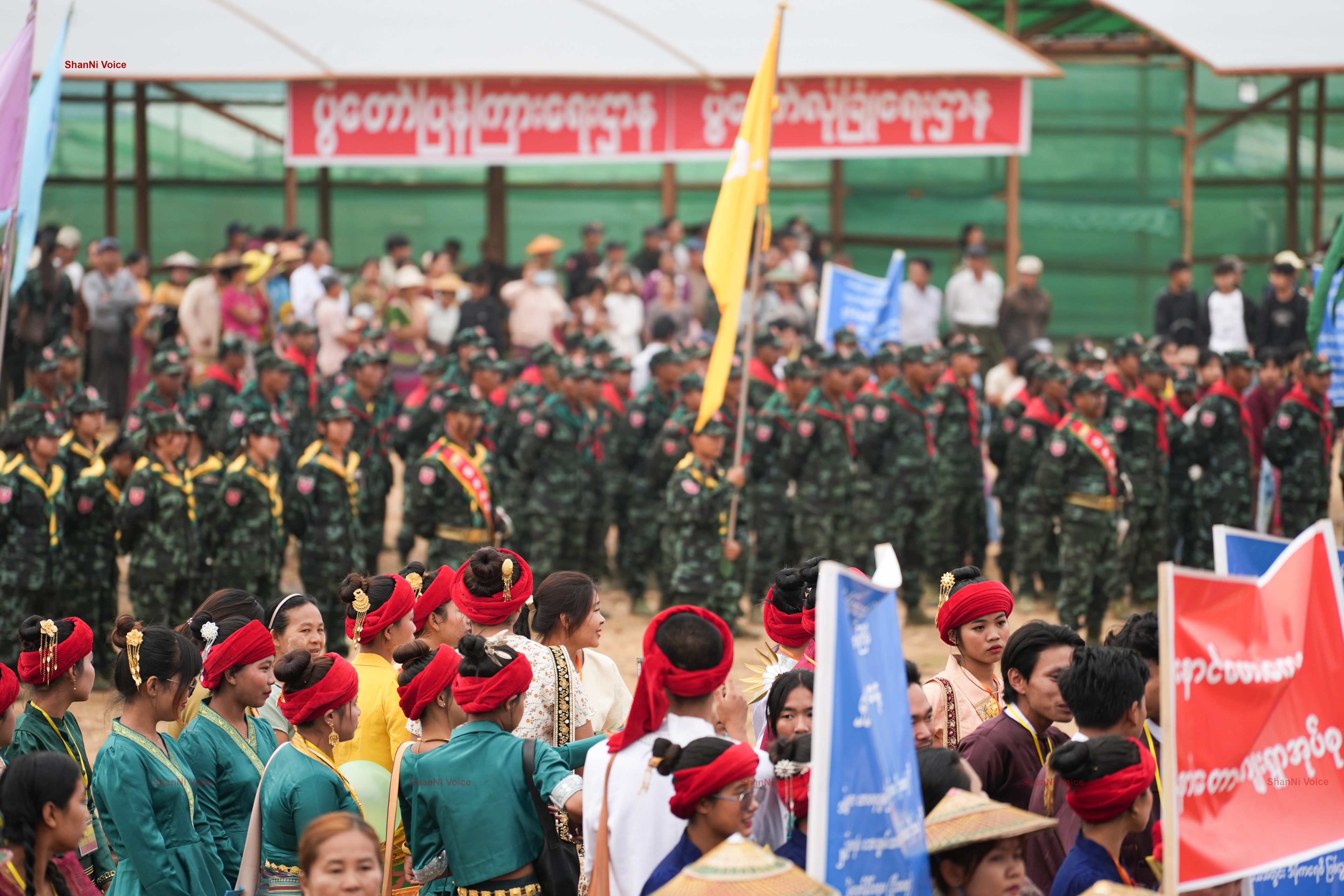
The Shanni Nationalities Army (SNA) seen alongside the Shanni public.
Based on current population figures, Homalin and Banmauk townships in the Sagaing Region could potentially form a Shanni Self-Administered Zone, Chairman Sai Htay Aung told CNI News.
He added: "According to the current population ratio, over 80 percent of the population in Homalin Township is Shan. We currently have to operate under the existing 'Shan' registration. There, the Shan population is over 80 percent. Additionally, in Banmauk Township, it is over 68 percent. There are no other Shan groups there; it is entirely our Shanni people. If the Shanni name is successfully registered, these are the first two townships in that region that can be acquired, as they meet the criteria set for designation. Therefore, if we can establish our name in the immigration registry, our people will be able to demand the rights we are entitled to."
The Shanni people are demanding the creation of a Shanni State by combining areas they historically occupied, which include Myitkyina, Mohnyin, Mogaung, Bhamo, Hkamti, Homalin, Tamu, and Kalay districts.
However, since these areas are currently integrated into Kachin State and Sagaing Region, and because the likelihood of acceptance by both the government and the Kachin Independence Army (KIA) is weak, the Shanni people's territorial demands are bound to face significant challenges.
Therefore, political analysts point out that it is vital for the Shanni political parties, armed groups, and the public to be united and speak with a single voice in their demands.