
CNI News
May 26, 2026
Given the current situation in Myanmar, the country must exercise caution regarding all regions connected to China and India, the two superpowers among its neighbors, said Pu Pu Htan, spokesperson for the Zomi National Party (ZNP), in an interview with CNI News.
He noted that if China exerts influence over Myanmar, India will follow suit.
Pu Pu Htan said: "Among our neighbors, China and India are the largest. I believe we must be careful with all regions connected to China and India. Their influence is terrifying. While India's influence might not be as pronounced initially, if China expands its influence, India will surely do the same. India will step in as much as China does. Therefore, we need to be cautious about the regions bordering China and India. The respective ethnic regions and the Union Government need to negotiate, reconcile, and work hand in hand to protect the country. It will only work if both sides coordinate and cooperate; one side alone cannot protect it successfully."
The regions in Myanmar that share borders with China and India include Shan, Kachin, Chin, and Rakhine States, as well as the Sagaing Region.
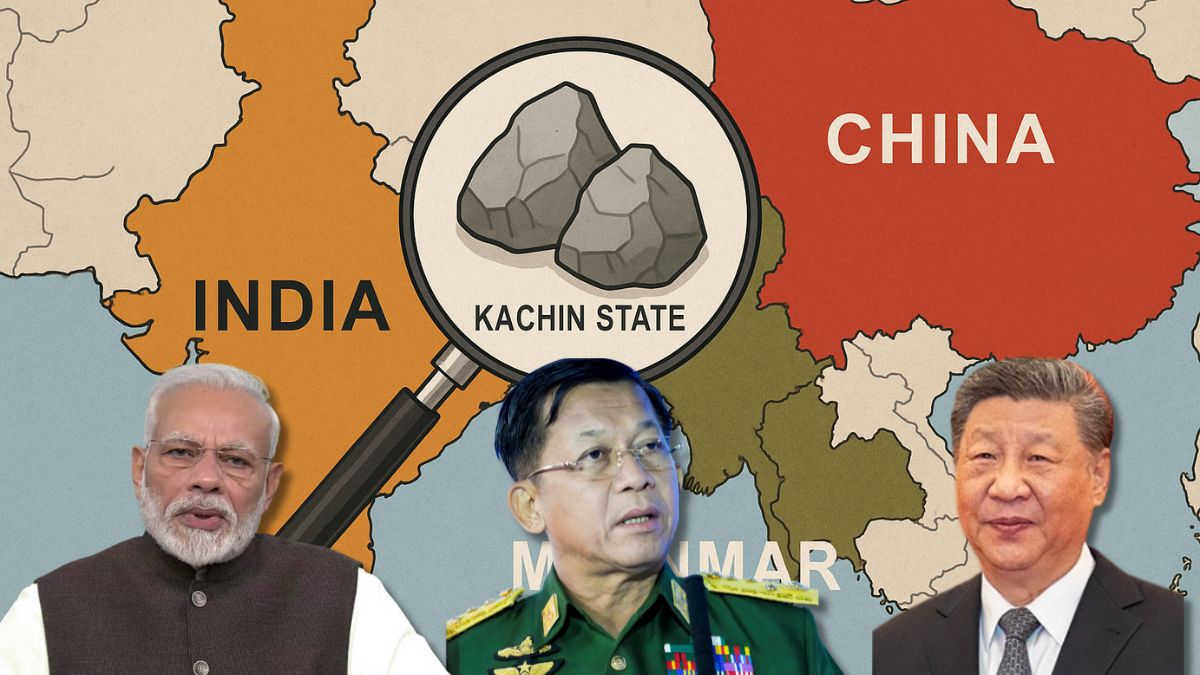
Leaders of Myanmar, India, and China.
Among these areas, the most vulnerable locations at risk of territorial encroachment and falling under foreign dominance are Buthidaung and Maungdaw in Rakhine State, and northern Shan State, political analyst Dr. M Kawn La told CNI News.
He stated: "The reason is that in our country, there are actually only two places facing the highest risk of territorial encroachment and foreign dominance: Buthidaung and Maungdaw in Rakhine State, and northern Shan State. Currently, the tension is identical in both locations. In my view, this issue is more critical than any other. Otherwise, parts of our territory will break away. While the situation in Buthidaung and Maungdaw is somewhat contained, northern Shan State appears to be breaking away rapidly. Although the reopening of trade routes and the implementation of the BRI (Belt and Road Initiative)—with the MNDAA acting somewhat like a security guard force—might be deemed beneficial for the government, our territorial integrity and national identity are deteriorating day by day. To put it bluntly, the current situation in northern Shan State is now even more critical than the Bengali issue on the other side."
Military and political analysts told CNI News that while the entire country is in turmoil, there are specific states that need to be prioritized and resolved through political, military, and diplomatic means.
Among the current ethnic armed organizations, military and political analysts consider the armed forces from Rakhine, Kachin, Shan, and Karen States to be the most powerful.
Shan State is home to various diverse ethnic groups, and according to the current landscape, it is the most complex and critical region, Dr. Aye Maung, Chairman of the Arakan Front Party (AFP), told CNI News.
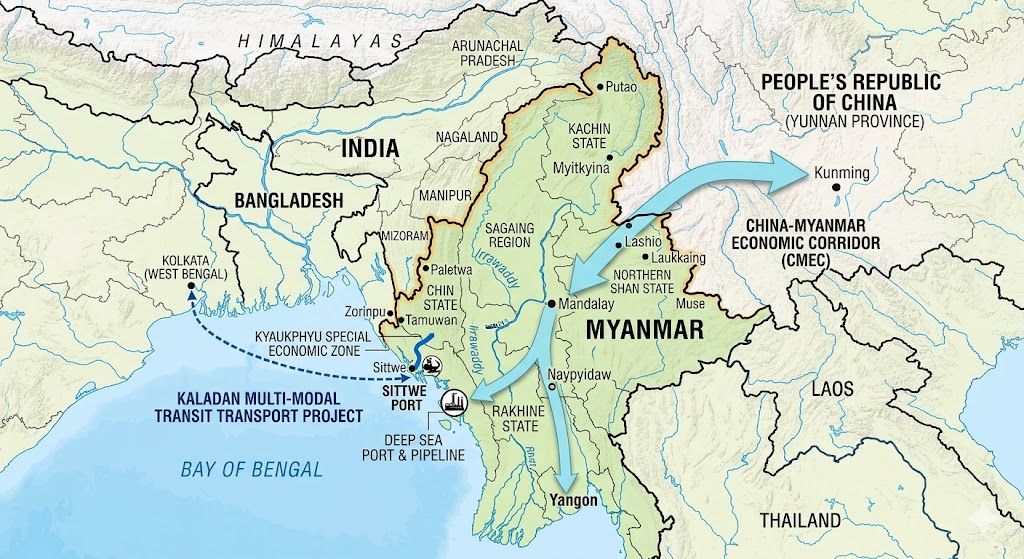
A map of Myanmar.
He explained: "Shan State is the most complex. There are diverse ethnic groups and many different political 'colors' (factions). Rakhine, however, doesn't have many colors; it is just black and white. It is not multi-colored. After Shan State, the next most complex would be Karen State, given its vastness. Mon State is also interconnected with it. There are also various PDFs. Even within the Karen forces, they are divided into multiple factions. Karen and Karenni states are also interconnected and based near Thailand. Rakhine is the most straightforward among all these territories. One side is white, the other is black. If it is a win-win situation, negotiations must take place. If it is a win-lose situation, this problem will only end when one side wins. One side must lose, and the other must win; otherwise, it won't end. If we want a win-win outcome, both sides must meet, discuss, and find a solution centered around the public. Shan State has too many colors. As for Chin State, no matter how large the population is, the armed conflict is not that severe."
Military and political analysts assess that the stances of China and India toward Myanmar are fundamentally based on their own national interests, geopolitical competition, and border stability.
They pointed out that China's primary objective is to gain access to the Indian Ocean and secure economic benefits, while India's objective is to secure its northeastern border and counter China.
Analysts further evaluate that China views Myanmar as a component of its global economic empire (the Belt and Road Initiative), whereas India views Myanmar as a vital buffer state and an indispensable neighbor for its security.
Currently, ethnic and regional armed groups including the UWSA, NDAA, MNDAA, SSPP, TNLA, AA, KIA, SNA, NSCN, CNF, and Meitei armed groups are active along the Chinese and Indian border regions.