
CNI News
May 18, 2026
Military and political analysts have pointed out that the Kokang army, known as the Myanmar National Democratic Alliance Army (MNDAA), is strategically executing plans to increase China's influence and intervention in Myanmar's military, political, economic, and border control affairs.
Starting from January 2026, the MNDAA reopened the Chinshwehaw and Kyin San Kyawt border gates under its control, allowing bilateral trade to resume, with over 300 cargo trucks passing through daily.
Furthermore, local residents report that Chinese entrepreneurs have been granted business concessions in Hsenwi, Kutkai, Namtu, and Namhkam townships, and they are forcibly purchasing agricultural land plots from locals.
Political analyst Dr. M Kawn La pointed out that the influx of Chinese nationals into northern Shan State to live and conduct business is becoming increasingly similar to the situation of Bengalis encroaching into Buthidaung, Maungdaw, and Rathedaung townships in Rakhine State.
Political analyst Dr. Aung Myo told CNI News that since China’s current policy has shifted from communism toward nationalism, this phenomenon of Chinese nationals entering and dominating Myanmar might not be the direct policy of the Chinese government, but rather a result of the system implemented by the MNDAA.
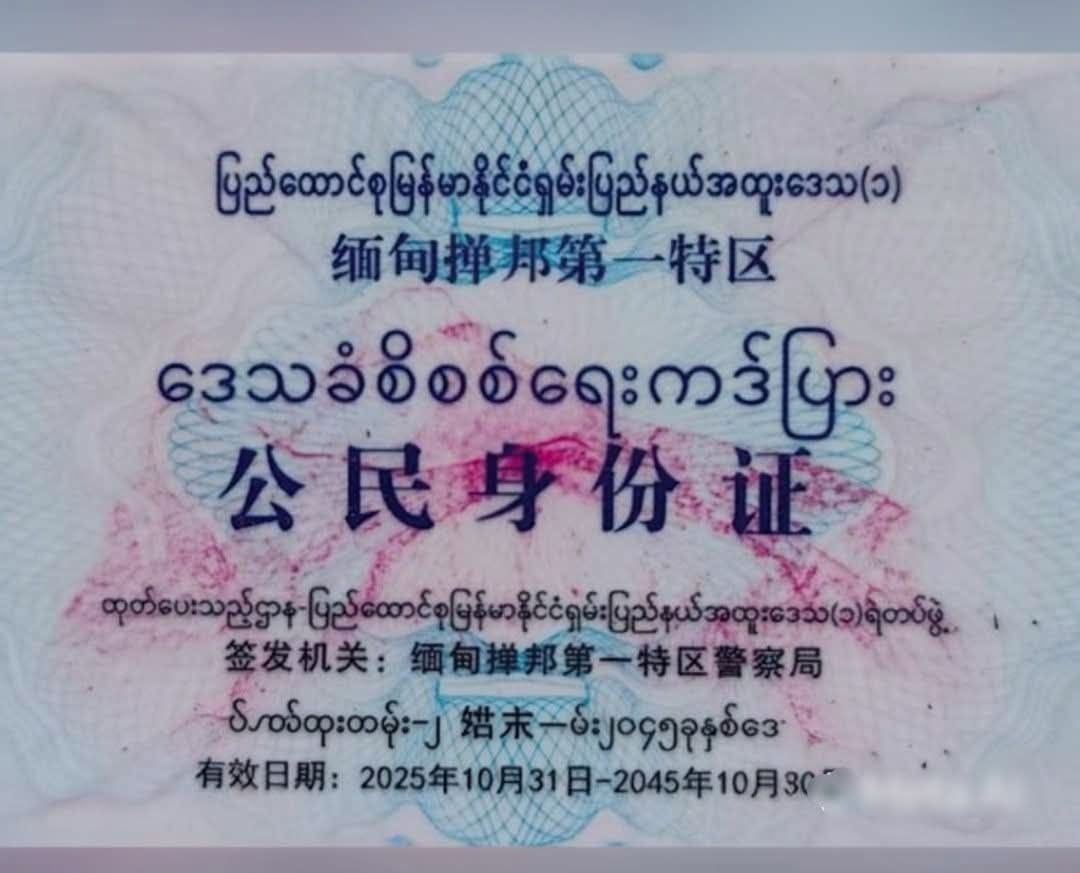
a local identification card issued by the MNDAA.
"This doesn't seem like the Chinese government's idea," Dr. Aung Myo said. "In my view, it's the MNDAA's plan. Additionally, the Chinese government needs to clearly and definitively present its policies to Myanmar officials. China crossed the border line and extended its fence into Myanmar territory. It is a minor issue; we don't pay much attention to that. Myanmar and China have already signed firm treaties regarding the border. Even if local authorities on the Chinese side covertly encroach, it's not a major issue; they will have to retreat once re-surveys are done.
However, there is one thing: if the MNDAA starts recognizing only the Chinese language, no one on this side will tolerate it. Frankly speaking, those who arrived as war refugees during the Ming Dynasty of China are now acting presumptuously toward us, which causes a great deal of resentment. Therefore, in short, we need to know the Chinese government's policies more clearly than this. The Chinese government also needs to openly declare its policy regarding this matter. We do not appreciate a flip-flop, dual-standard approach. That is our stance."
In the townships under its control, the MNDAA has been undertaking actions such as changing town entrance signs into Chinese characters, issuing national identification cards in Chinese, converting household registration lists into Chinese, and forcing the exclusive use of the Chinese Yuan (RMB) for local currency transactions.
Political analyst Dr. M Kawn La told CNI News that the Myanmar government needs to urgently address this dominance by an ethnic group from China within Myanmar territory.
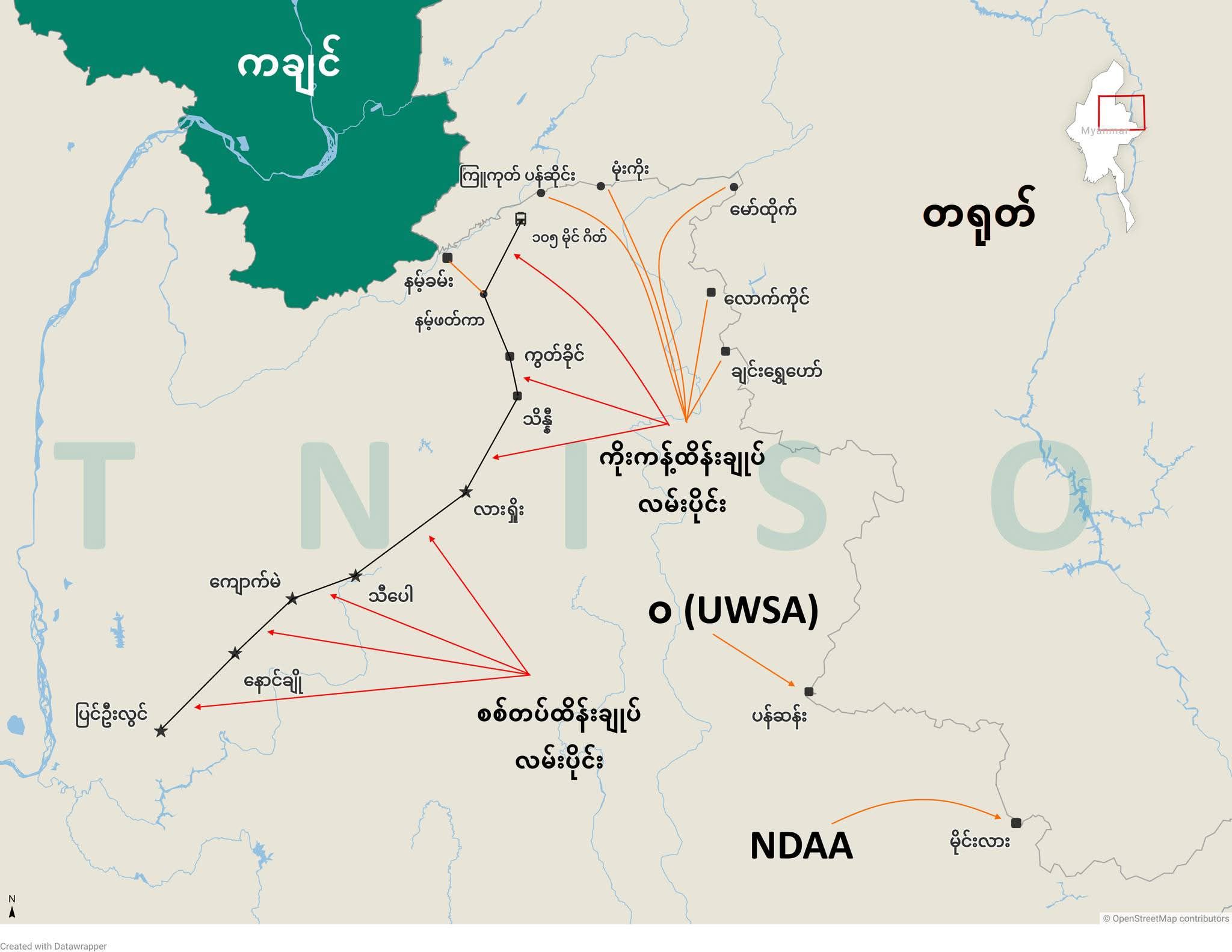
An illustration depicting the MNDAA's strategic plans to control northern Shan State.
"Their (Kokang) population does not exceed 200,000," Dr. M Kawn La said. "Under the 2008 Constitution, they were granted the Kokang Self-Administered Zone, which comprises Laukkai and Konkyan. Chinshwehaw and Kunlong are not included in it. However, the territories are contiguous. Since Chinshwehaw is the most important border trade hub after Muse, they have encroached into that area.
Demographically, it is impossible for them to win a war, control such a massive administrative territory, and cross over to the west bank of the Thanlwin (Salween) River on their own. So what is happening now? A lot of news is emerging, as everyone knows. In northern Shan State, they are bringing in construction projects and Chinese entrepreneurs. Through these entrepreneurs, Chinese laborers are being imported. By bringing in Chinese laborers, they are practicing the exact same method as the Bengalis to dominate the demographics."
To interfere in Myanmar's internal affairs, China has been applying pressure and mediating as needed by providing support to armed groups in the border regions. It is observed that China is putting more pressure particularly on the MNDAA and TNLA, which are located along the border trade routes.
Additionally, to resume railway projects that are part of China’s Belt and Road Initiative (BRI), the Myanmar military and the MNDAA have been holding coordination meetings in Lashio once a month.