
CNI Interview
May 15, 2026
The Kachin Independence Army (KIA) has been conducting liberation operations across the Northwest, linking Kachin State with Sagaing Region, Chin State, and Rakhine State.
Following over a year and three months of military operations, the Myanmar Tatmadaw regained control of towns in the border areas between Sagaing Region and Kachin State on May 6, 2026. As a result, the KIA’s liberation operations across the Northwest are now facing significant crises.
On the other hand, the Myanmar National Democratic Alliance Army (MNDAA), with Chinese support, has seized control of towns along the China-Myanmar trade route in northern Shan State and is currently preparing to take control of Namhkam.
Furthermore, Chinese nationals are entering northern Shan State, purchasing land, and making business investments. This population growth is being viewed as an expansion of Chinese influence.
CNI News contacted political analyst Dr. M Kawn La to discuss these developments.
Q: Why do you think the military is currently launching an offensive in Kachin State?
A: At this point, the Myitkyina-Mandalay highway has reopened. Areas like Nantsiung and Mohnyin are clear. Since the government has retaken Katha, frankly, the situation in Bhamo does not look good for the KIO.
The government is in a position to retake everything. From my perspective, regarding the new government, this issue is quite broad. It would be best if the new government could engage in the peace process with the KIO as effectively and quickly as possible, rather than focusing on total annihilation.
The current military offensives in Kachin State are aimed at clearing territory—specifically to cut off the supply routes to Sagaing Region and Chin State—to regain the upper hand in the war. However, while they focus there, a major weakness has emerged in northern Shan State.
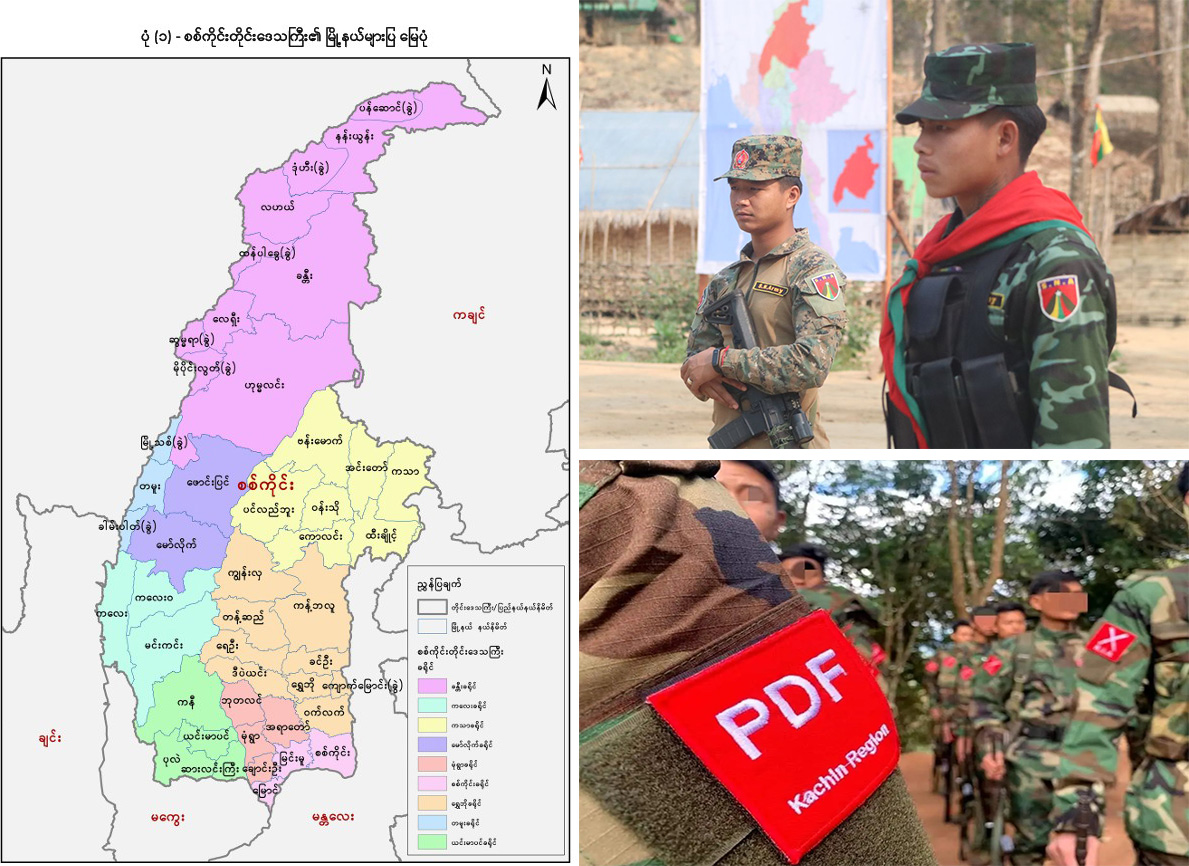
Sagaing Region, SNA and KIA/PDF joint forces
As efforts are made to open the BRI (Belt and Road Initiative) trade routes, the MNDAA is establishing administrations in territories that do not belong to them. This, along with the impact on our national identity, poses a greater danger. I believe that if peace can be made with the KIO, the critical issues in northern Shan State can be resolved more quickly. In reality, there are two areas most at risk of territorial encroachment and foreign influence: Rakhine (Buthidaung/Maungdaw) and northern Shan State.
The tension in both is currently equal and more critical than other issues. If not controlled in time, we will lose those territories. While Buthidaung and Maungdaw are still being held, northern Shan State seems to be breaking away rapidly. While opening the BRI route and having the MNDAA act as a "security guard" might seem beneficial to the government, our territorial integrity and national identity are deteriorating daily. Frankly, the situation in northern Shan State is now more critical than the Bengali issue in the west.
To prevent this, I believe we must achieve peace with the Kachin, SSPP, Shan, and other EAO (Ethnic Armed Organization) troops in northern Shan State to handle this effectively. The Kachin offensive has already cleared the Myitkyina-Mandalay route. Rather than fighting to the finish, I see the priority as implementing internal unity as quickly as possible to protect against foreign encroachment and the loss of territory.
Q: What is the likely strategic pattern behind the military launching so many offensives right now?
A: My view is that the government forces are "cutting out" the connections between revolutionary forces in the West and Northwest—specifically the Sagaing-Magway links. For example, they are launching offensives toward the Kalay/Kalaywa and Falam routes. In Kachin State, they are reopening trade routes. Regardless of which government is in power, these are tasks they would prioritize.
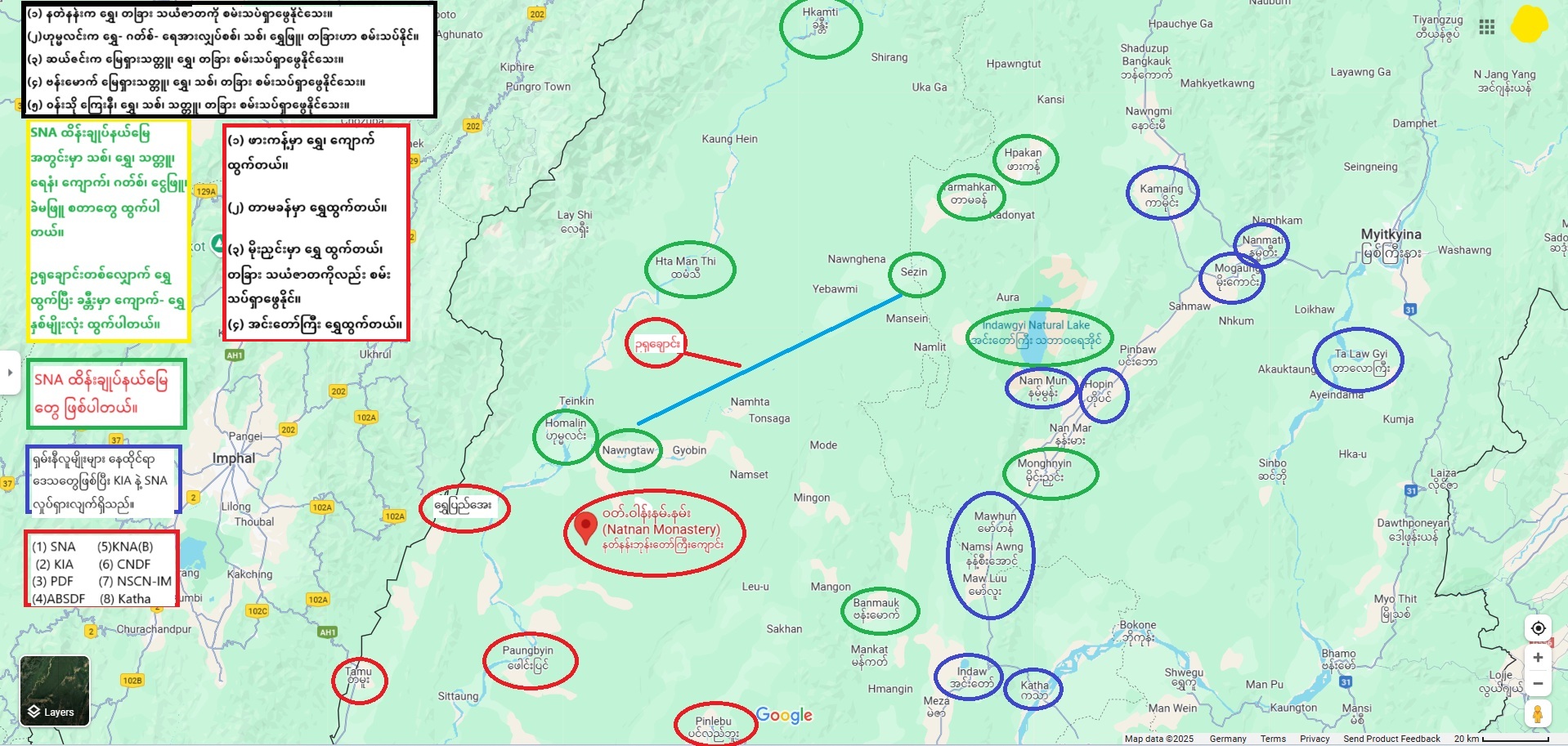
Armed groups and territories in Sagaing Region
The government sees the connectivity between the Chin, Naga, Kachin, and Rakhine—which General Gun Maw mentioned back in March—as a major threat. While the ethnic liberation groups have their own legitimate goals, the government, from a state perspective, is launching rapid offensives out of fear that the country will disintegrate. Even while they cut these lines, we are still losing territory elsewhere.
The Kokang (MNDAA) issue is the most critical; everything else pales in comparison. The government is offensive-oriented to open the India trade route through the Northwest (Chin/Naga) and to sever the supply lines for Sagaing and Magway. I see this as the military simply doing its job.
Q: Now that the military has retaken towns on the border of Kachin and Sagaing, what changes can we expect?
A: The battle for Tagaung was decisive. After Tagaung, they reached Htigyaing, which houses the Chinese-owned Tagaung Nickel Factory. Once they cross to the west of the Ayeyarwady River, they begin operations in the "Ka-Thone-Lone" (K3) region.
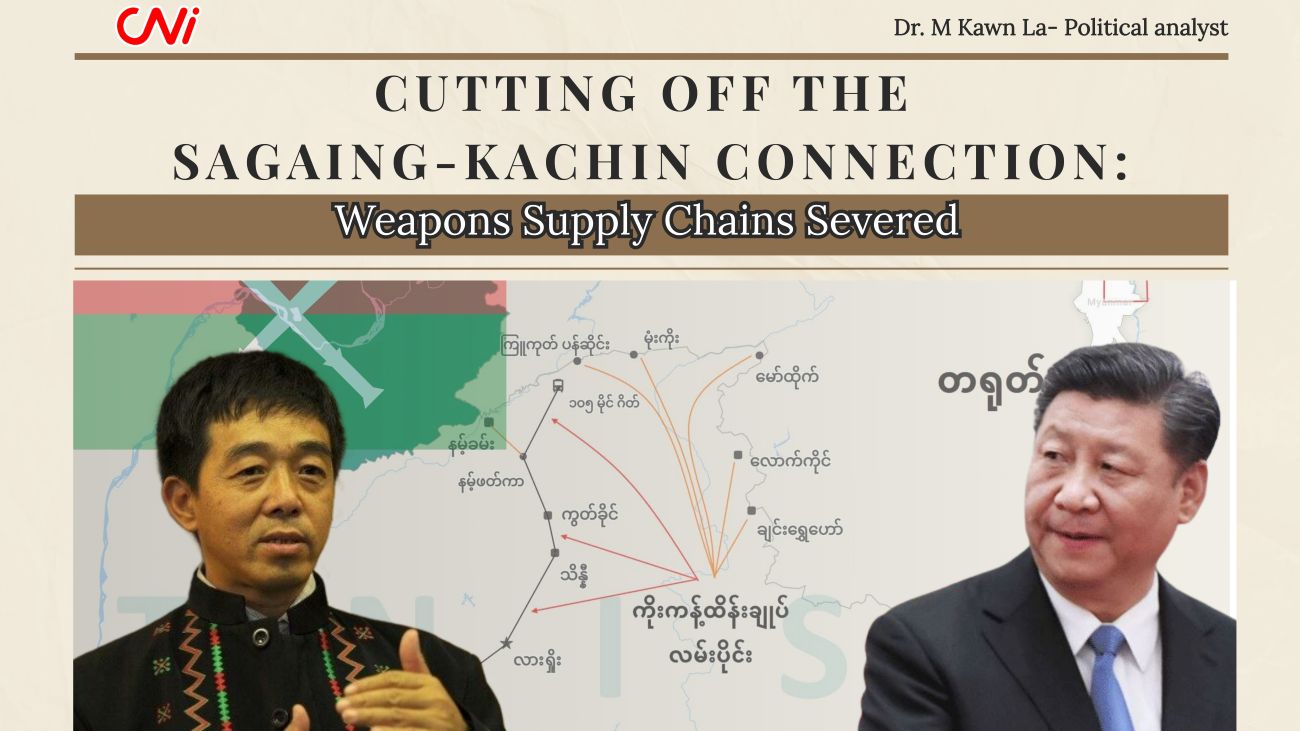
Cutting the connection between Sagaing and Kachin severs the weapons supply lines for the Sagaing-Magway heartland and the CNF-dominated areas in Chin State. This is highly strategic. The weapons supply for Sagaing, Chin, and Magway doesn't come much from the AA; it primarily comes from the KIO and their weapons factories. For the government, this operation is essential. It is a "must-do" to regain control over Sagaing and Magway. I suspect that while they consolidate control there, they might implement a peace process as early as next month.
Q: We see increasing Chinese presence in northern Shan State. How should the government prevent this, and what happens if they fail?
A: Although the MNDAA carries the name, their actual population is only about 150,000 to 200,000. After the previous Kokang wars and the departure of Peng Jiasheng, the Bai Suocheng group cooperated with the Myanmar government. Now, Peng Daxun’s group has retaken the region. Their demographics are key—they don't have enough people to govern such a vast area or cross to the west bank of the Salween River.
However, reports show that construction businesses and Chinese entrepreneurs are being brought into northern Shan State, followed by Chinese workers. They are attempting to dominate via population, much like the Bengali situation. Within the Kokang EAO, we hear there are fewer Kokang soldiers than local Kachin, Shan, and even Bamar laborers from central Myanmar who serve as mercenaries for the salary.
They are preparing to build up troop strength to maintain territory. They have already taken Kunlong and crossed the bridge to the west of the Salween. They have reached Hsenwi and control up to Kutkai. The worst part isn't just the occupation, but the establishment of an administration that enforces a Chinese national identity—teaching Chinese, using Chinese signage, and dominating demographically. This is a grave danger to our country.
To stop this, the local people and ethnic EAOs are vital. There needs to be a rapid peace agreement with the KIO. Both sides need this. While the KIO has its political aspirations, we need unity among ourselves as fellow citizens of the Union. What we are seeing now is akin to a foreign invasion. These issues stemmed from the 2021 political conflict, but now foreign interference has become more significant than our internal fighting for political status.
To protect the country, the peace process must be fast-tracked. The local Kachin and Shan in northern Shan State are the key. We need to make peace with the SSPP/SSA and the Kachin to contain the MNDAA’s influence. Once the battles in the Northwest and West are settled, we must set aside grudges and unite through agreement. This is the first priority. We are facing an encroachment by a foreign-backed ethnic group acting underhandedly between China and Myanmar. I believe the authorities are aware and planning for this. I appeal to both sides to look at this danger, be magnanimous, and resolve our internal differences.
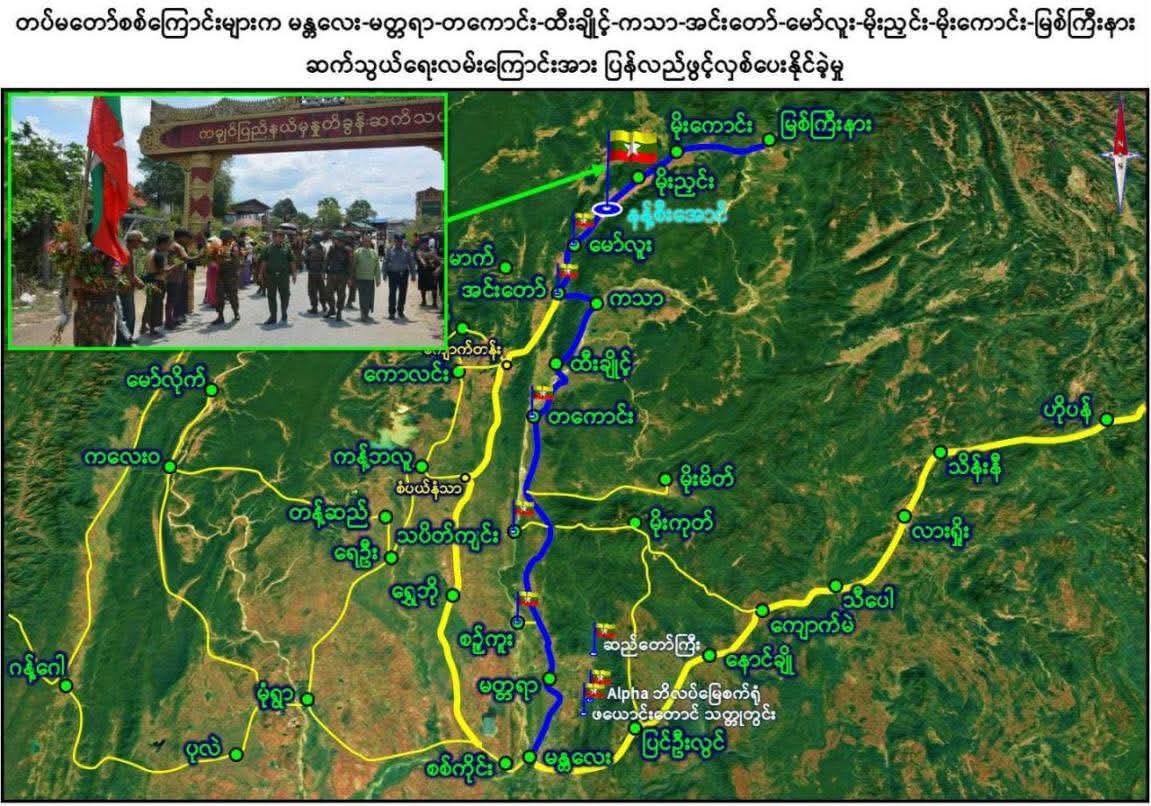
The Tatmadaw gained control over Mandalay-Indaw-Myitkyina Route on 6 May 2026 Leader of the MNDAA
Q: How should the remaining ethnic armed groups in Shan State cooperate to solve the current situation?
A: Take Kutkai, for example. Areas like Kutkai-Muse, Kyukoke (Pansai) — which is currently seized by the MNDAA — Mong Ko, and Mong Paw are all Kachin territories. The population there is predominantly Kachin; they are entirely Kachin villages. Furthermore, Kachin Independence Army (KIA) Brigades 4, 6, and 10 are stationed in those areas. If we can establish a mutual understanding among ourselves, we need to solve this issue using the strength of the local population. It needs to be handled both politically and militarily.
The reason is that, demographically, a group with a population of less than 200,000 is expanding its territory to this extent acting as a proxy. If we allow ourselves to be encroached upon, I see it as our own weakness. This can still be managed if handled politically and militarily. If left as is, it will become much more difficult in the future. From what I know, the Kokang (MNDAA) are currently building up their military strength—expanding both personnel and weaponry. Crucially, they are bringing in Chinese people from the China side to increase their Chinese population. We must take serious action on this matter.
Specifically, the Ministries of Immigration and Home Affairs need to enforce strict measures once political discussions are held. They must be kept in their own territory east of the Salween River, beyond Kunlong. To do this, we need to coordinate effectively and settle matters with China. If we are busy fighting among ourselves, we won't be able to negotiate with China, and the MNDAA will take advantage of the gap. I see this as a very dangerous situation.
Q: On the other hand, a new government has emerged in Bangladesh, and the relationship between the new Bangladesh government and China seems to be improving. How do you analyze the situation in Rakhine State within this context?
A: To be honest, it depends on how the U.S. and the Western bloc implement their "China Containment Policy." One needs to know the history. Regarding Myanmar, under the China Containment Policy, they (the West) persistently create a political problem to spark conflict, indirectly leading to international opposition and sanctions. In Myanmar, the place where they can implement this is the western region—specifically the Bengali issue in Buthidaung and Maungdaw.
Under the China Containment Policy, they plan to establish a separate administrative zone for Bengalis and proceed politically from there. This method is intended to disrupt China's Belt and Road Initiative (BRI) and China's routes through Myanmar. Therefore, the neighboring country to the west, Bangladesh, is crucial. In Bangladesh, there was a government change where Sheikh Hasina was ousted and Yunus’s interim government was installed.
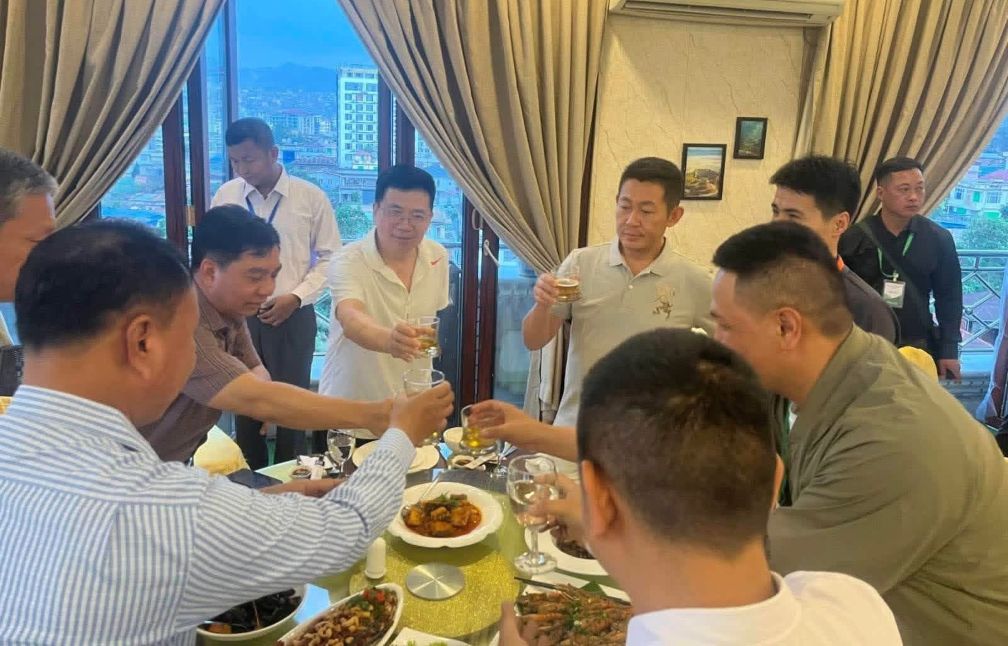
Chinese Special Envoy Deng Xijun, Myanmar Tatmadaw Representative Lt-Gen Ko Ko Oo and MNDAA delegates
To speak frankly, when the Western bloc wants to manipulate a country, they have specific people they have "groomed." By installing Yunus in Bangladesh, they prepared to implement the China Containment Policy on a large scale through the Bangladesh gateway. I believe China is trying very hard to dismantle that.
If we look at the Bangladesh elections, there are three major parties: the BNP, Jamaat-e-Islami, and the ousted Sheikh Hasina’s Awami League. However, in the election held by the Yunus government, the main contest was between the extremist Jamaat-e-Islami and the now-victorious BNP. To be blunt, I think China facilitated the BNP’s victory. For China to protect itself, the ruling government in a neighboring country that could cause disruption must be "their person." China’s maneuvers are subtle.
While the west of Myanmar is one gateway, another area for disruption is the international entry point in southern Myanmar—the Tanintharyi Region. This is the territory controlled by KNU Brigade 4. Now, FBI agents and SCSS (Security Coordination) have arrived in the Tanintharyi region near the Thai border regarding "Jia Piang" (online scam) cases.
The China Containment Policy is actually being implemented in the west and south of Myanmar. These are the two points where the West plays its game. That is why the connection between the ruling BNP in Bangladesh and China has a very long history. It requires looking back quite far. This is how China operates. Every superpower in the world acts this way, working for their own interests.
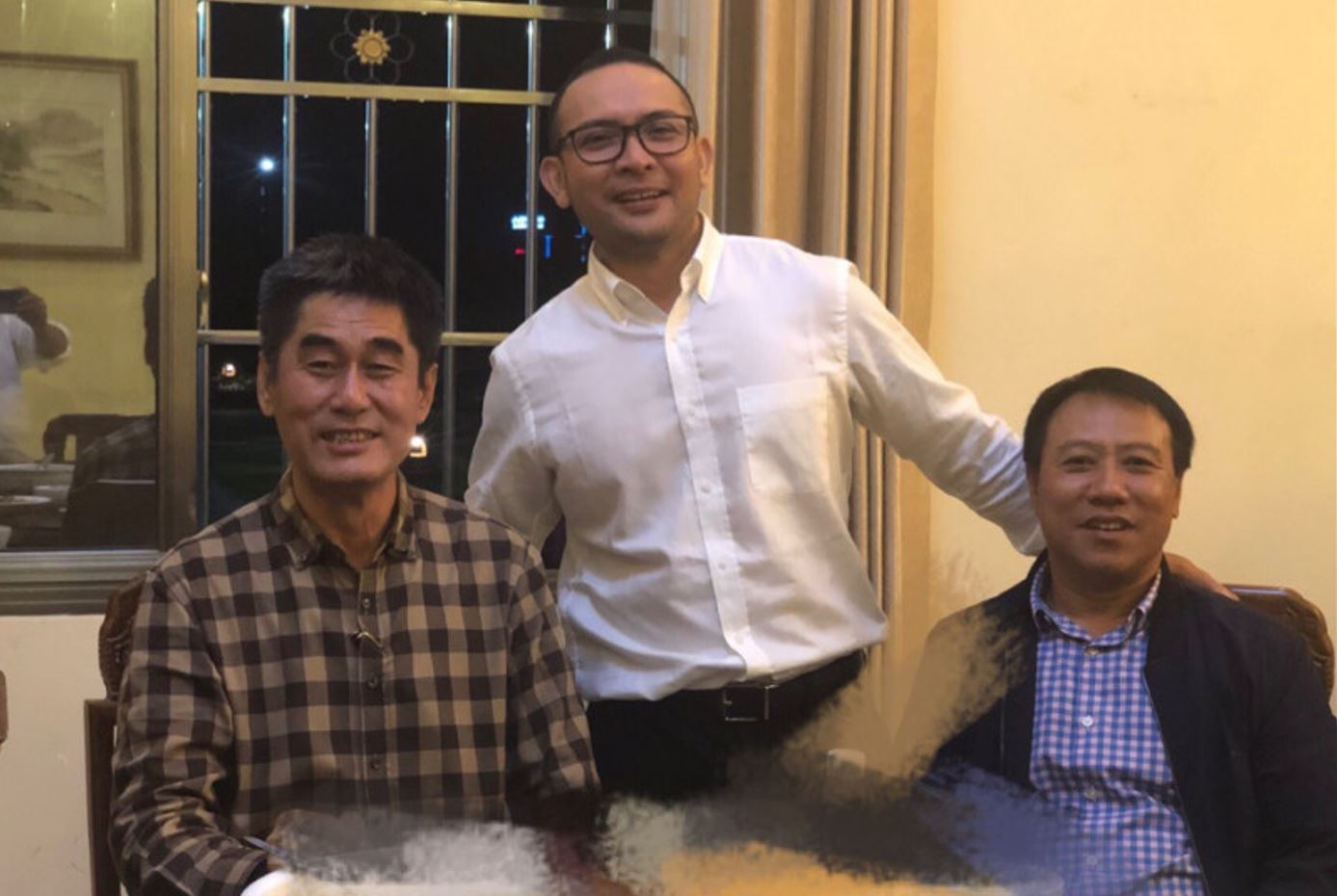
Leaders of AA, MNDAA and TNLA
Q: In an interview with a foreign news agency, AA (Arakan Army) chief Twan Mrat Naing seemed to favor peace and dialogue. However, he mentioned that the military's demands are unrealistic and impractical. What do both sides need to concede to achieve peace between the military and the AA?
A: I believe the key is understanding who sent the AA to Rakhine to act as a "buffer." If you can guess who is orchestrating behind the scenes, the issue becomes clear. Many assume the AA was moved by the Western bloc, but that is not true. If you look at the AA’s roots, although the KIO initiated it, their actual supply chain for weapons and personnel comes from the "Wa" (UWSA).
Additionally, before moving to Rakhine, AA leaders lived in Pangsang. They left Laiza in Kachin State long ago. They moved since the formation of the Northern Alliance. If you look at this history, it's clear who is behind the AA.
One needs to grasp China’s strategic political thinking. Since 2021, China has a specific vision. In areas connected to its borders—like Northern Shan and Rakhine in the west—China prefers control by EAOs under its influence rather than a strong national government. It seems they want to move toward an "automated (autonomous) region" plan for the future. This is my assessment.
For example, in Northern Shan, the arrangement is clear: from Eastern Shan State up to Kengtung, they have Mong La, Wa, and Kokang. They also have the TNLA in Namkham. They perform bargaining and trade-offs. They intentionally keep EAOs there. This is the "fire in one hand, water in the other" policy. In Rakhine, there is the massive Bengali issue. Everyone knows who is behind it. To protect against this, a central Union government faces difficulties due to UN regulations and international rules. So, if China wants to protect its interests quickly, who would they send? That thought is the answer.
So, to act as a buffer against Bengali groups, RSO, and ARSA, and to block the China Containment Policy coming from the Bangladesh side, China must have an EAO there. So, it’s clear who is behind them. Therefore, I believe the peace process will follow the pattern China wants, similar to Northern Shan. The current (Myanmar) government will try to spread its sovereignty as much as possible, while the other side will demand as much self-autonomy as possible.
In my opinion, the Rakhine situation isn't as urgent as Northern Shan right now. Because on one side, it's "China’s person," and on the other side, it's also "China’s person." To be honest, there is still some time to resolve the Rakhine issue politically. Northern Shan, however, is out of time. So while Rakhine is important, it is not an emergency like Northern Shan.
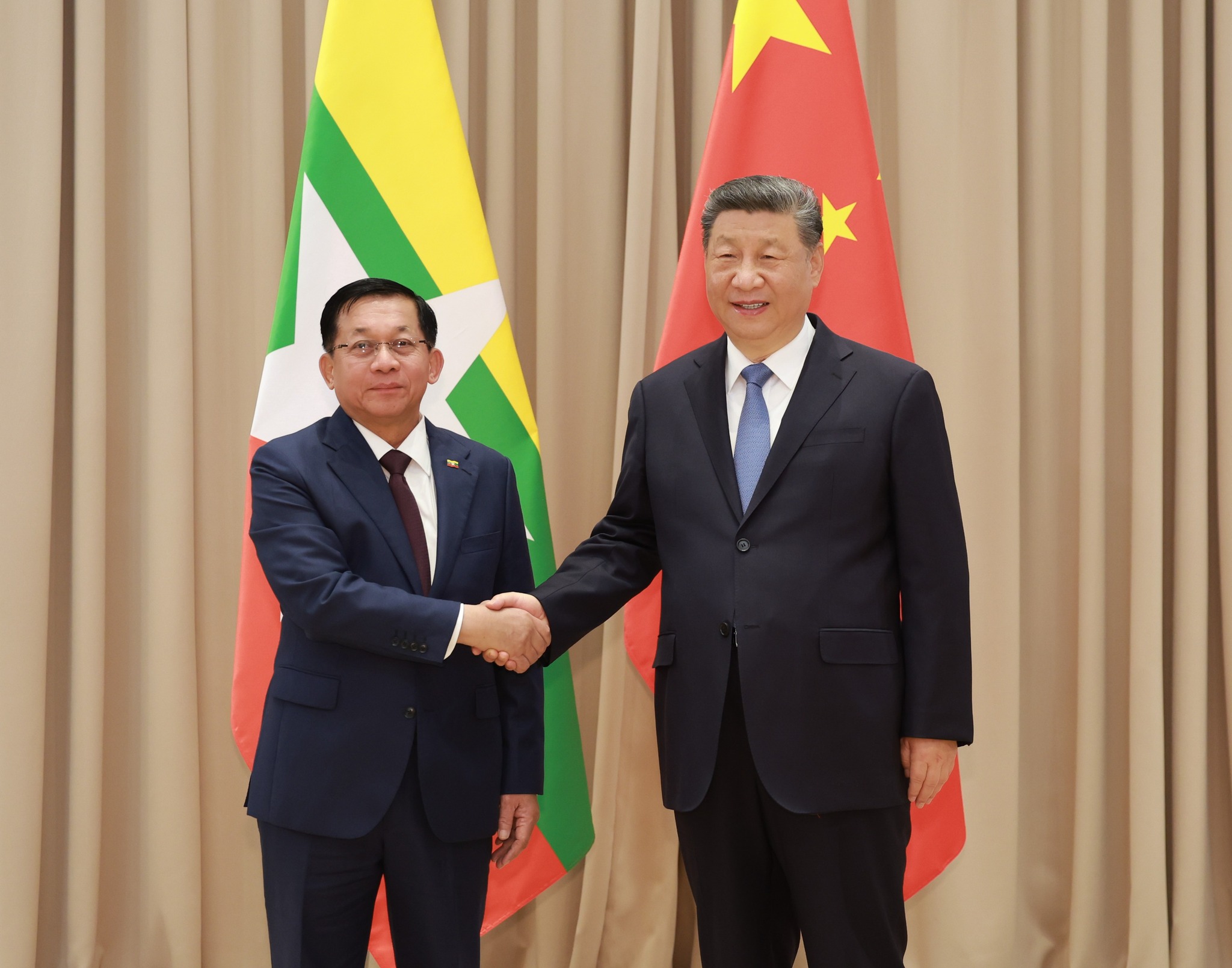
Chinese President Xi Jinping and Myanmar President U Min Aung Hlaing
Q: Looking at the overall current landscape, what will happen if foreign invasions cannot be prevented? How should everyone unite to stop this?
A: Some who understand geopolitics use a correct analogy: we must look at Tibet. What happened to Tibet? Northern Shan could become like Tibet. This is very worrying for us. Tibet was peaceful until 1943, before Mao Zedong and the Communist Party took power. It was a separate, independent country. But as a religious state, it couldn't perform effectively, and Mao invaded Tibet in 1950. They seized Tibet within five years.
They seized it because, geopolitically, to reach Central Asia, one must go through Tibet. Tibet is also crucial because it is the source of many rivers—the Mekong-Lancang, the Yangtze, and others. Our Ayeyarwady also originates from the Tibetan plateau. That is where the water comes from. To control water resources and to secure Central Asia (Xinjiang, etc.), seizing the buffer of Tibet was a must. China followed that path. That was the geopolitical fate of Tibet.
China is also wary of the Malacca Strait control, and there were recent reports about Indonesia's actions. Now, in the South and East China Seas, Japan is awakening. Top Japanese officials visited Vietnam and the Philippines recently. The Japanese Prime Minister went on a friendship tour, held military coordination with the Philippines, and is selling destroyers to them.
Japanese defense is starting to establish a "Strategic Ring." China wants to seize Taiwan because it is like its "breathing hole." They seized Tibet for resources. For Myanmar, we are China’s trade route. If China’s "breathing holes" are closed, the only opening to the Bay of Bengal is through Myanmar. Thus, our fate is similar to Tibet's. We must be careful. We cannot say it's impossible to be seized in this era. There are many ways to seize a country—through economic takeover or by creating a government they want through population occupation and elections.
We cannot rule out the use of force to take sovereignty either. If a global crisis occurs, it could happen. We must consider these things in advance. Every citizen needs to have this vision. Political institutions need to know this. It is already getting late. I believe we must solve this quickly.
Q: Is there anything else you would like to add?
A: I want to appeal to both the EAOs and the new government: nothing is more important than the external threat. I want the peace process to be implemented quickly through political compromise. I urge both sides to look at this danger and protect the country as quickly as possible.
If we remember the 1951 Kuomintang (KMT) invasion—back then, we had to fight the KMT invasion while still suppressing the BCP (Burma Communist Party). History is repeating itself. This is just like the KMT invasion. However, back then it was an overflow from the Chinese Civil War, so the UN could intervene. Now, it’s not easy for the UN to act. They (the threat) are entering under the "shadow" of trade routes. They have cover. It is very difficult for the international community to handle.
This time, it is worse than the 1951-52 KMT invasion. This is something that must be clearly understood.