
CNI News
May 5, 2026
Political and economic analysts are currently weighing in on how China’s role in Myanmar's affairs might evolve under the new government led by President U Min Aung Hlaing.
The bilateral relationship between China and Myanmar has reached its 75th anniversary, and the government led by President U Min Aung Hlaing has welcomed China's stance toward Myanmar. Military and political observers point out that China has become deeply involved and influential in Myanmar’s political and military landscape following the changes that occurred after February 1, 2021.
Dr. Hla Kyaw Zaw, an observer of China-Myanmar affairs, told CNI News that the Chinese government is likely to aim for the completion of its major projects in Myanmar—the Belt and Road Initiative (BRI) and the Kyaukphyu Deep Sea Port project—within the next five years.
"In China's economic plan for the next five years, priority is given to Yunnan and Guizhou provinces," she said. "Since these provinces lag behind others in terms of development, they will be given special priority. The unique characteristic of Yunnan and Guizhou is that they are landlocked; they have no sea outlet. Their only maritime exit will be the Indian Ocean gateway created through Myanmar via the Kyaukphyu Deep Sea Port. This is crucial. Only with this outlet can the economies of Guizhou and Yunnan prosper. China's projects in Myanmar under the BRI are quite delayed. In ASEAN, China’s work in Laos, Thailand, and Vietnam is already well-advanced."
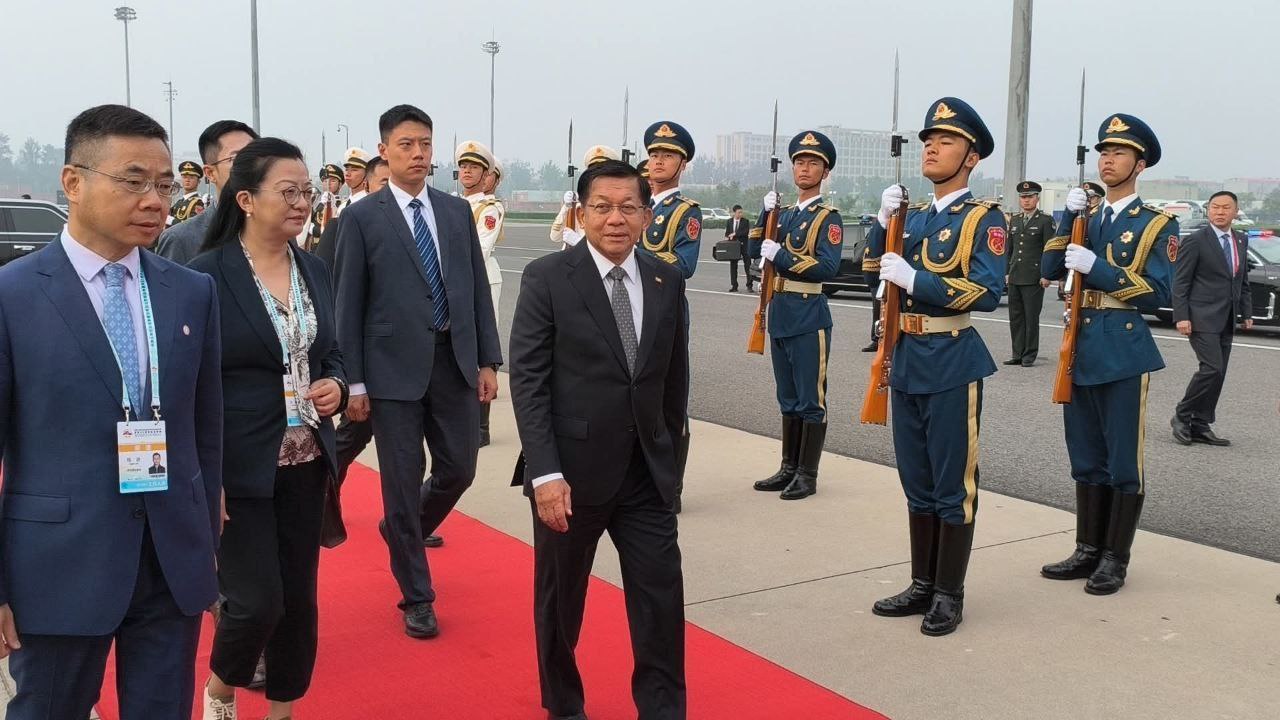
President U Min Aung Hlaing seen when he arrived in China
She continued, "Therefore, I think they will make significant efforts regarding projects in Myanmar. I expect them to initiate talks regarding the stability and peace of the regions along those routes. To put it plainly, China will become more deeply involved in Myanmar's affairs moving forward. The primary strategy in Myanmar is the route to the Kyaukphyu Deep Sea Port. The construction of the railway and highway from Kunming through Mandalay to Kyaukphyu is the main goal. Other projects will gradually increase to support its success. We already see them working on ceasefires and similar efforts; I think it will lean further in that direction. China's logic is this: they calculate that if the economy improves for the people, no one will engage in armed revolution. They believe focusing on development for the public will work. They likely estimate that if this route is built, job opportunities will flourish along the way, improving people's livelihoods and thus reducing armed conflict. Since it's a five-year plan, there is a likelihood they will aim to finish this route between 2026 and 2030."
The Kyaukphyu Deep Sea Port project is strategically vital for China’s modern Silk Road (BRI) and is also intended to serve as a gateway to the Indian Ocean for Myanmar. Additionally, projects such as the Muse-Mandalay trade route, a railway line, and the Shwe Li-Mandalay-Kyaukphyu expressway exist to facilitate smooth bilateral border trade.
However, these projects face challenges due to regional instability and internal armed conflicts. Economic analyst U Htay Aung Kyi told CNI News that China might intensify efforts to ensure stability along trade routes through its influence over ethnic armed groups, and that Myanmar needs to navigate skillfully between China and the United States.
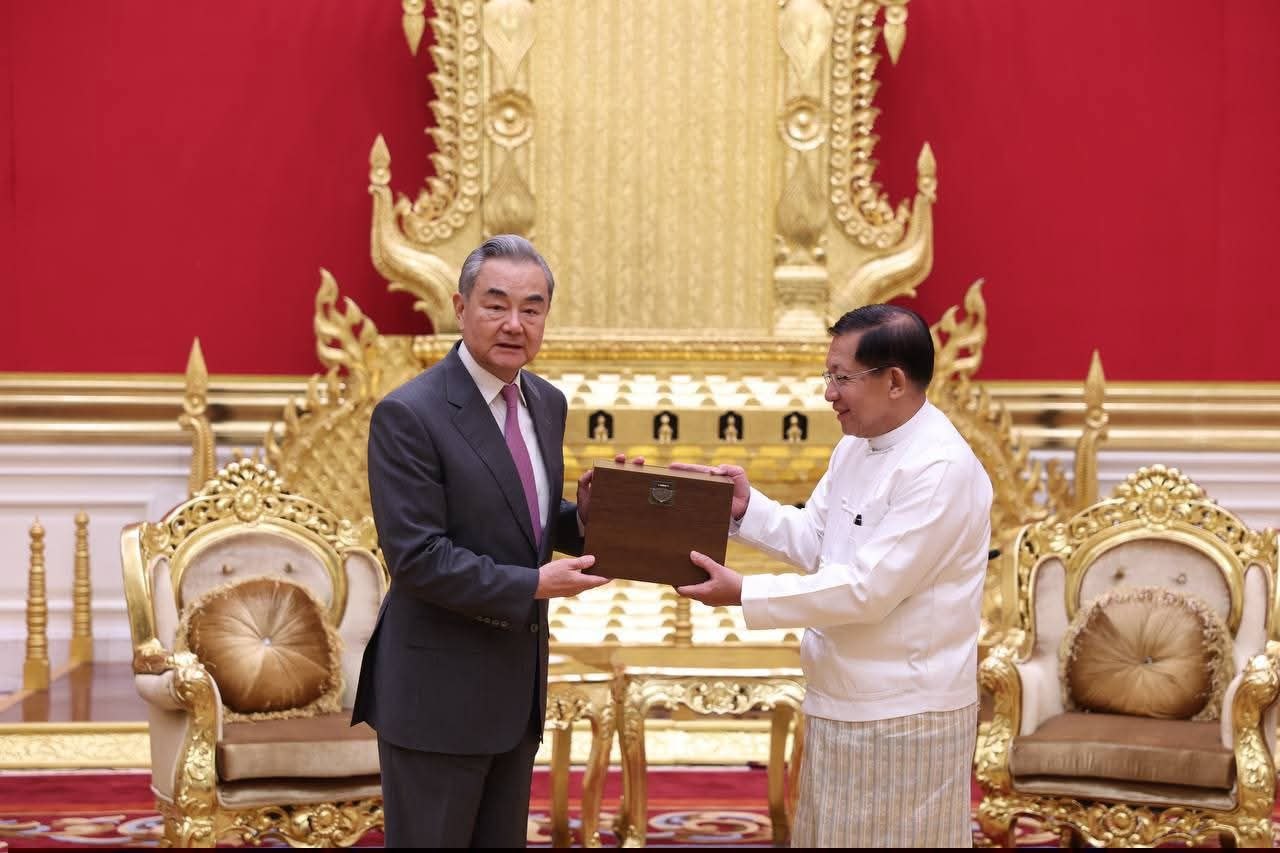
President U Min Aung Hlaing seen with Chinese Foreign Minister Wang Yi.
"First, China holds influence over all armed groups in Northeast Shan State," U Htay Aung Kyi said. "To be blunt, border trade is much larger than normal [maritime] trade. Economically speaking, we must work to return the trade routes through Yunnan to their previous state with the ethnic armed groups. Secondly, Kyaukphyu is vital to China's strategy. Generally, China is influential and has a strong foundational framework here. Within this framework, another factor is the U.S. It is clear that China does not want U.S. interference in its strategy. In such a situation, how we act wisely is key. Opportunities like this might not come again. We cannot think of 'non-aligned policy' as a rigid, fixed concept. It’s true we are non-aligned, but the basic framework must move on from there. I want it to be dynamic, not static. Our problem is that whenever we consider something, 'non-alignment' becomes a fixed dogma. Furthermore, looking at our history, we need to distinguish between International Relations (IR) and ideology. The main thing is to look at how Vietnam manages. Of course, our situation is different from Vietnam's. We are a few steps behind, and Vietnam doesn't have the ethnic armed conflict issue. Given that China influences almost all ethnic armed groups, it is quite difficult. We have to weigh how much influence they will exert over us and consider how to prevent total dominance and how to conduct relations. If we don't think this through, it is quite concerning."
On April 25, 2026, President U Min Aung Hlaing and Chinese Foreign Minister Mr. Wang Yi met for talks in Nay Pyi Taw. During the meeting, they discussed China's steadfast support for Myanmar's sovereignty, territorial integrity, and stability, as well as its support for national peace, ethnic reconciliation, and social harmony.
Military and political observers pointed out that as long as political and military instability persists in Myanmar, China-Myanmar economic activities cannot be fully realized. They noted that China is more inclined toward strategic opportunities regarding Myanmar rather than just immediate economic ones.