
CNI News
May 1, 2026
Among the numerous armed groups existing in Myanmar, questions have emerged among military and political analysts regarding the criteria used by the government and the military (Tatmadaw) to designate a group as an Ethnic Armed Organization (EAO).
Colonel Khun Okkar, Chairman of the Pa-O National Liberation Organization (PNLO-NCA/S)—a signatory of the Nationwide Ceasefire Agreement (NCA)—told CNI News that theoretically, there are four fundamental pillars required to be considered an EAO.
"Technically, these principles exist, though they aren't explicitly codified," he stated. "First, an EAO must represent a specific population—for example, the Pa-O, Palaung, or Lahu people. Second, there must be a territory where that population resides, regardless of size. Third, there must be a political organization leading the welfare of that population. Fourth, that political organization must lead an armed wing under its command. Having an armed force, political leadership, territory, and a population are the four basics. Without these, a group cannot be listed as an EAO or ERO (Ethnic Revolutionary Organization)."
Sai Htay Aung, Chairman of the Tai-Leng (Shanni) Nationalities Development Party, suggested that the government likely has its own specific standards. He noted that if an organization possesses strong political goals and institutional strength, it eventually gains recognition.
He added that the government likely has specific frameworks for how such groups operate and fit into official categories.
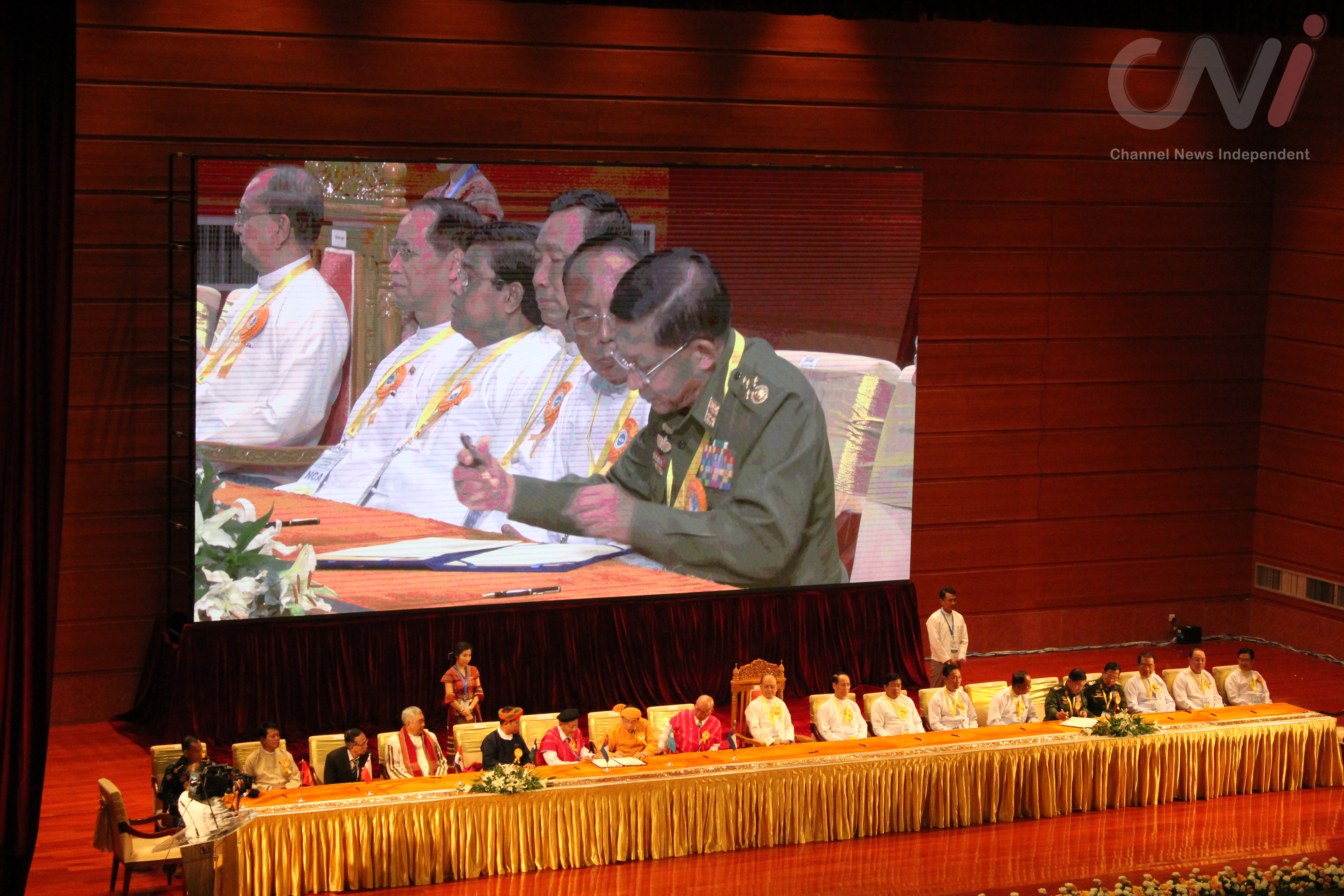
The signing of the NCA during U Thein Sein's era.
Revolutionary forces pointed out that while armed conflict has persisted in the states since independence in 1948, the population in central Myanmar remained relatively stable and showed little interest in ending these conflicts until the political shift following February 1, 2021. Since then, the central mainland population has gained a deeper understanding of the nature of armed conflict.
The landscape of armed organizations is currently divided into several categories based on their relationship with the NCA:
NCA Signatories: Restoration Council of Shan State (RCSS), Democratic Karen Benevolent Army (DKBA), KNU/KNLA Peace Council (KNU/KNLA-PC), Arakan Liberation Party (ALP), Pa-O National Liberation Organization (PNLO), New Mon State Party (NMSP), Chin National Front (CNF), All Burma Students' Democratic Front (ABSDF), Lahu Democratic Union (LDU),
Karen National Union (KNU).
Note: KNU, CNF, and ABSDF have declared the NCA void and withdrawn. LDU, NMSP, PNLO, and ALP have split into factions—those favoring the NCA and those wishing to withdraw.
Non-NCA Signatories (Major Groups):United Wa State Army (UWSA), National Democratic Alliance Army (NDAA-Mongla), Shan State Progress Party (SSPP), Kachin Independence Army (KIA), Myanmar National Democratic Alliance Army (MNDAA), Ta'ang National Liberation Army (TNLA), Arakkha Army (AA), Karenni National Progressive Party (KNPP).
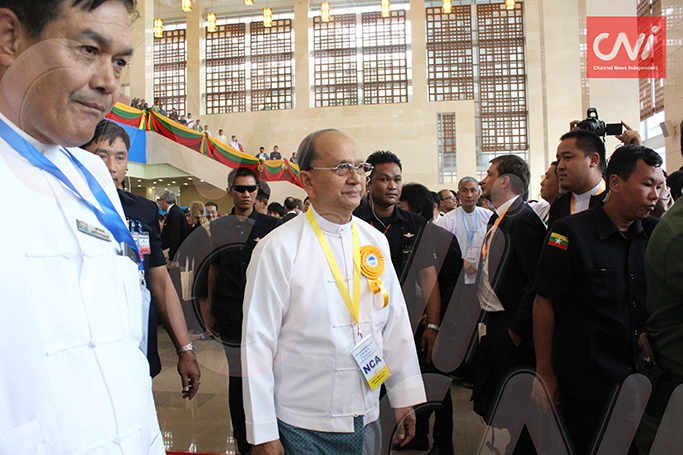
A peace ceremony held during the U Thein Sein administration.
Groups Not Officially Recognized as EAOs by the Government:
Despite being ethnic-based armed groups, the following are not yet officially recognized as EAOs by the government/military:
Shanni State Army (SNA/SNUC), Kuki National Army (KNA/KNO), Zomi Revolutionary Army (ZRA/ZRO), Eastern Naga National Defense Army (ENDA/ENNO), NSCN-K (Ang Mai and Yung Aung factions), Arakan National Council (ANC).
Political analyst Dr. Aung Myo told CNI that he hasn't heard of formal "criteria," arguing that the term was a diplomatic concession.
"I haven't heard of specific standards. Historically, ethnic groups taking up arms were called 'rebels' or 'insurgents.' During President U Thein Sein's administration, they requested not to be called 'rebels,' so the term EAO was chosen because it sounded better. No government would create a formal 'checklist' to become an EAO, as that would look like an invitation to rebel. It was simply a terminology change to facilitate dialogue," Dr. Aung Myo explained.
The term EAOs became officially and widely used in peace processes during the U Thein Sein administration (2011–2016).
Currently, while President U Min Aung Hlaing's government has invited armed groups for peace talks, military and political analysts note that there is still no clear stance on whether ethnic armed groups outside the NCA framework will be allowed to participate.