
CNI News
April 25, 2026
If Myanmar’s transitional government can fully implement the Nationwide Ceasefire Agreement (NCA), it could restore the country's regular relations with ASEAN, according to Colonel Khun Okkar, Chairman of the Pa-O National Liberation Organization (PNLO-NCA/S).
ASEAN has previously demanded that Myanmar follow a Five-Point Consensus, which includes:
Releasing political prisoners.Cessation of violence. Holding inclusive peace dialogues with all stakeholders. Providing unhindered humanitarian assistance.
Due to the government and military’s failure to implement these points, Myanmar was excluded from ASEAN summits from 2021 to 2025, with only non-political representatives invited.
Colonel Khun Okkar noted that if the new government fully executes the NCA, it would inherently fulfill ASEAN’s requirements, potentially paving the way for a return to the summit table.
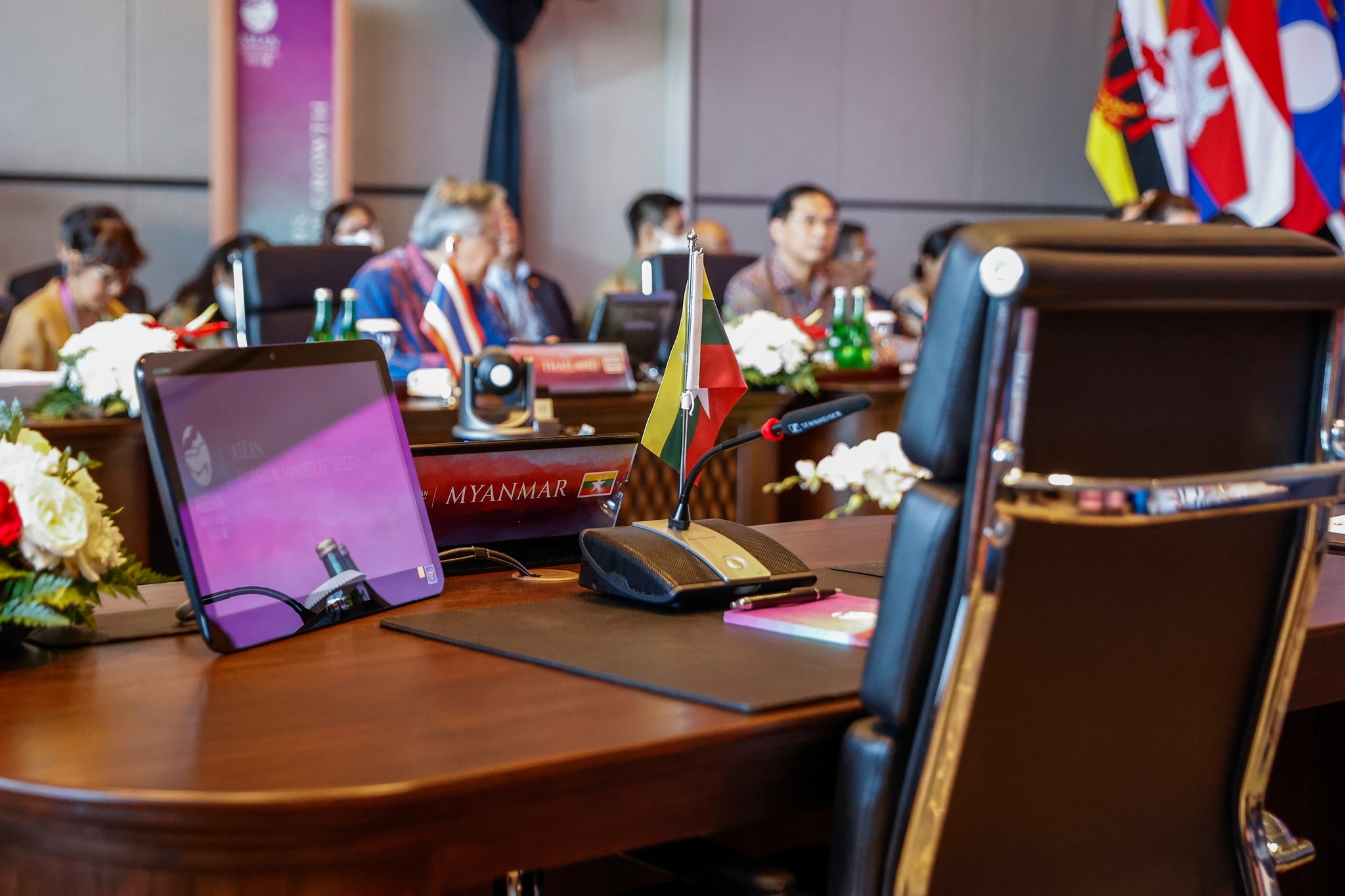
The vacant seat for the Myanmar representative at an ASEAN meeting.
"ASEAN still holds to its Five-Point Consensus. If those points are followed, Myanmar can get back on the ASEAN track. I haven't heard them explicitly say they are working on the Five-Point Consensus yet, though they have mentioned reconciling with ASEAN. A key part of the ASEAN plan is 'inclusive political dialogue,' which is also a core component of the NCA. Therefore, implementing the NCA aligns perfectly with ASEAN’s goals. There are two overlapping areas: inclusive political dialogue and humanitarian aid. If these can be carried out freely, it kills two birds with one stone—fulfilling both the NCA and the ASEAN consensus. This country could realistically achieve this within the 100-day plan," Colonel Khun Okkar said.
Despite the emergence of a transitional government, political analysts point out that ASEAN will likely only fully readmit Myanmar once President U Min Aung Hlaing demonstrates concrete reforms.
The NCA consists of 7 chapters and 33 sub-articles. It is viewed by many as the only viable exit strategy for amending the rigid 2008 Constitution and as the framework for building a democratic and federal union.
U Thein Tun Oo, Director of the Thayninga Institute for Strategic Studies, suggested that reconnecting with ASEAN through the NCA would be a "by-product" or secondary benefit of internal peace.
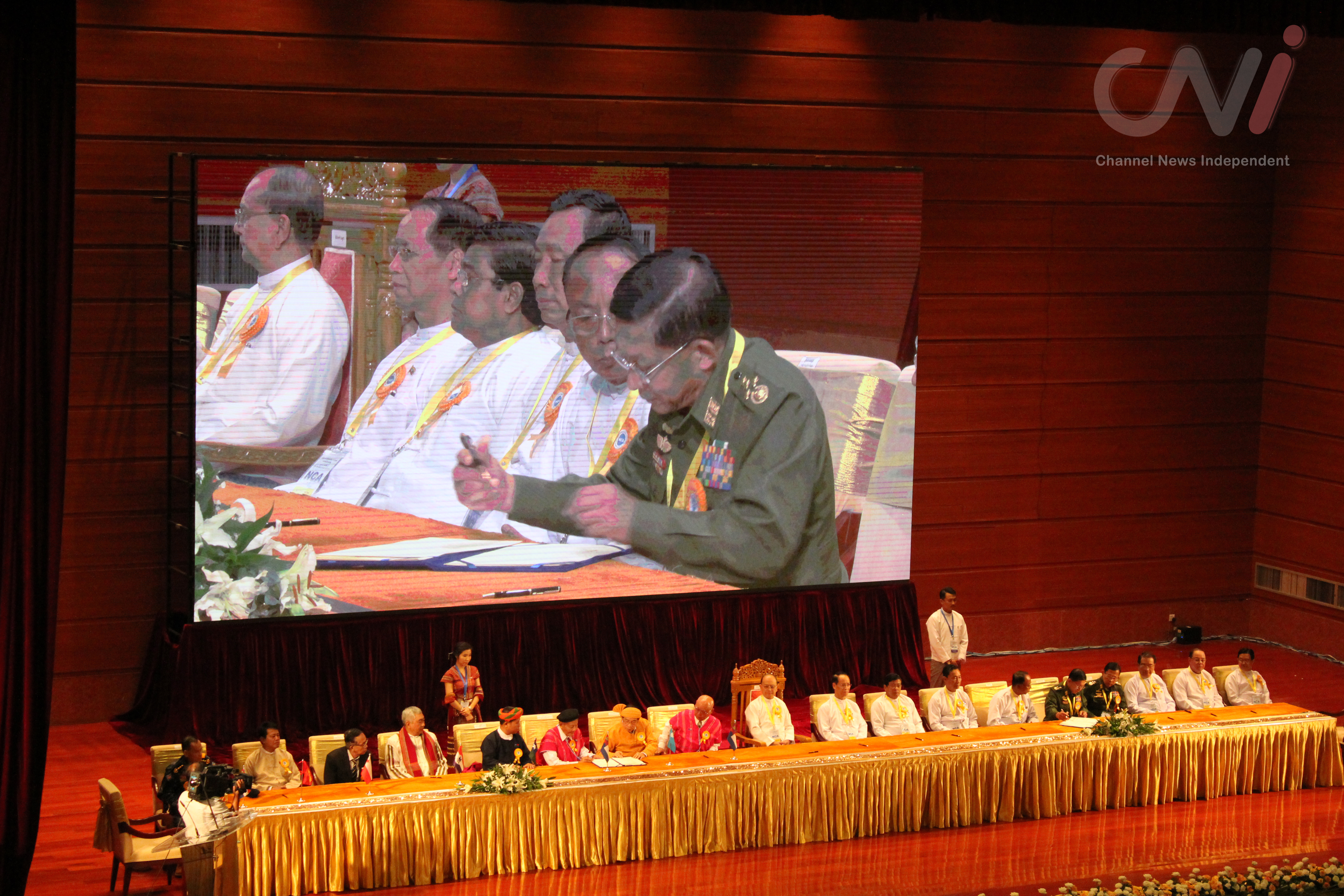
U Min Aung Hlaing signing the NCA.
"Since the Five-Point Consensus was released, Myanmar has stated it would work on points that are feasible and aligned with the country's current situation. Some actions may overlap with previous efforts or be collaborative in nature. If the other side is satisfied with these steps, a reunion might happen. However, it's important to remember that Myanmar is a sovereign state. It must move forward with policies that suit its own context. We shouldn't assume Myanmar must follow every ASEAN whim just to rejoin. Reconnecting with ASEAN because of successful NCA implementation is a secondary benefit. I don't think the NCA is being rushed just to satisfy ASEAN—the focus must remain on the NCA itself. Once the NCA is implemented successfully and peace is achieved, the other issues will resolve themselves," U Thein Tun Oo said.
The NCA is the foundational political agreement between the Myanmar government, the military, and Ethnic Armed Organizations (EAOs), serving as the cornerstone of the national peace process.