
CNI News
4 April 2026
Sai Htay Aung, Chairman of the Tai-Leng (Shanni) Nationalities Development Party (TNDP), told CNI News that he is concerned Myanmar—a pivotal country in the global political landscape—could become like Afghanistan due to the geopolitical tug-of-war between China and the United States.
"The situation in Myanmar is somewhat worrying due to the rivalry between China and the US," Sai Htay Aung said. "After World War II, the US dismantled Soviet Russia. In the post-Cold War era, they dismantled the EU. Now, China has become their primary competitor. Geographically, Myanmar is the best foothold to dismantle China's influence. Because of this, I worry that the people of Myanmar will be caught in a war zone. We are already in a period where civil war flames are burning. Furthermore, regarding the current global situation with Iran, I don't think the US can win that fight. If they withdraw, Iran aligns with China, allowing Chinese influence to gradually spread to the Middle East. Therefore, the US will try to break China, and I am very concerned that Myanmar will become a war zone like Afghanistan."
Military and political analysts point out that Myanmar is situated at a strategic geopolitical crossroads in the competition between China and the United States.
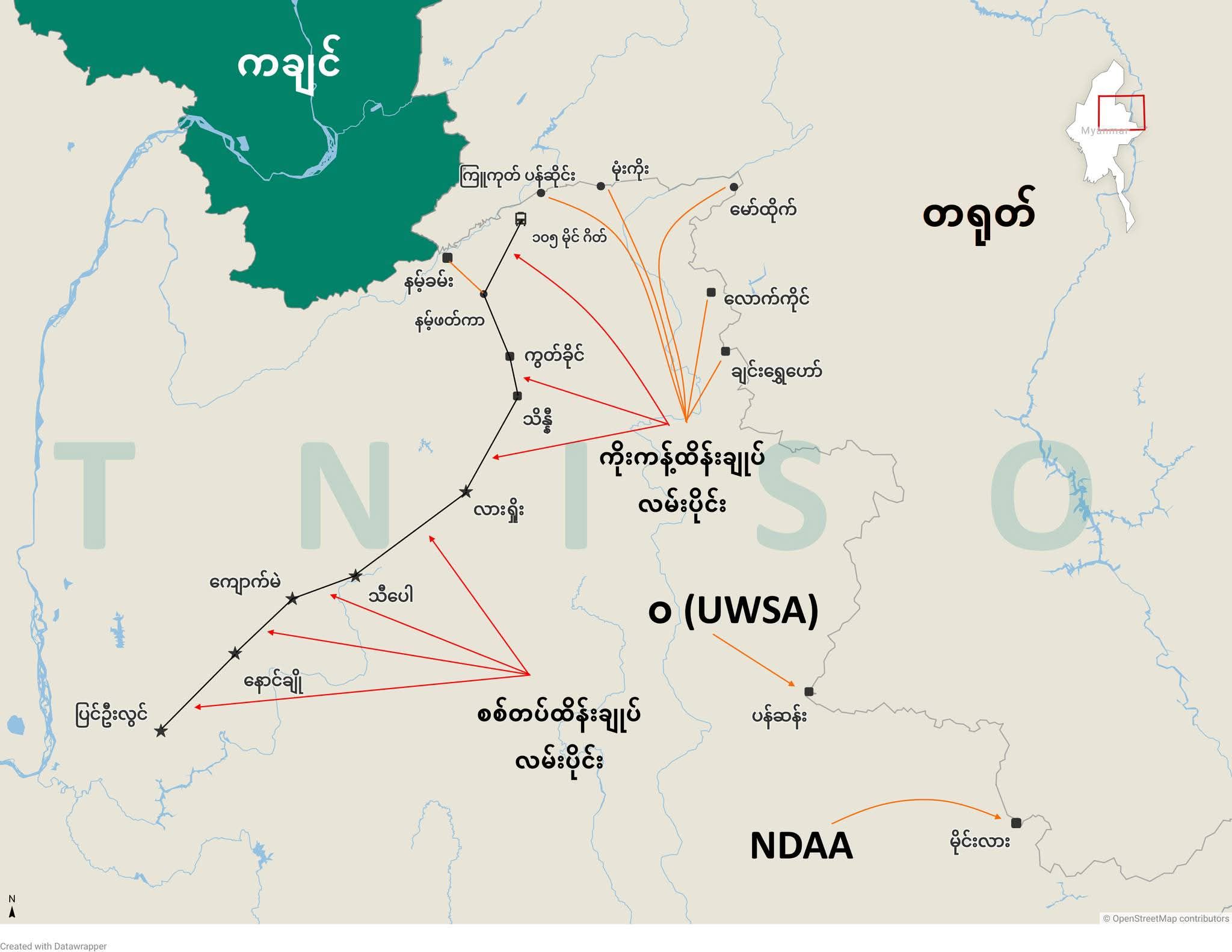
Illustration of China’s strategic goals for controlling Northern Shan State
For China: Myanmar is the primary route to bypass the potential blockade of the Malacca Strait. The "lifelines" for China include railways, roads, and oil/gas pipelines stretching from Yunnan Province to the Indian Ocean (Kyaukphyu, Rakhine State).
For the US: Myanmar is a vital location to contain China's expansion of influence.
Analysts suggest that while China attracts Myanmar by providing economic and political backing amidst Western sanctions, the US focuses on democracy and international pressure. Through legislation like the BURMA Act, the US supports Spring Revolution forces to elevate its regional role and pressure rulers close to China.
Currently, groups with good relations with the US—such as the KIA, CNF, and NUG—are collaborating with the AA, ABSDF, PDFs, and Naga insurgents to implement the Ka Thone Lone (Kanbalu-Kawlin-Katha) operation to control the Sagaing Region. Their goal is to link Kachin State, Sagaing Region, Chin State, and Rakhine State to liberate Northwest Myanmar.
China reportedly suspects the US is supporting the KIA’s efforts in the northwest. Consequently, China has utilized the MNDAA (Kokant army) in northern Shan State to control the "Kachin Sub-State" areas of Kutkai and Namkham to ensure security.
The Presidents of China and the United States
Political analyst Dr. An Kaw La told CNI News that in such geopolitically significant countries, armed groups can no longer look only at their own local interests.
"In the current situation, countries in significant geopolitical positions are facing Bipolarization," Dr. An Kaw La said. "They often suffer in the middle of the rivalry between two powers. This is true for Iran, and now Myanmar. Regarding the China containment policy, the Tanintharyi coast—with its seas and ports outside the Malacca Strait—is seen as an entry point for the West."
He added: "Myanmar is the primary alternative trade route (the Second Exit) for China to reach the Indian Ocean. Deep-sea ports like Kyaukphyu, Dawei, and Yangon have always been important to China, but they are even more critical now. These geopolitical maneuvers are arriving directly in Myanmar. As soon as fighting broke out in the area between Myeik and Dawei, we saw EAOs (Ethnic Armed Organizations) trusted by China taking control of territories in northern Shan State. They opened union roads and supply routes, preparing to decisively attack groups linked to the West. These developments are happening rapidly."
Military and political observers emphasize that the situation in Myanmar is a direct collision between China's Indian Ocean dream and the US policy of containment. Therefore, the Myanmar issue is not merely an internal affair but a crucial piece in the geopolitical game of global powers.
While it is currently difficult for Myanmar to maintain a balance between these two giants, the central government maintains a closer relationship with China.