
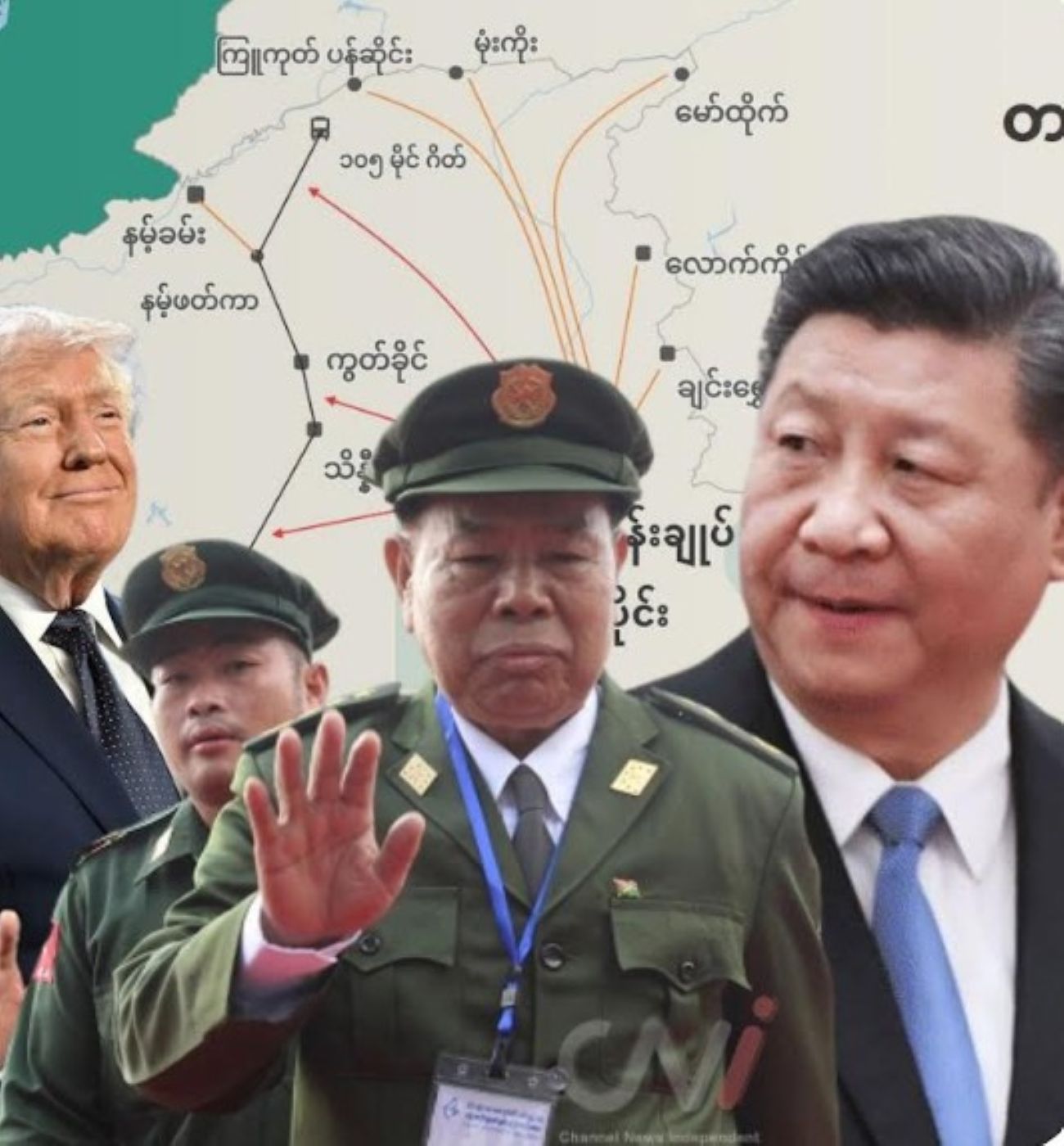
CNI Interview
March 24, 2026
Armed conflict remains intense in Myanmar, and the involvement of neighboring China and the Western bloc (specifically the US) is being closely monitored.
Recently, in northern Shan State, the Myanmar National Democratic Alliance Army (MNDAA) seized Kutkai—previously controlled by the Ta'ang National Liberation Army (TNLA)—and is preparing to take control of Namhkam. There are allegations that China is behind these operations.
On another front, the KIA has declared that Sagaing Region is its "security gateway." They have launched the "Ka Thone Lone" operation (Kanbalu-Kawlin-Katha) to intercept the enemy and are working toward the "liberation" of Myanmar’s northwestern corridor. CNI News contacted political analyst Dr. An Kaw La to discuss these developments.
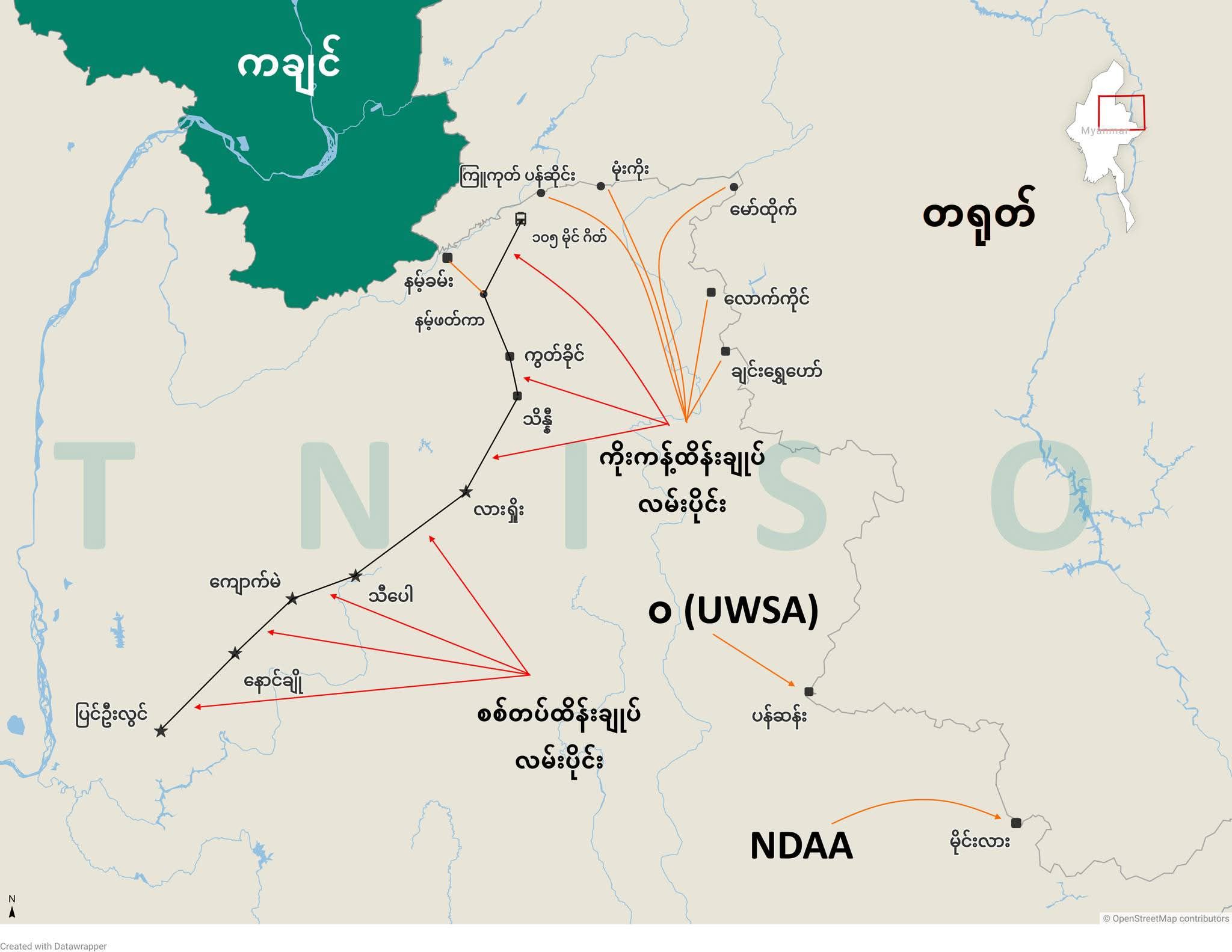
Illustration of China's Northern Shan State Containment Plan
Q: In the Northern Shan State landscape, is the conflict between the Kokang (MNDAA) and the Palaung (TNLA) happening because China is trying to control the entire region? What is your view?
A: Kutkai has effectively moved to the west bank of the Salween River. Looking at this, there are two Ethnic Armed Organizations (EAOs) that are on good terms with China. One is the UWSA. Currently, I believe the UWSA is responsible for the east bank of the Salween down to Kengtung, while the MNDAA has been tasked with the west bank, including Kutkai and Hsenwi.
Of the main Union Highway from Mandalay to Lashio, and from Lashio to Muse, the section from the mainland to Lashio is currently under the government control. However, from Lashio to Muse, it appears the MNDAA—which has good relations with China—has been tasked with maintaining the critical areas of Kutkai and Muse. We see this as China placing the MNDAA in charge of the west bank of the Salween because they trust them.
Q: What would happen if the entirety of Northern Shan State fell under Chinese influence?
A: This is important. As I mentioned, Northern Shan is divided by the Salween. To be blunt, the TNLA hasn't been on great terms with China since last year; they didn't get along well in meetings. Consequently, China seems to have replaced them with the MNDAA.
When we say "Northern Shan State," we must include Namhkam. The MNDAA is being encouraged to take it. I haven't heard that Namhkam has fallen yet, but it is very close to Muse. If Namhkam is left alone, the TNLA could cause disruptions from there. Therefore, it appears the MNDAA is being tasked with Namhkam, a border trade gate. Historically, Namhkam is the "gateway" between Kachin State and Northern Shan. By having the MNDAA control Namhkam, China likely intends to keep the KIA in check as well.
Geopolitically, Namhkam is vital. If the KIO/KIA is not on good terms with China and the MNDAA holds Namhkam, the KIO can be threatened at any time. The battlegrounds where the KIO is fighting government troops, like Bhamo and Katha, are very close to Namhkam (Bhamo is only about 65 miles away). The outcome of the Bhamo battle becomes very sensitive if the MNDAA holds Namhkam. It seems China wants its two preferred EAOs to control Northern Shan and then negotiate with the Myanmar government to open the Union Highway trade route.
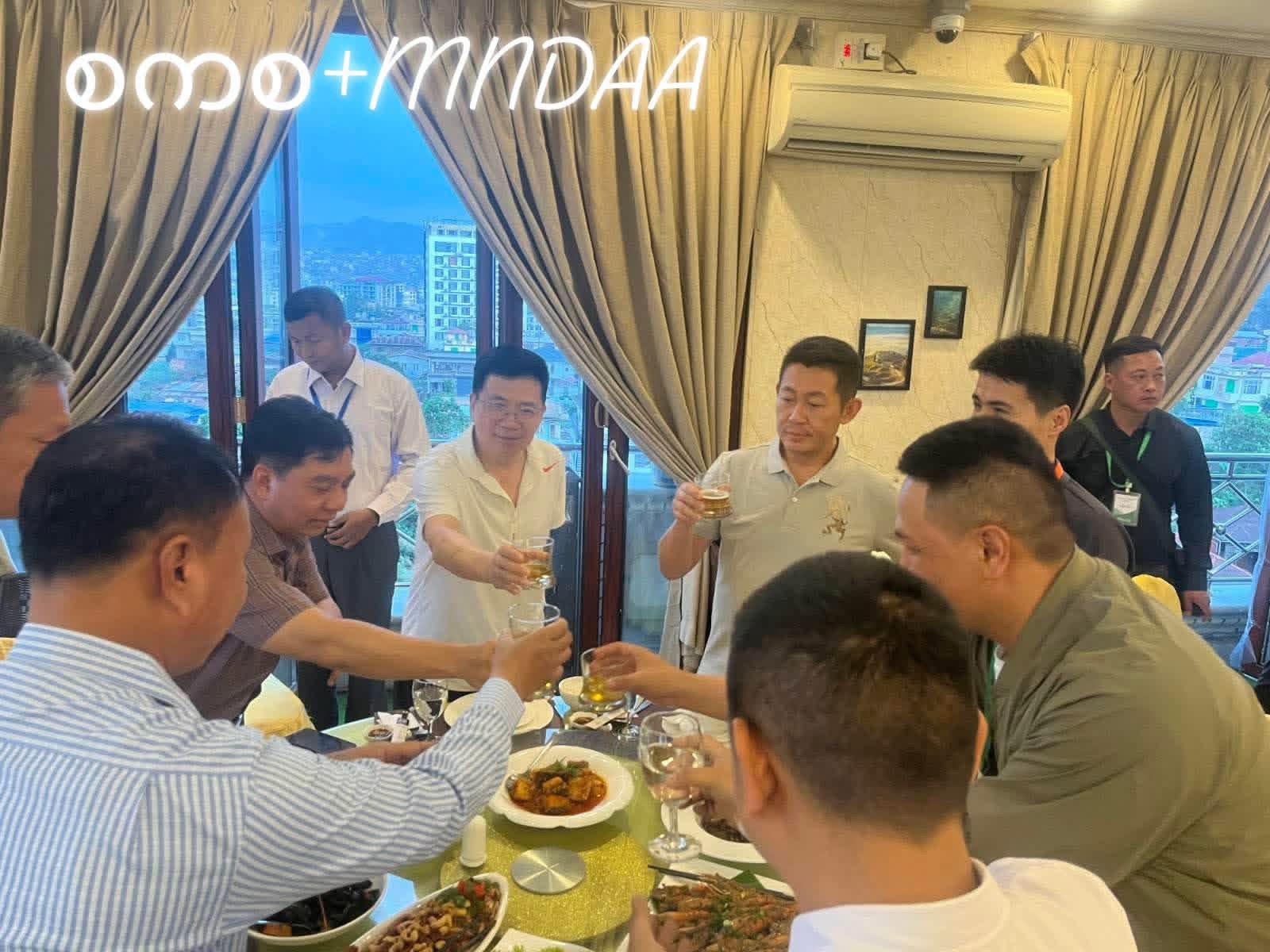
Representative of the Tatmadaw Lt-Gen Ko Ko Oo, Chinese Special Envoy Deng Xijun and Delegates of the MNDAA
Q: If China plays for the whole of Northern Shan, what is the strategy? China wants peace in Myanmar, yet they are playing this game. What is their policy?
A: The control of Northern Shan depends heavily on the statements made by KIO Lieutenant General Gun Maw during Kachin Revolution Day on February 5. He spoke about connecting Kachin, Naga, Chin, and Arakan units to dominate the "Ka Thone Lone" area (Katha, Kawlin, Kanbalu). This would block the entrance to Sagaing and create a contiguous liberated zone across the West and Northwest, eventually leading to a sea outlet.
The MNDAA's push to Namhkam is likely a Chinese preparation in case the KIO actually implements that plan. After the KIO discussed these western units, the "Win Wa" battle broke out in Tanintharyi (between Dawei and Myeik). The KNU and PDFs attacked there, eventually using drones on the Myeik Air Force base.
China does not seem geopolitically comfortable with the fighting in Tanintharyi. Soon after those events, the MNDAA's Northern Shan battles intensified. We cannot look at a war in one region in isolation. From a geopolitical lens, the Western bloc's "Malacca trade" is key. The Tanintharyi coast is crucial just outside the Malacca Strait. China’s concern that the West might enter the Tanintharyi coast has led to the emergence of territory control by pro-China EAOs in Northern and Northeastern Myanmar.
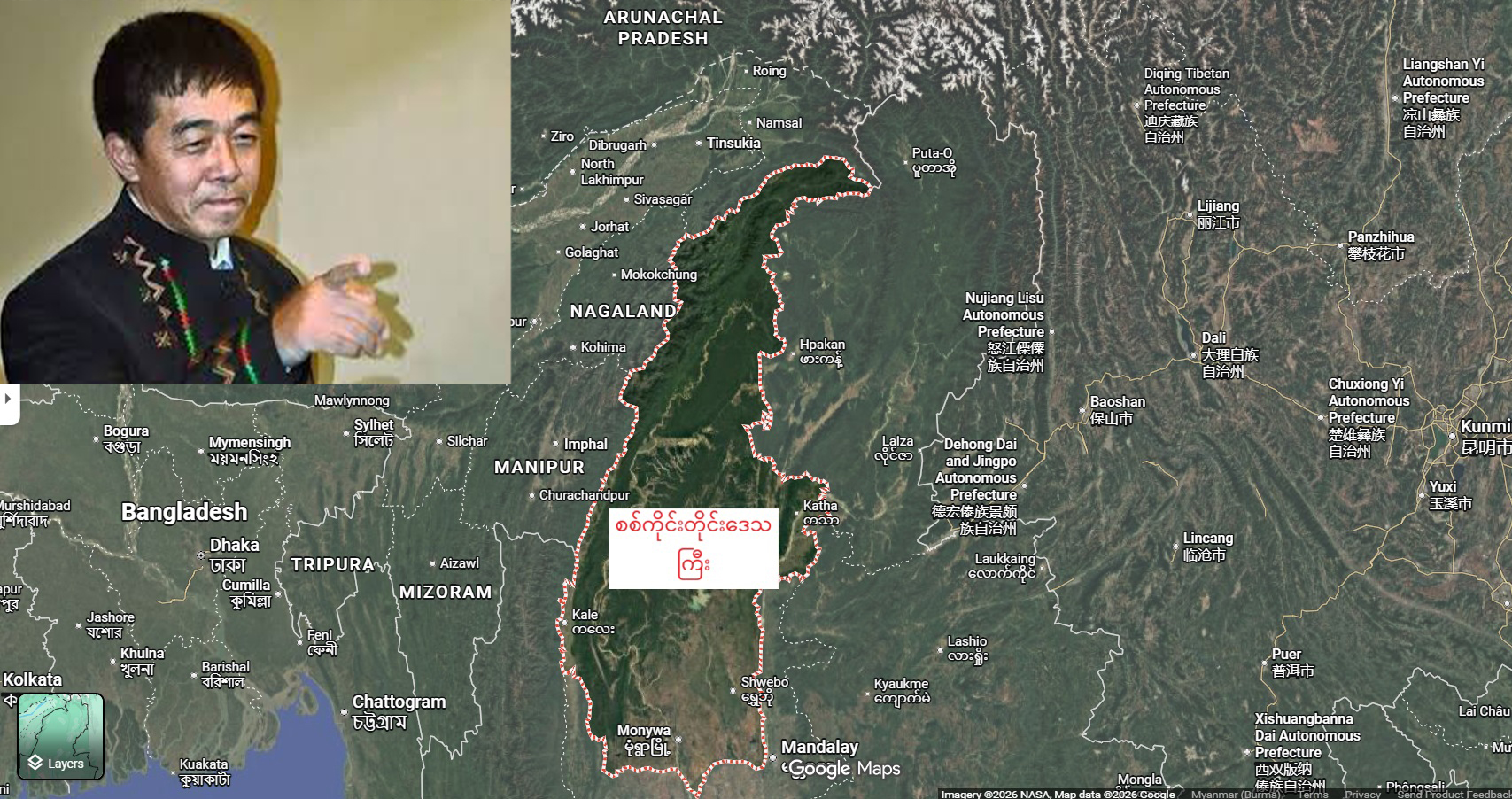
KIA's Lt-Gen Gun Maw and Sagaing Region
Q: Looking at the Northern Shan situation, what will happen to the Brotherhood Alliance (3 Brothers)?
A: To be honest, the "3 Brothers" is just a temporary alliance for an armed revolution. In the long run, when the interests of individual organizations diverge, it cannot last. When an organization lacks a long-term military or alliance vision, it will fragment. We are already seeing them clash. If their interests interfere with the relationship between the Myanmar government and the Chinese government, they will be sidelined regardless of their alliance structure.
Q: In the current parliamentary landscape, we are seeing Kachin representatives included. What could this indicate?
A: From my perspective, there are three key actors in Myanmar’s ongoing armed conflicts and peace process: the Kachin, the Karen, and the Rakhine. If peace can be achieved with these three groups, resolving Myanmar’s armed political conflicts would become much more feasible.
In that context, the role of the KIA/KIO, particularly in areas including Sagaing Region, is especially important for bringing the process to a conclusion. At present, Kachin representatives have secured seats in the legislature. Moreover, if we consider the rotational arrangement for positions such as the vice presidency, it appears that it may now be the turn of the Kachin or Rakhine, which suggests a real possibility.
It is also possible that individuals from the Kachin community—both men and women—who previously served under the SAC have been selected with the expectation that this could facilitate future peace efforts with the KIA. Of course, there may be other reasons as well, which I cannot say for certain.
Overall, this is just an assessment of how current government leaders may be thinking. Nevertheless, I see it as a positive development, and it is likely to be beneficial.
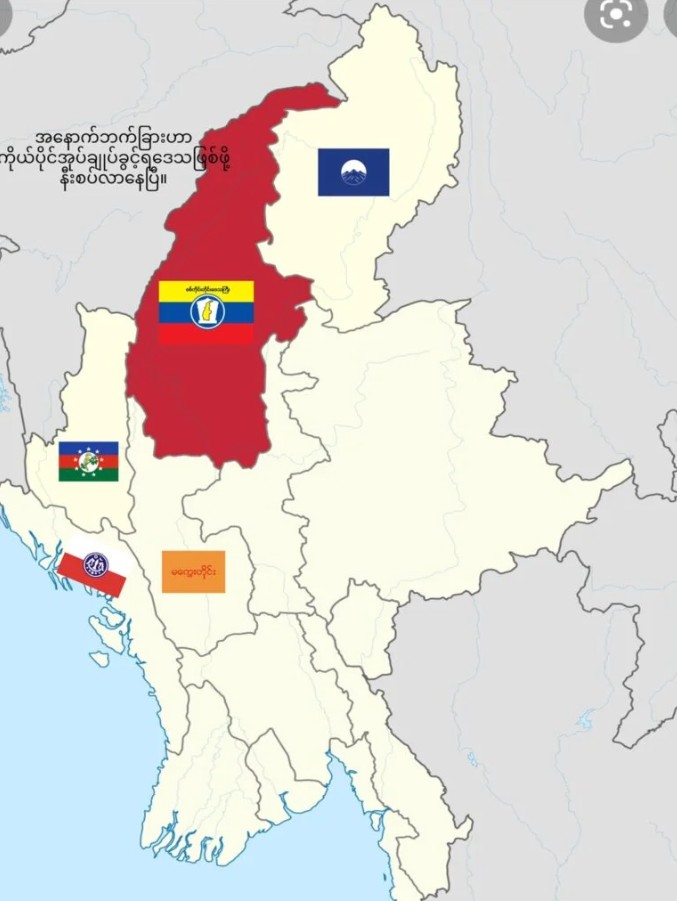
Regions along the Northeastern Corridor
Q: In 2009, during peace negotiations, groups like the Rakhine and others were excluded by the Tatmadaw. In the current situation, if some armed groups are left out—whether due to weaker strength or because they are not actively fighting the military—can peace still be achieved?
A: That is difficult to predict. At present, there are calls for an all-inclusive approach to peace. However, when it comes to actual implementation, circumstances can change in many ways, making it hard to say in advance.
That said, the current Commander-in-Chief, Senior General Min Aung Hlaing, has invited all groups to participate. But in reality, formal negotiations have not fully begun yet, although some processes are underway.
Given that some groups are still actively engaged in conflict and strongly opposing the military, the situation remains highly fluid and difficult to assess.
Q: In the current context, what kind of approach is needed to ensure inclusive participation?
A: In my view, simply inviting all groups is not enough. Their interests differ, as do the importance and conditions of the territories where conflicts are taking place. These differences can significantly affect the process.
Therefore, achieving “all-inclusiveness” will likely require a bilateral approach—engaging each group individually. Unlike during the NCA process, where there was an attempt to include many groups at once, such an approach may be difficult under current conditions.
In practice, since interests vary, separate negotiations tailored to each group will likely be necessary. The peace process involves many stages, and it is unlikely that everything can happen simultaneously. Many steps and conditions must be navigated first.
Ultimately, outcomes will depend on how these preparatory phases are managed and whether they succeed or fail, which will shape future developments.
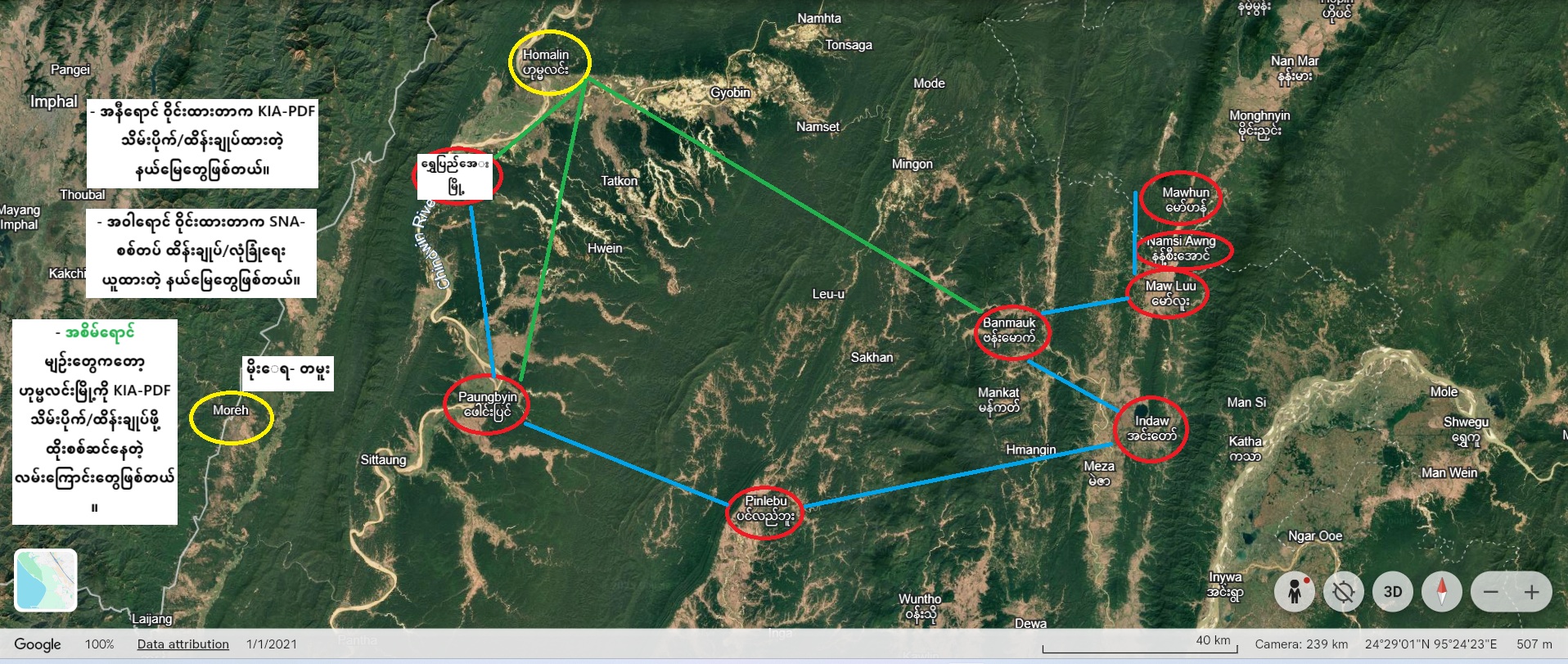
Sagaing Region's areas controlled by the KIA
Q: Regarding the Arakan Army (AA), what should the military do?
A: If you look at the map, the AA is fighting for Kyaukpyu and Sittwe. The war won't stop. The AA is also connected to three regions: Ayeyarwady, Western Bago, and Western Magway. Rakhine's Ann is linked to Magway and Padan is linked to Western Bago.
They are even patrolling near Defense Industry (Ka-Pa-Sa) factories 5 through 11. The Pathein-Monywa road has become highly strategic. The AA’s goals are the most ambitious among the EAOs. By seizing a state capital, they are aiming for either a Sovereign State or a Sub-autonomy State.
The AA is moving toward a "Confederation" or a Sovereign-style goal. The state will have to work very hard to resolve this political conflict, which is currently being fought militarily.
Q: Do you have anything else you’d like to add?
A: Our political and military conflicts have reached a critical juncture. We cannot just look inside our borders; we must view this through geopolitical connections. We are seeing a "Bipolarization" between China and the US. Countries caught in the middle often suffer.
Myanmar is central to the "China Containment Policy" regarding the Tanintharyi coast and the Malacca Strait. Conversely, Myanmar is China’s "Alternative Way" to the Indian Ocean via deep-sea ports in Kyaukpyu, Dawei, and Yangon. Geopolitical games are arriving directly in Myanmar. We need a broader vision that links local peace efforts with international trends to find a solution.