
CNI News
March 10, 2026
Military and political analysts are raising questions regarding which path and method should be used to initiate the formation of a Federal Army in Myanmar.
U Ko Ko Gyi, Chairman of the People’s Party (PP), told CNI News that if a Federal Army is to be formed, the military (Tatmadaw) and winning parties should operate within the framework of the 2008 Constitution. He emphasized that efforts must be made within Parliament to effectively amend the 2008 Constitution.
"Currently, we are considering solving this within the 2008 framework involving the military, the current winning party, and all registered political parties. On the other hand, there is an approach that suggests the 2008 Constitution must be completely abolished and rewritten. As political parties, we need to implement practical and timely reforms when amending the constitution. Therefore, there have been discussions regarding constitutional amendment, and some are still ongoing. I believe we must strive in Parliament to achieve effective reforms. Fundamentally speaking, there are two types of structures: a Union based on ethnicity and a Union based on territory. Furthermore, there are considerations for symmetric federalism, where everyone is treated equally, and asymmetric federalism. Talking about 'Federalism' is easy, but the details require extensive discussion. The current 2008 Constitution already has state structures based on ethnicity and regional structures based on territory. So, if we start talking about federal units, there is much to say. However, practically, we cannot solve certain issues immediately while conflict is intense. Therefore, our primary effort right now is to return to a path of stability, rule of law, and political solutions," said U Ko Ko Gyi.
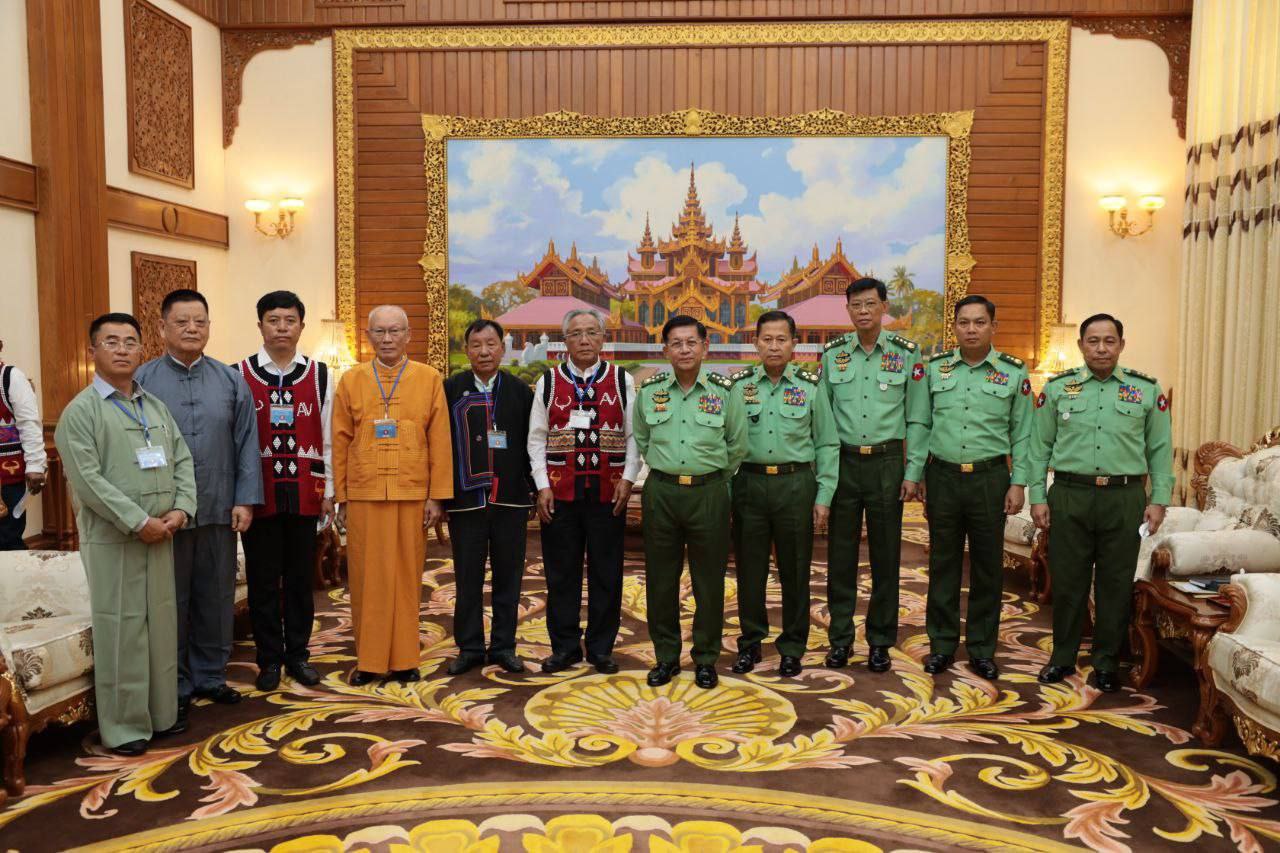
Photos showing Senior General Min Aung Hlaing and leaders of armed organizations.
Military and political observers point out that the federal issue has existed since the 1947 Panglong Agreement or 1962. They highlight that ethnic groups and all citizens must first create a stable and secure environment.
U Thein Tun Oo, Executive Director of the Thayninga Institute for Strategic Studies, told CNI News that rather than focusing on which method to use, an answer will emerge if work is done based on the actual attitudes on the ground and how cooperation is managed.
"First, we need to clarify what should be included under the model of a 'Federal Army' and how it will function. Rather than just the method, the desires, remarks, and aspirations of those involved are important if a Federal Army is to be formed. It is better to move forward with a model that is appropriate and feasible. For the Federal Army model, what have the current military and the groups following the peace path via the NCA (Nationwide Ceasefire Agreement) prepared? That point is crucial. It must depend on that. It would be better to work based on the points agreed upon by the people who will actually participate. Therefore, the best solution will come by working based on the actual attitudes on the ground, what they want to do, and how they will cooperate," he said.
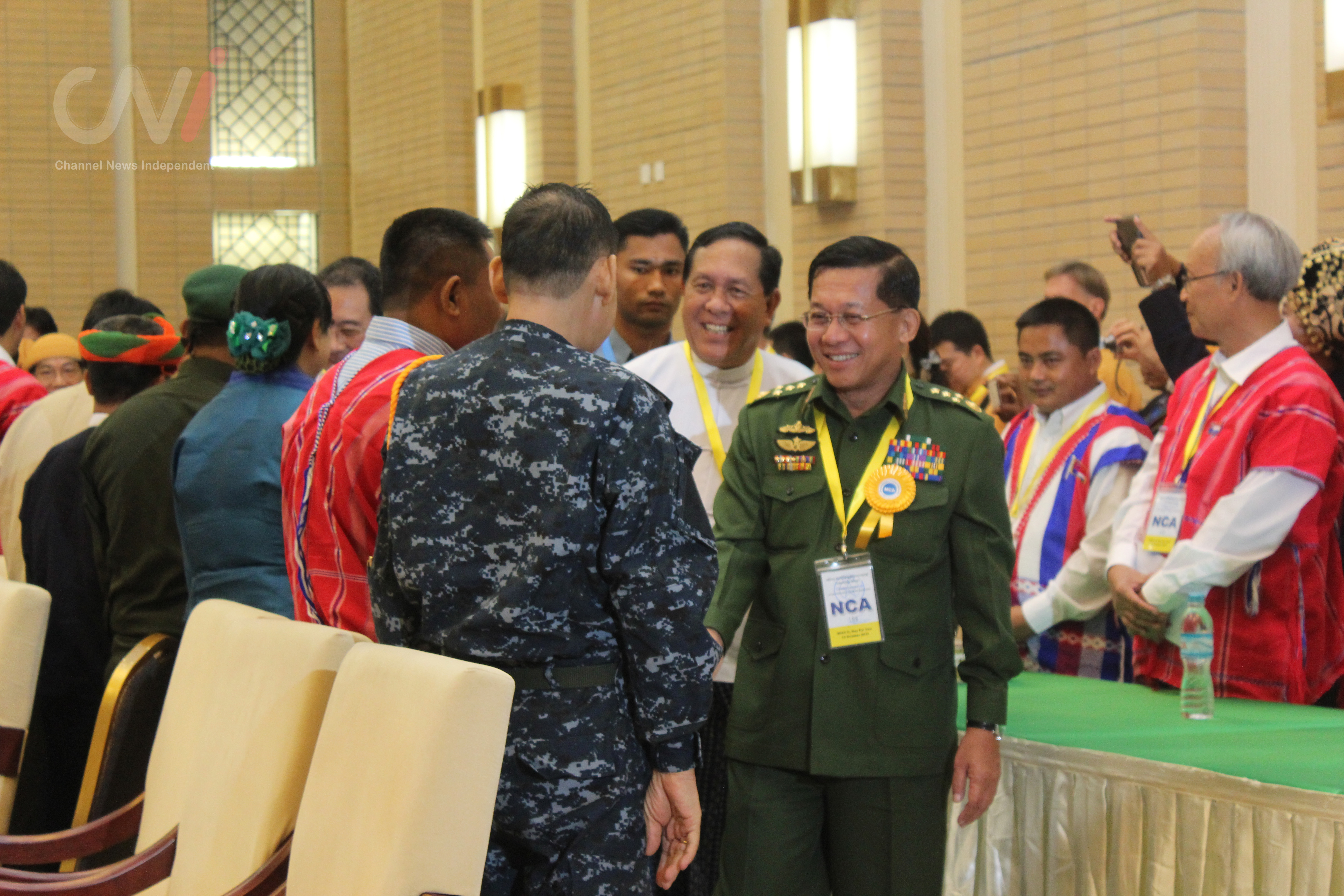
Photos showing Senior General Min Aung Hlaing and leaders of armed organizations.
The current landscape shows two primary stances on military integration: The Military's (Tatmadaw) Stance: They lean toward transforming armed groups into Border Guard Forces (BGF) or People’s Militia Forces (PMF) to cooperate with the Tatmadaw, followed by the formation of political parties to compete in elections.
The Armed Groups' Stance: Many ethnic armed organizations (EAOs) stand for forming National Guard or State Guard forces first. After building trust, they would then integrate with the central Myanmar military step-by-step to transition into a Federal Army.
Political circles analyze that establishing a Federal Union Army may be difficult due to the existence of numerous ethnic armed groups and the hundreds of armed organizations that emerged following the political shifts of February 2021.