
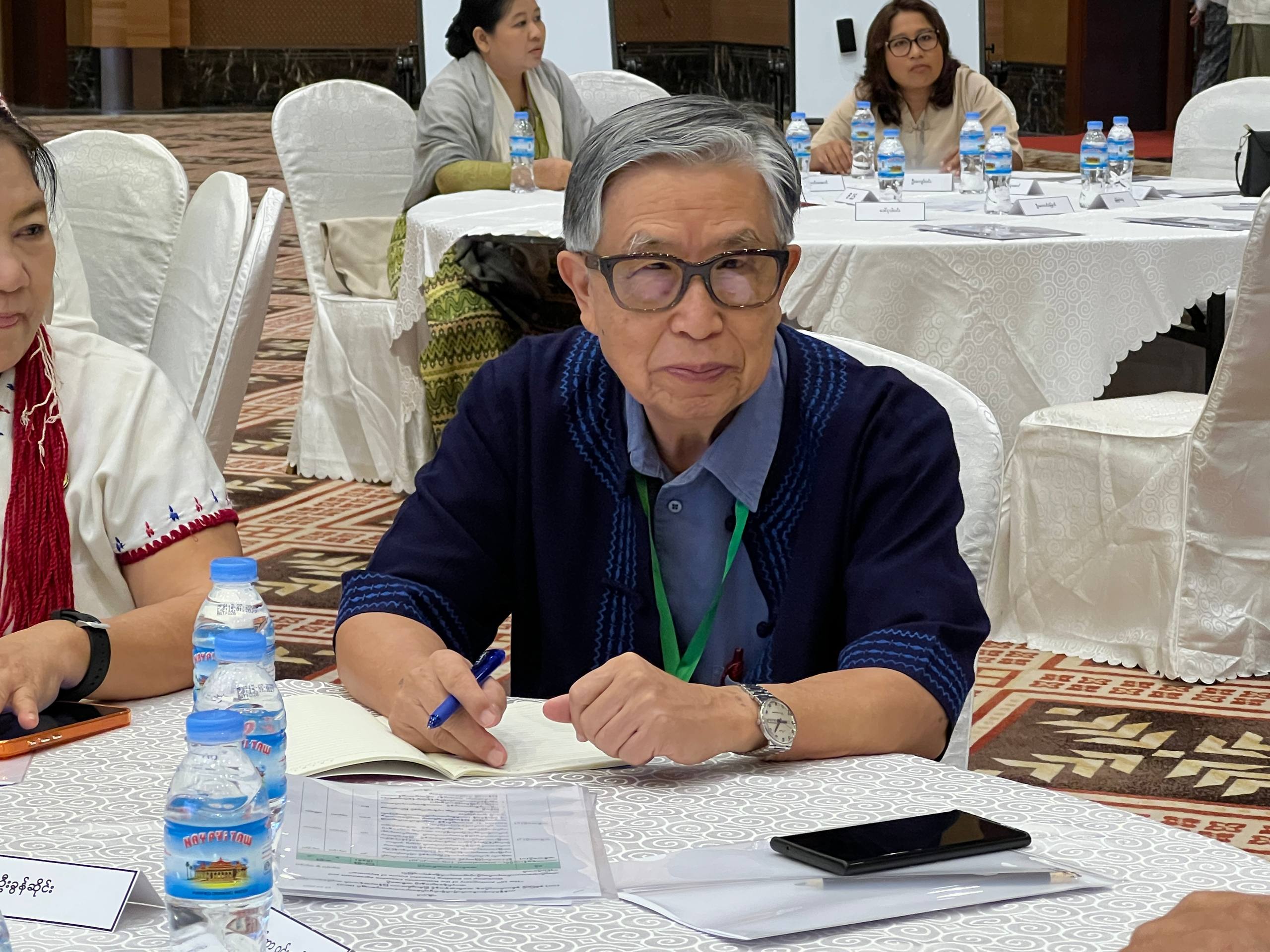
CNI Interview
March 6, 2026
Myanmar is currently home to numerous armed organizations, and intense fighting is breaking out across the country. While there are calls for peace and attempts at dialogue, success remains elusive. Despite practicing a non-aligned policy between neighbors China and India to promote national development, the country continues to face a general political crisis.
CNI News Agency contacted U Khun Sai, a participant in the peace process, to discuss these conditions.
Q: During the British colonial era, Myanmar had a "98 Departments" administration—though most know it as the "91 Departments" administration. The British controlled seven key departments, while the remaining 91, which were considered less critical, were left to Burmese control. Would a similar system work in Myanmar today? For instance, having the center hold key departments while appointing and empowering local leaders in their respective states?
A: I haven't studied that specific historical system extensively, so I can't give a definitive answer. What I can speak to is the Panglong Agreement. According to the agreement and its subsequent protocols, the central government handles matters concerning everyone, while states handle matters concerning their own territories.
When people hear "the center handles collective matters," it can be interpreted as the Burman government ruling while non-Burman ethnicities only manage their own states. Many understand it that way. However, the leaders who drafted the Panglong Agreement—including Burman leaders—didn't view it like that. The central government wasn't meant to be "Burman-only." It was intended to include ethnic and minority leaders working together.
If you look at the Panglong Agreement, points 1 through 4 relate to the central government, and you can see ethnic leaders were involved there. Since ethnic leaders themselves are part of the center, there is no need for the central government to worry about states governing themselves.
Nowadays, when "Panglong" is mentioned, people often think of secession or independence. But Panglong wasn't built for that. It allows for self-administration within a state. If everyone manages collective matters together at the center, the issue of secession won't even arise. We need to distinguish this clearly. If we don't, and the mindset remains "Burmans hold the center while ethnicities hold the states," then there is a real reason to worry.
In U Nu’s era, state leaders—then called "Chairmen" rather than Chief Ministers—participated in the Union government. This supported the essence of Panglong: that matters concerning everyone are decided by everyone. We need to act in that spirit. Regarding the 91 or 98 departments, I have no specific comment.
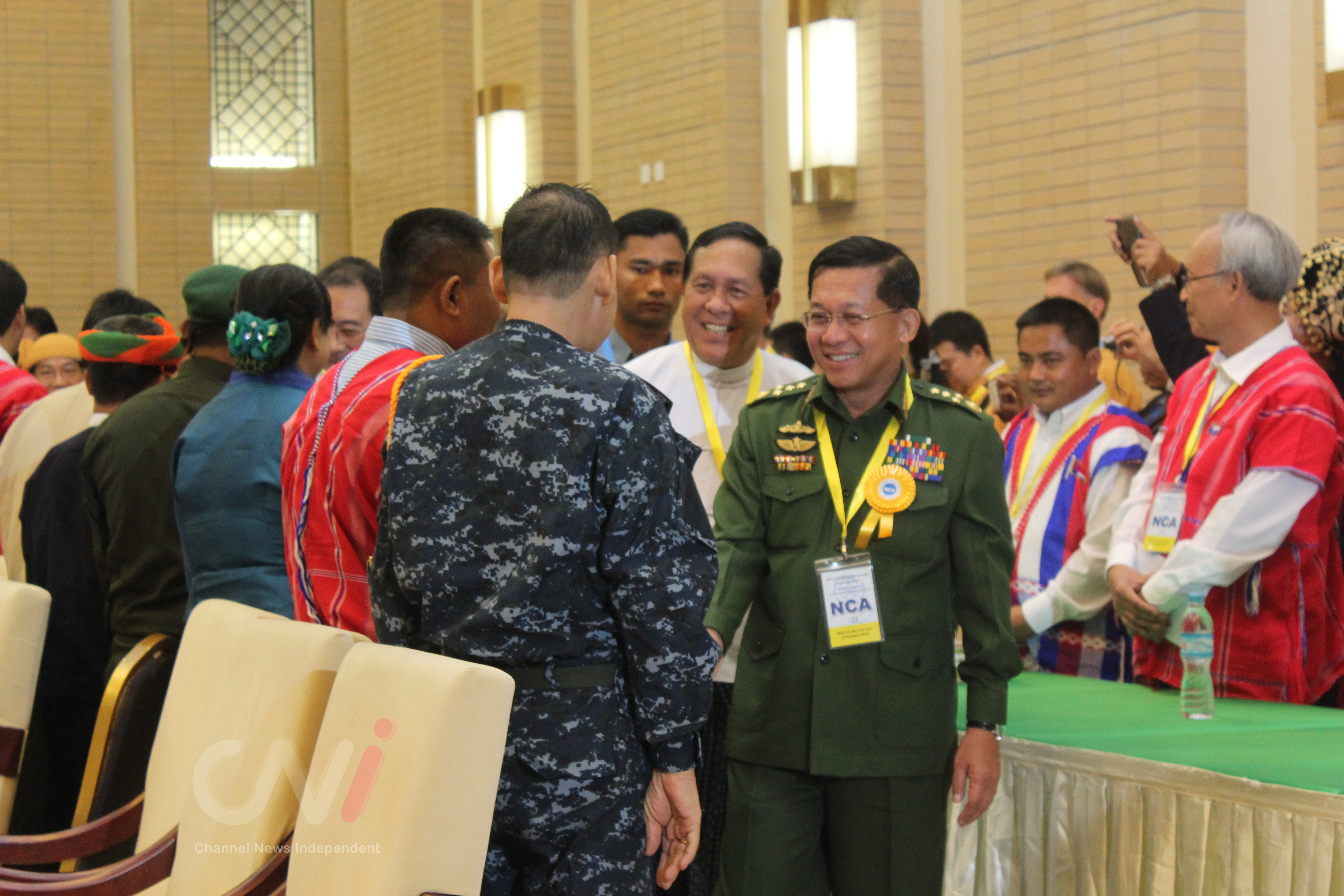
Senior General Min Aung Hlaing and representatives of armed groups.
Q: How do you think the issue of Ethnic Armed Organizations (EAOs) should be resolved?
A: Regarding the EAO issue, looking at current proposals like the "Watan Act," the Burman government might find them unacceptable, viewing them as a "Confederation." However, if we accept and apply the principle that collective matters are managed together while state-specific matters are managed by the states, there is nothing to fear.
Q: Would it be feasible to grant EAOs administrative authority in their respective states?
A: Practically speaking, this could be a necessary temporary measure. However, we must accept that as we build a democracy, we must—sooner rather than later—give the public the right to participate in decision-making. A government that lacks public support, whether it's a state or central government, cannot be sustainable in the long run.
Q: Currently, the Military (Tatmadaw) is using the Border Guard Force (BGF) and People's Militia models, asking armed groups to join as such. EAOs generally dislike this. What if a model like the U.S. National Guard were adopted instead?
A: This is something that takes time. During the NCA (Nationwide Ceasefire Agreement) negotiations, the government stood for a "Single Army" principle, while EAOs stood for "State Guard Forces" in their respective regions.
These two positions represent a conflict: a "Single Army" is a globally accepted norm for a nation, while "State Guard Forces" arise from a lack of mutual trust and security. At that time, it was agreed to negotiate how to transition from separate state forces to a single Union Army step-by-step.
Work had already begun during the Third Union Accord. Had the coup (or "power-keeping") not occurred, we would have made significant strides by now. Now, because of the coup, the "Single Army" concept is even harder to accept. It will take more time and require more stringent regulations.
However, these are not insurmountable issues. Look at Switzerland. They operated with state-level forces for hundreds of years. They managed collective matters together and handled local security with their own state troops. Eventually, they became a Union Army. We don't need to wait hundreds of years like Switzerland; it could happen in a decade. But we need serious dialogue. Everyone must realize that we cannot ensure security alone as a single state or a single ethnic group. If we accept that we must work together, it is entirely possible.
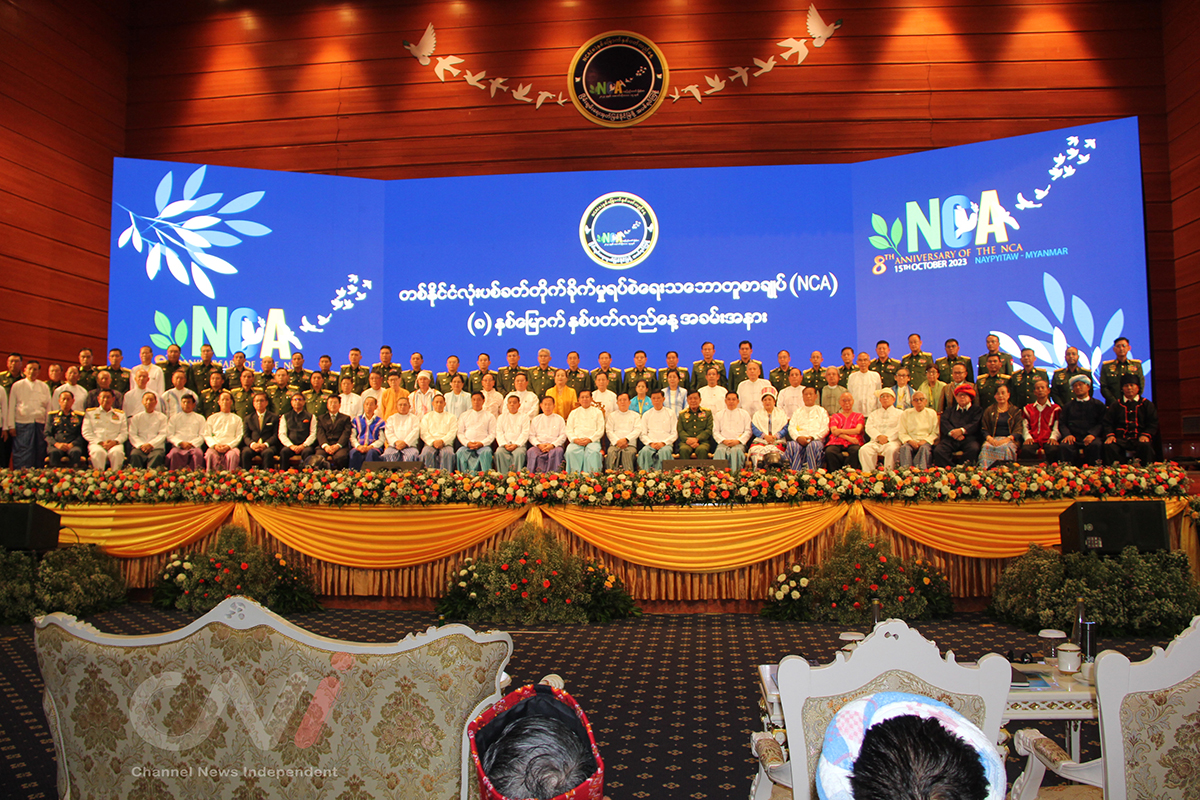
An Anniversary Celebration of the NCA (Nationwide Ceasefire Agreement).
Q: If the right to form these specific State Guard Forces were granted, how do you think the landscape of Myanmar would change?
A: Accepting this wouldn't mean accepting it as a permanent fixture. It must be viewed as an interim stage. We would need to establish clear phases for how these State Guard Forces would eventually transition into a single, unified national army.
Q: Looking at the current situation, many states have multiple EAOs. In Shan State, for example, there are many groups. How should they be organized? In the U.S., they have a Joint Chiefs of Staff model. If Myanmar moves toward a State Guard Force model, how should the initial structure look?
A: I cannot provide technical details on that. In such matters, we should collectively study how Switzerland operated before they formed a unified federal army and establish a policy that fits our own country.
What I recall is that during World War II, they still functioned with state guards. However, they had a Joint Staff for the entire country. During the war, their Joint Staff made the decisions on how to defend the nation, and the respective state guards followed those decisions.
Q: In South Africa, during Nelson Mandela's time, more than seven armed groups were integrated to form the South African National Defence Force (SANDF). His approach involved disarmament, disbanding old units, and then reintegrating them. Since they had been enemies for years and trust was hard to rebuild, they formed commissions where parties could confess their grievances and engage in dialogue. Only then were they retrained under military discipline and standards. Is such a model possible here? How should Myanmar handle this?
A: First, we must talk. But second, we currently lack figures or leaders like Nelson Mandela or Desmond Tutu. Because of this, immediate disarmament followed by reintegration is not easy in our country. It must be a step-by-step process.
However, because it is a gradual process, some might get impatient and say, "Just strip it all away—I’ll disarm first, then you disarm." That might happen, but we shouldn't rush. When we rush, we might overlook or bypass crucial details. If we ignore those details, larger difficulties will emerge later, and they will be harder to overcome. Regardless of the method, we need to talk. Through dialogue, we can find the best path.
We should consider how to combine the Swiss method I mentioned with the South African method you described. We can also study the Nepalese model and synthesize them. The most important thing is to agree: "We will absolutely not fight each other anymore."
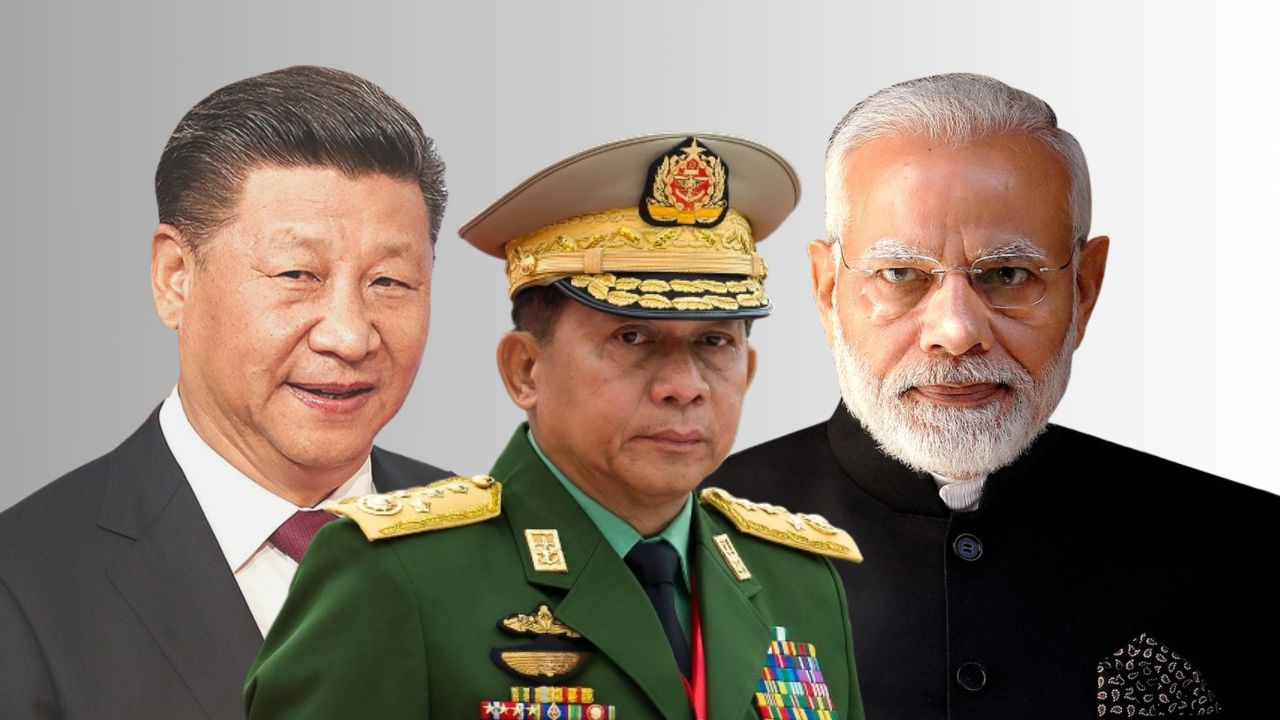
Senior General Min Aung Hlaing with Chinese President Xi Jinping and Indian Prime Minister Modi.
Q: Essentially, there must be a political agreement in place before these discussions can happen, right?
A: There must be. There is one thing we can all agree on right now: we all agree that we must become a Federal Democratic Union. However, the specific "model" of how that will look is what we must negotiate.
Q: A new government will emerge soon this month. What kind of policy should this new government adopt regarding the relationship with China and India?
A: We must follow a Non-Aligned Policy. Even though most people currently reject many sections of the 2008 Constitution, the principles that we are a non-aligned nation and that no foreign troops shall be stationed on our soil are points everyone can agree on. These should remain.
Most importantly, we need to move beyond just paying lip service to the 1955 Bandung Conference agreement and actually practice it. If we can execute that well, Myanmar could truly become the "Switzerland of the East."
Since independence, our Burmese leaders—and by that, I mean all national leaders—have dreamed of and admired this idea. It didn't happen then, but it is possible in our generation.
Q: If instead of a non-aligned policy, the new government leans heavily toward either China or India, what would that scenario look like?
A: If that happens, two things are possible. First, our country might remain a nation in name only. On the surface, we'd still be Myanmar, but in reality, we’d belong to someone else. One could argue there is a silver lining: we haven't known peace in the nearly 80 years we've governed ourselves, so one might hope that falling under another's influence would bring the same peace those countries enjoy. That is one perspective.
The other possibility is that if we align with either India or China, and those two remain at odds, we will inevitably suffer the fallout of their friction. Conversely, if our country can maintain friendship with both, we have nothing to worry about.
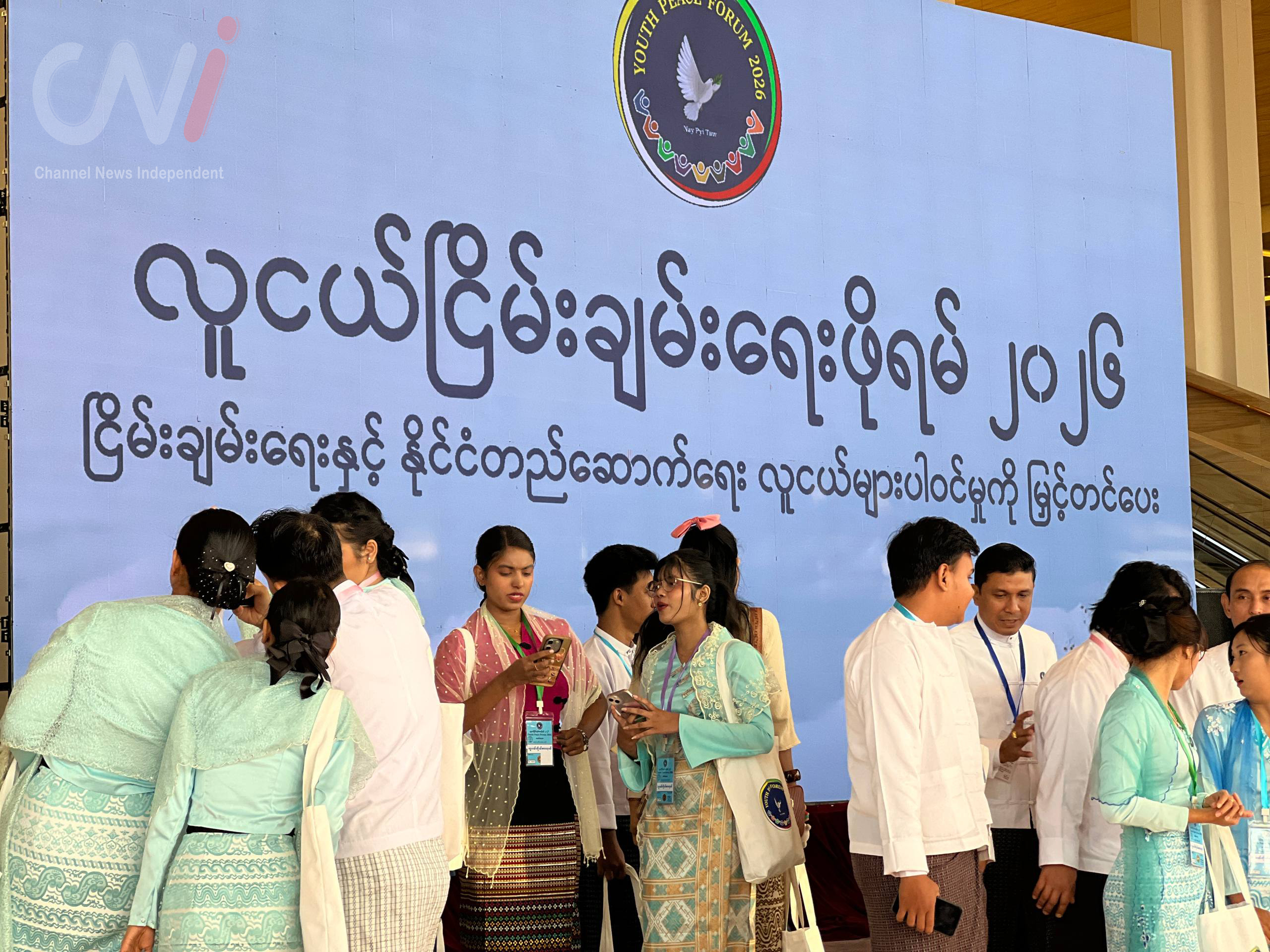
A Youth Peace Forum in progress.
Q: What is your analysis of current "Rare Earth Politics"?
A: Rare earth elements might be scarce in other countries, but you could say they aren't scarce here. Regardless, even if we sell them to whoever wants them, we shouldn't do it just to get some quick cash. We need to get the highest price for our resources.
Furthermore, the revenue generated shouldn't go into individual pockets; it must be used for the country. Geographically, our country is arguably the richest in Southeast Asia, but socially, we are incredibly impoverished. We are like a "rich man's son lost on a sandbank"—clutching a bag of money but with nothing to spend it on, reduced to a life of begging. This era of history needs to end.
I remember hearing our elders say that if every household were given just one teak tree from our forests, there is no way our people would be poor. I liked that idea. But in practice, instead of one tree per household, a single individual ends up owning and selling millions of trees. We must act to prevent this. Rare earth minerals are no different.
Q: Currently, most rare earth-producing areas are controlled by the KIA. How significant is the KIA’s role in this landscape?
A: A state with essential natural resources always has bargaining power. It is very significant. But on the other hand, consider one's survival. Suppose I am a rich man's son with billions of dollars, but I am surrounded by enemies. How can I use that money?
To use it, I need to be on good terms with everyone—or at least the majority. If you work toward that harmony, the benefits aren't just for you; they must include others. If there is a "yours and mine" balance, it’s good for everyone in the long run. We’ve all heard the fable where a deity offers a man who lost his sword a gold one, a silver one, and his original iron one. Because he chose the simple iron one, he received all three. But the one who greedily grabs for the gold sword ends up with nothing. I don't want that to happen to anyone.
In this world, we don't live alone; we live together. I don't need to teach the KIA this; General Gun Maw and General N'Ban La know this better than I do.
Q: Finally, is it necessary to place the military under civilian government control? If so, why?
A: This is a structure that has existed since ancient times. The military must serve under the "Ruler" (the Sovereign). Generals are subordinates to the Sovereign. Whether to keep a general or not depends on the Ruler. However, the Ruler must have the "Virtues of a King," and the Generals must have the "Virtues of a General." Each has their place.
I’m not speaking religiously here. Look at Sun Tzu’s The Art of War. It states that winning a war depends on five factors. Two of the most important are:
The Ruler (The Way): This is the political policy and morality of the leader. If the entire population supports the leader and is willing to follow them even unto death, victory is certain.
The General: The commander’s ability is also vital.
While both the Ruler and the General are crucial, the Ruler must be at the top.
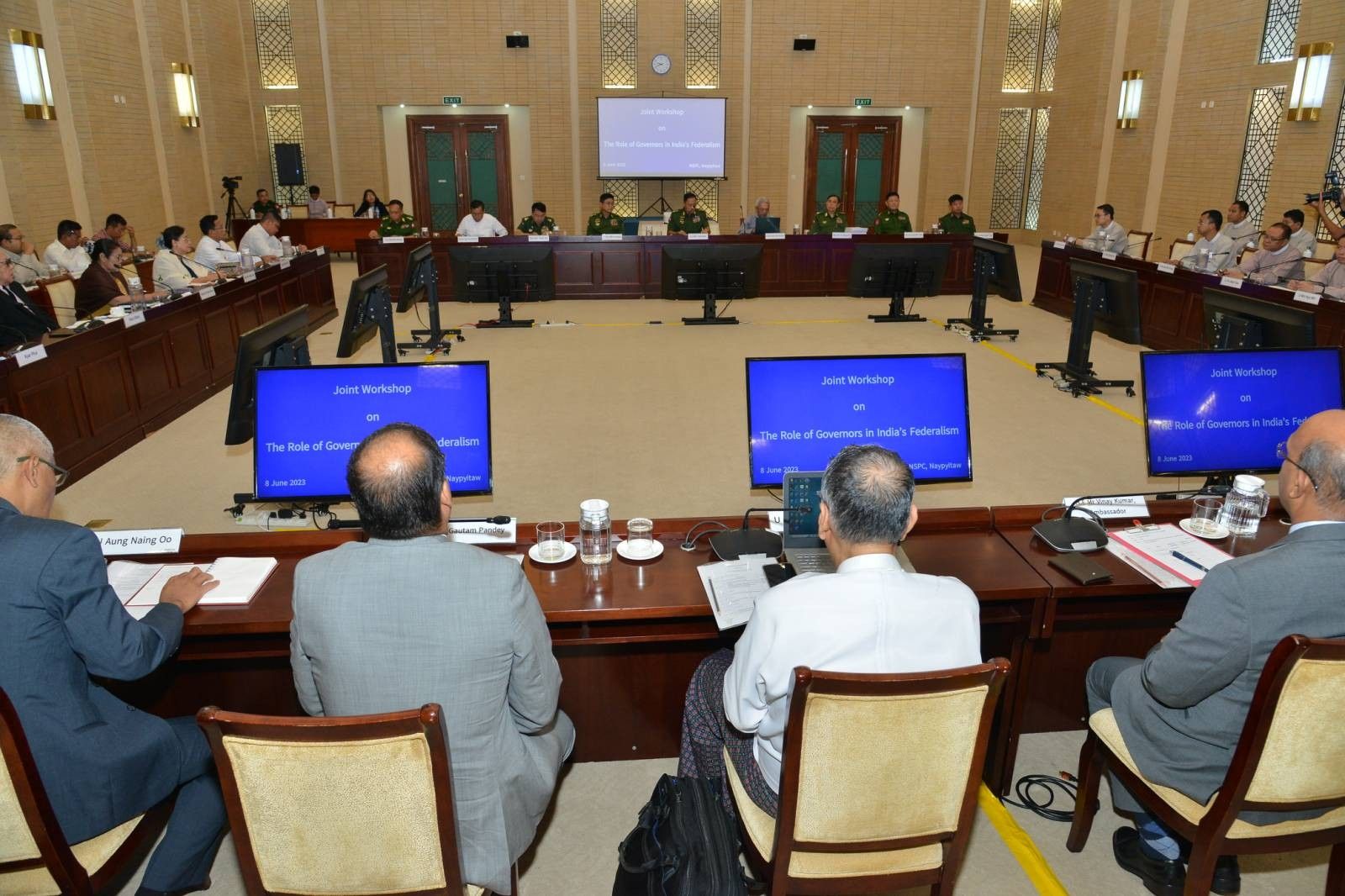
Discussions on Federalism in progress
Q: Do you see that kind of structure emerging in the current Myanmar political landscape?
A: Even George Washington became President. I'm not saying it can't happen here. But remember, when George Washington became President, he didn't rule America like he was commanding an army. That is worth remembering.
Q: If the military stays above the civilian government instead of under it, what happens to the country?
A: That contradicts the traditional wisdom of our elders, so it’s hard for such a system to be sustainable. Our country's failure to thrive is primarily because the military has stayed in a superior position. We must not forget that since 1962, as the military took the upper hand, our country went from being very wealthy to being very poor.
Q: Do you have any additional comments?
A: I think the main problem—and I might be wrong—is that we tend to make things more complicated while trying to solve them. I heard President Donald Trump say that the situation in Iraq was bad before they attacked, but it became much worse after.
This happens when the wrong methods are used for a solution. If we act out of fear and hatred instead of using the right methods, the country will never improve. If we have loving-kindness for one another and discard anger, we can solve any national problem.
Foreign peace experts have told me they've never seen a people as politically savvy and knowledgeable as those in Burma. Every group is full of political "doctors." But their problem is that instead of discussing to reach an agreement, they spend all their time trying to "win" the debate. When they can't win the debate, they take up arms.
That is why our country needs to move away from the culture of "Debate" (trying to beat the other side) and toward "Dialogue" (searching for the truth together). Whether it was President U Thein Sein or whoever else, we started talking about a new culture of solving political problems through discussion rather than force in 2011. It has been 15 years now. We haven't fully implemented it yet. I urge everyone: it is time to make it happen.