
CNI News
February 27, 2026
Military and political analysts are pointing out the necessity of territorial demarcation among Ethnic Armed Organizations (EAOs) due to frequent territorial disputes.
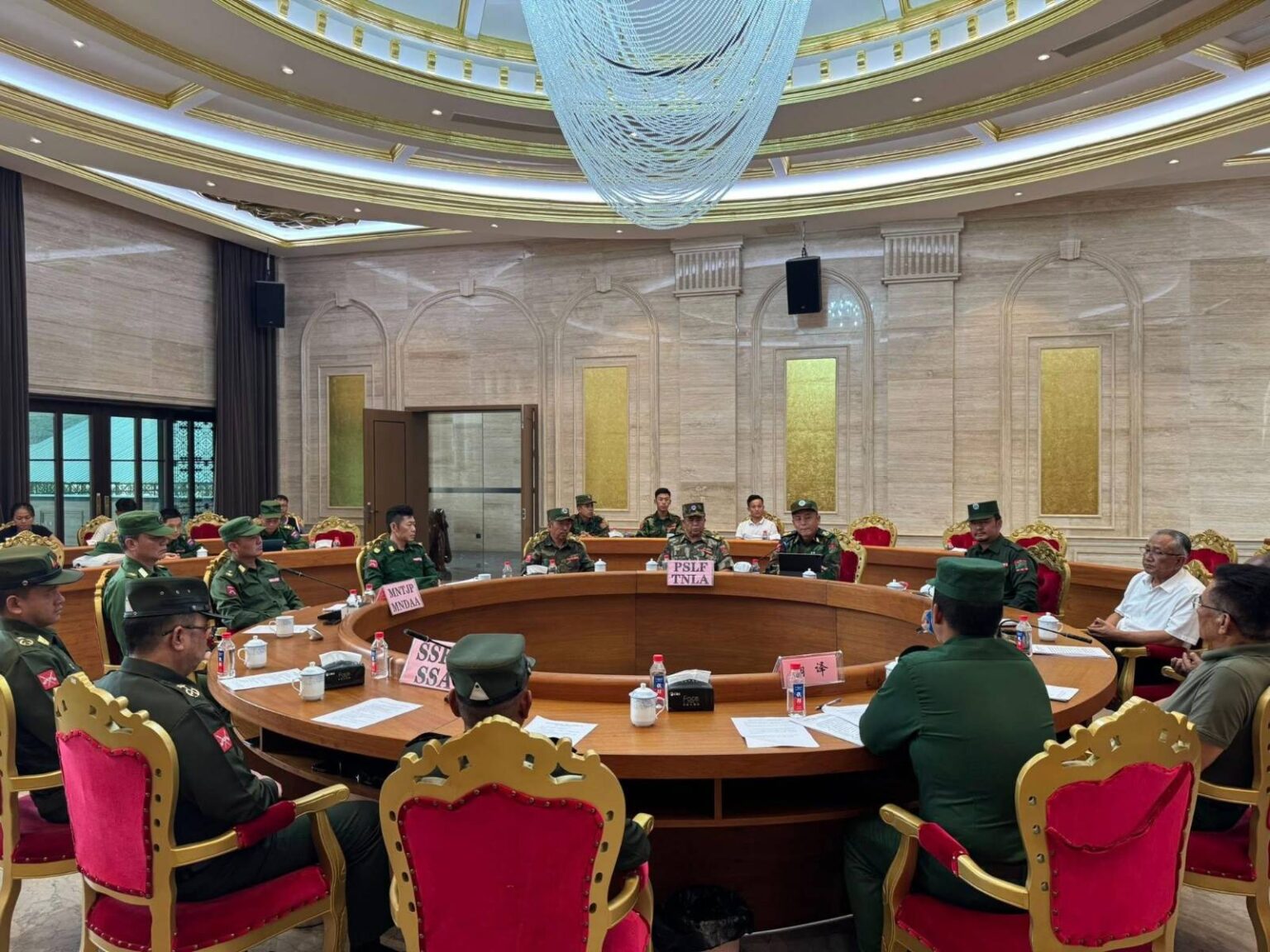
Recently, in Kutkai Township, Northern Shan State, administrative rivalries emerged between the MNDAA (Kokant Army) and the TNLA (Ta'ang Army). This led to altercations and the imposition of restrictive inspections on the movement of local civilians.
Locals reported that the friction between the MNDAA and TNLA was also evident during recent earthquake relief efforts; TNLA members reportedly intervened while MNDAA members were collecting funds, leading to physical brawls.
Dr. Hla Kyaw Zaw, a China-Myanmar affairs analyst, told CNI News that territorial demarcation is essential among EAOs. She noted that since these disputes involve not just administration but also self-interests like taxation, clearly defined borders could reduce the likelihood of conflict.

TNLA and MNDAA forces seen inside Kutkai.
"Territorial demarcation is necessary because a systematic administrative system needs to be built. In some places, there are no defined boundaries. When boundaries are missing, there should be negotiations. If districts overlap, they could implement joint administration or take turns. They used to do that. I don’t know if they are doing it now, but boundaries must be set. Conflicts arise not just over administration, but over tax collection. When self-interest is involved, the conflict escalates. Therefore, there must be clear definitions and rules on how to resolve issues when they arise. The leaders likely have these rules, but sometimes the grassroots levels act out of emotion," she said.
Following "Operation 1027," which began on October 27, 2023, in Northern Shan State, the TNLA has faced territorial and administrative rivalries with the KIA, MNDAA, and SSPP. Currently, Northern Shan State sees active presence from the TNLA, KIA, MNDAA, AA, SSPP, and UWSA, alongside people's militias and PDF forces.
Political analyst U Htet Aung Kyaw told CNI News that while territories might be demarcated amidst ongoing conflicts, such arrangements would only be temporary. He believes territorial disputes will only truly end when a peace process agreed upon by all parties is reached.

Members of the Shanni Nationalities Army (SNA).
"When you take up arms, everyone wants to claim 'this is my territory.' However, I want to see the civil war end quickly and move toward a political landscape that is fair and agreed upon by all. In my opinion, dividing territories like this shouldn't happen. But by the nature of being armed, there will be 'your territory' and 'my territory.' Only when we reach a political settlement will these disputes end. Any demarcation before peace is achieved is just temporary. In Northern Shan State, multiple ethnicities live in a single town. You can't just separate the people based on who controls the area. You can't say 'only Palaung live here' or 'only Chinese live there' because the population is intermingled. Therefore, problems will persist," he explained.
Currently, across Myanmar, battles for territorial control and dominance are occurring between the Myanmar military and armed groups, as well as among the armed groups themselves. The KIA is conducting operations in Kachin State, Shan State, and Sagaing Region, leading to clashes with the Shanni Nationalities Army (SNA) and the Myanmar military (Tatmadaw), as well as disagreements with the Naga armed group (NSCN).