
CNI News
26 December 2025
The emergence of reports regarding a secret agreement between India and the Kachin Independence Army (KIA) may be intended to incite a tripartite conflict between India, Myanmar, and China; however, it is unlikely that India would allow the situation to reach that stage, Dr. Hla Kyaw Zaw, a China-Myanmar affairs analyst, told CNI News. She added that such reports could also be aimed at creating friction between the KIA and China.
The US-based Silicon Valley Times reported that a special investigation uncovered a secret agreement signed between India and the KIA in Myanmar. This agreement reportedly involves strategic cooperation for rare earth mineral extraction at a time when Myanmar’s sovereignty is being undermined.
Regarding this, Dr. Hla Kyaw Zaw explained to CNI that rare earth minerals cannot be used immediately after extraction; they require complex processing, a stage currently dominated by China.
"Actually, rare earths exist in other countries too, like the US, but they don't process them due to environmental impacts. China takes those risks and uses its processing capability as a trump card. I think this news is being spread to disturb the KIA. Some want to replace China with India in the rare earth trade between China and the KIA. To my knowledge, the KIA sells almost all of its rare earth to China, and only Chinese companies are operating there. So, this news might be aimed at creating conflict between China and the KIA," she said.
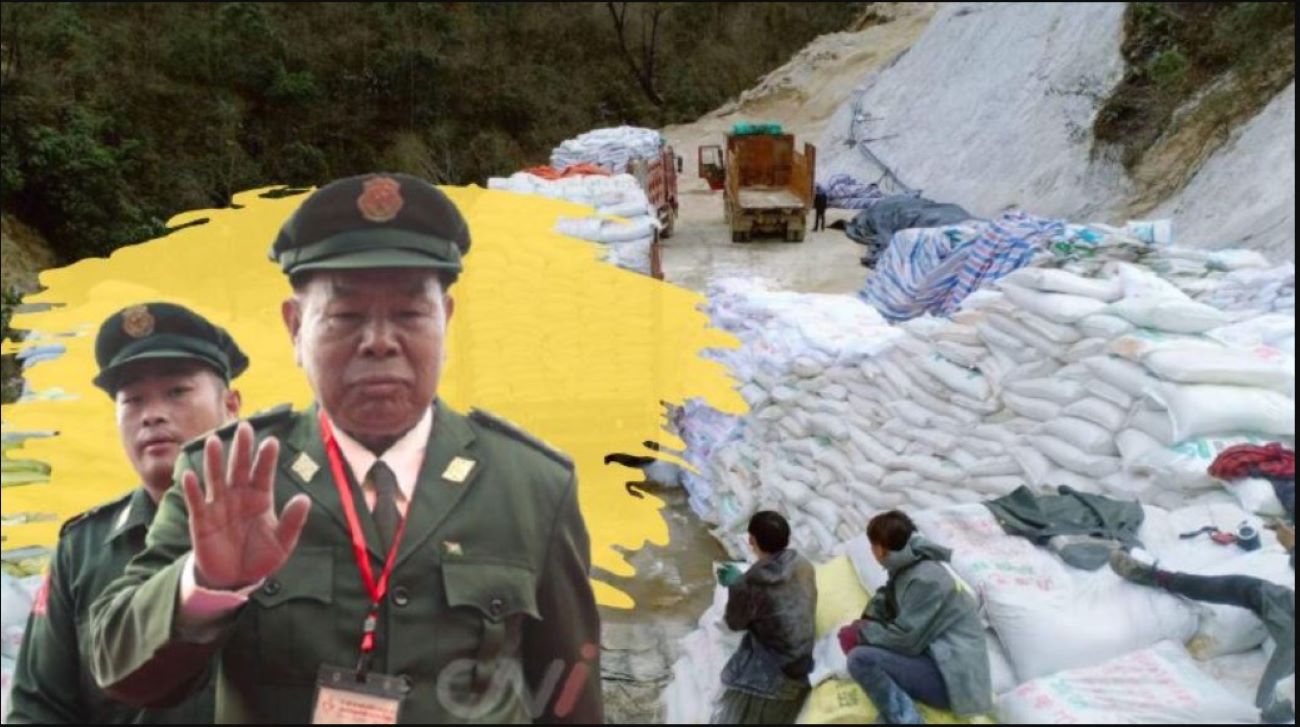
KIA and rare earth minerals seen
She further noted, "What they might not realize is that India and China are currently on quite good terms. They are even considering joint strategic cooperation. Therefore, I don't think India would do anything to trigger a conflict with either the Myanmar government or China. There might be discussions at the corporate level, or perhaps through joint ventures between Indian and Chinese companies, but I doubt it is happening at the state level."
Colonel Naw Bu, the spokesperson for the KIO's central information department, has denied the reports, stating that the news of a secret agreement between the KIA and the Indian government is false. However, political and military observers pointed out that it is not surprising for both parties to deny such claims, as admitting to a secret pact could be seen as a sign of political weakness.
In contrast, the Silicon Valley Times claimed that satellite imagery and cross-border intelligence confirmed the construction of a 365-km road from Vijaynagar in India’s Arunachal Pradesh to rare earth mines in Chipwi, Kachin State. This road, allegedly built without the permission of the Myanmar government or the military, would allow India access to Myanmar’s rare earth resources in exchange for providing weapons, medicine, and other logistics to the KIA. The partnership reportedly also includes a secret plan to build a second strategic road connecting the KIA headquarters in Laiza to Rihkhawdar in Chin State, passing through the Sagaing Region.
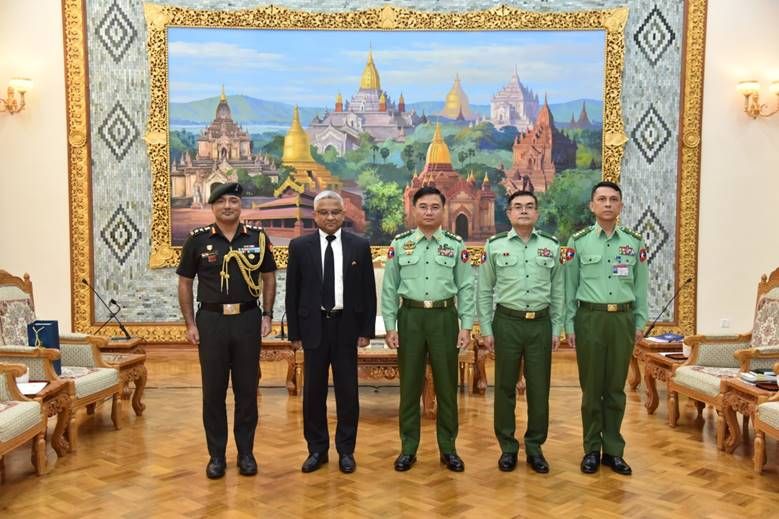
Indian Ambassador and General Kyaw Swar Kin, Chief of the General Staff (Army, Navy and Air)
Colonel Khun Okkar, Chairman of the Pa-O National Liberation Organization (PNLO-NCA/S), told CNI that while there are communications between India and the KIA, a secret agreement remains unconfirmed.
"They do have communications. I'm not sure if a secret agreement has been reached. The KIA has long had a department called 'Rawka I' for Indian affairs and 'Rawka T' for Thailand. It’s possible that negotiations are being conducted through Rawka I," he said.
Following the reports of the secret pact, the Indian Ambassador to Myanmar, Mr. Abhay Thakur, met with General Kyaw Swar Lin, Chief of the General Staff (Army, Navy, and Air), on December 15, 2025. During the meeting, they discussed enhancing cooperation between the two militaries to ensure border security, stability, and the rule of law.