
CNI News
25 December 2025
Following the shifts in Myanmar’s political landscape after February 1, 2021, various ethnic groups have voiced their respective desires for political status. Consequently, Mon politicians are currently analyzing and discussing the specific political landscape desired by the Mon people.
Mon politicians point out that, unlike some other ethnic groups, the Mon already have a designated State level. However, they emphasize that the current administrative system is not a democracy based on federalism.
Dr. Aung Naing Oo, a veteran Mon politician, told CNI News that the Mon people desire the right to self-determination and the right to choose their own administrative bodies.
"Regarding the political landscape we want to pursue, based on our Mon negotiations, the one point we all fundamentally agree on is the issue of federalism. In other words, we desire a democratic system based on federalism," he said. "Such a system means that the federal units—the States and Regions—must have the right to self-determination and the right to elect their own administrative bodies. That is the path we want to take. Additionally, we must hold substantial legislative powers ourselves. Simply put, we want a genuine federal system."
Historical records show that during the Revolutionary Council era in 1972, the Mawlamyine and Thaton districts of the Tenasserim (Tanintharyi) Division were designated as Tenasserim Division No. 1, while Dawei and Myeik districts were designated as Tenasserim Division No. 2. Later, on January 3, 1974, Tenasserim Division No. 1 was officially re-designated as Mon State.
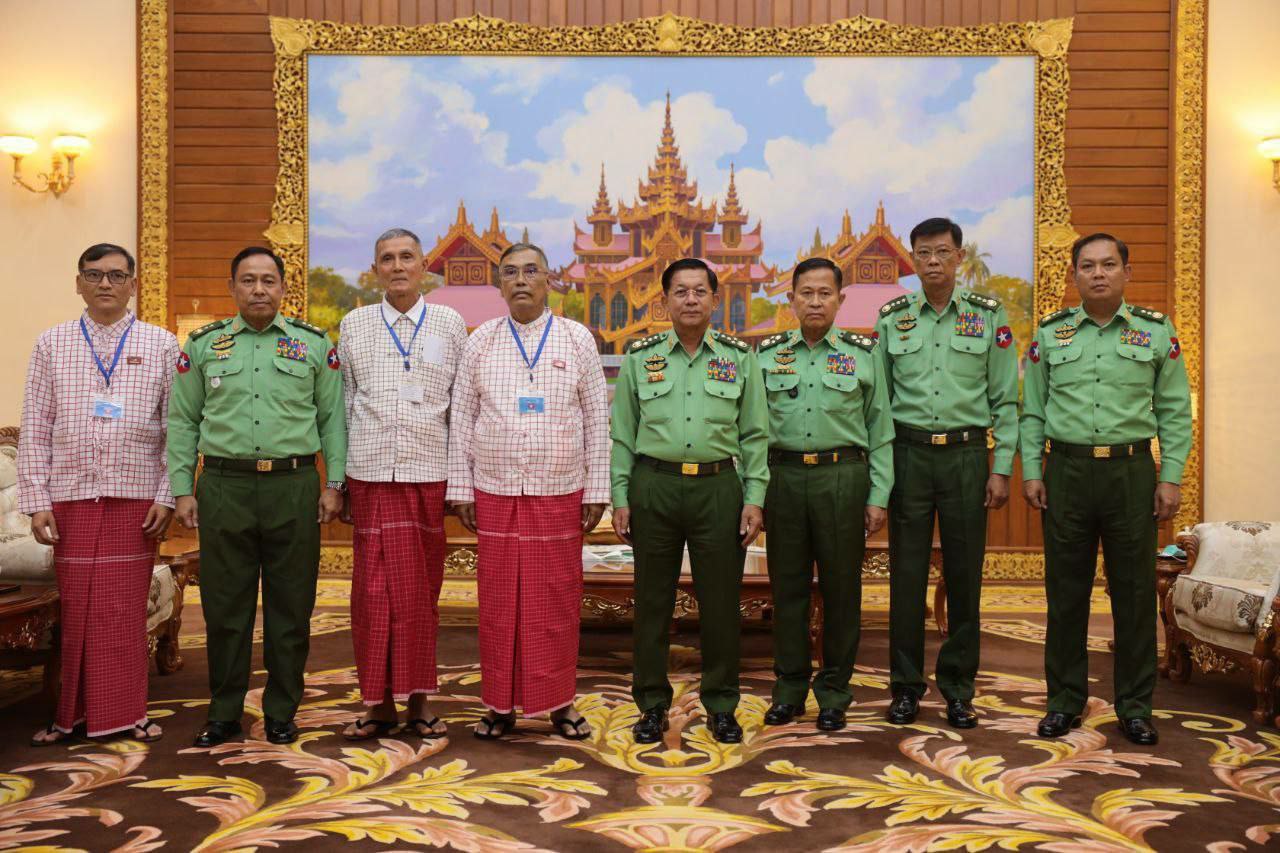
The armed New Mon State Party seen
Currently, the Mon people primarily reside in Mon State, Kayin State, Yangon Region, Mandalay Region, Bago Region, and Tanintharyi Region, and are scattered throughout Myanmar. In Kayin State, they live in certain villages within Kawkareik, Hpa-an, and Kyainseikgyi townships, as well as in Myawaddy and Hlaingbwe townships.
Naing Than Shwe, spokesperson for the Mon Unity Party (MUP), told CNI News that for a Mon State that already exists, it is essential to implement local administration that best aligns with federal standards.
"In this election as well, our main focus is federalism. When we shape federalism, it involves levels of government, particularly the administrative sector," he said. "If we implement local governments according to federal standards, whether you call it self-administration or otherwise, it will be more beneficial for the public. Currently, if we look at the administration, the administrator of a township is not chosen by the local residents but is an official from the General Administration Department (GAD). When a local government cannot govern its own area, how can it develop that area? Locals lack the authority. Therefore, it is crucial to implement local administration effectively; this is consistent with federal standards."
Following the 2021 political changes, a group called the New Mon State Party - Anti-Dictatorship (NMSP-AD) broke away from the New Mon State Party (NMSP).
Subsequently, four Mon armed groups emerged: the Mon Liberation Army (MLA), the Mon National Liberation Army-Anti Dictatorship (MNLA-AD), the Mon State Defense Force (MSDF), and the Mon State Revolutionary Force (MSRF). These four groups have formed the "Mon Army" to conduct military operations.
While the Karen National Union (KNU) and PDFs under the NUG are also active in the region, Mon State currently remains relatively more stable compared to other states.