
CNI News
June 17, 2026
It has been reported that Members of Parliament (MPs) representing political parties must notify the Union Election Commission (UEC) regarding any meetings with foreign organizations.
On August 11, 2022, the UEC sent a letter instructing registered political parties in Myanmar that they must notify the Commission if they intend to meet with foreign organizations. Following this, on June 11, 2026, a directive was issued stating that MPs must also notify the UEC if they are to meet with foreign organizations.
U Kyaw Min Htet, a Yangon Region MP from the People’s Pioneer Party (PPP), told CNI News that while it is standard practice for MPs to report meetings with foreign organizations and diplomats, requiring them to report meetings with individuals feels like a restriction on the personal freedom of MPs.
He said, "When the statement was issued, notifying the UEC about meeting foreign organizations and diplomats wasn't the issue. However, when it includes meeting with 'foreign individuals,' it infringes upon our personal freedom. They (the authorities) probably fear that MPs might coordinate with or receive support from people belonging to countries they are not on good terms with. But on the other hand, this is a time when we have to engage in international business, and some MPs used to be business owners. A question worth asking is whether business-oriented MPs must also report their routine meetings with foreigners regarding business matters. The definition of 'foreign individuals' is a bit too harsh."
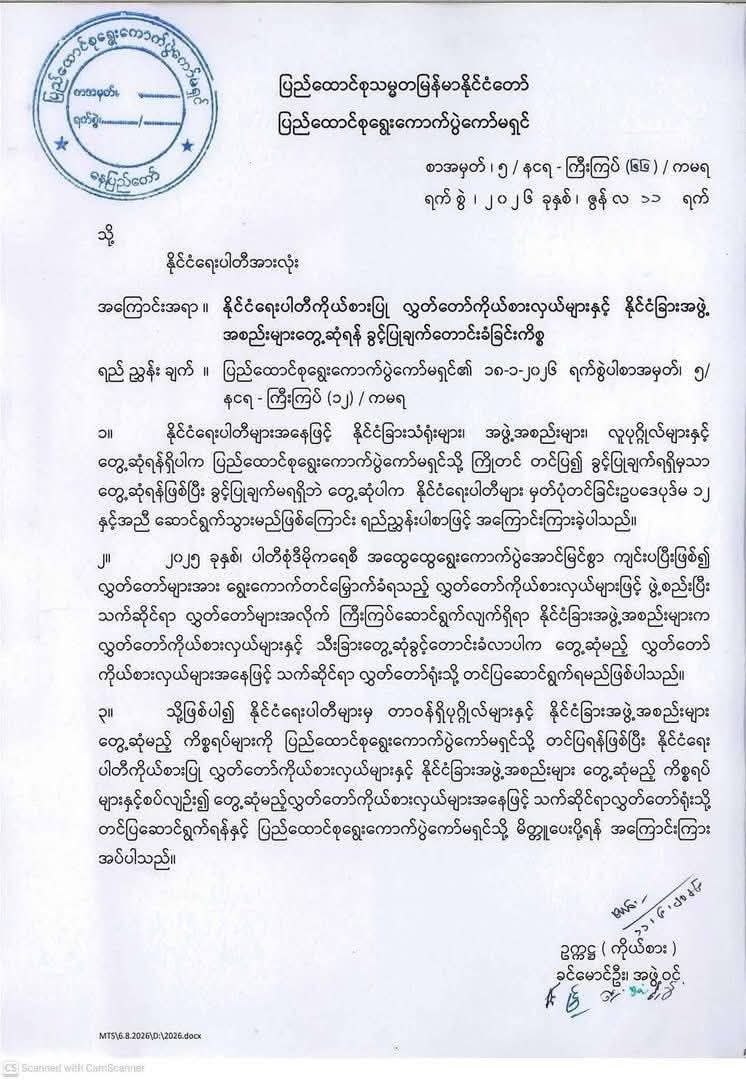
The issued directive instructing MPs to notify authorities when meeting foreign organizations.
U Kyaw Min Htet further stated that restricting MPs from freely meeting foreign organizations is inappropriate for a country aiming to build democracy.
"Notifying ahead of meetings with international diplomats and non-governmental organizations (NGOs) isn't much of a problem, but having to report meetings with foreign individuals feels a bit too restrictive. Just reporting it isn't an issue. But if it leads to situations where permission is denied, it will become a major problem. If it is just about reporting and then going ahead with the meeting, that is fine. But if denials happen after an MP submits a report, the question will arise whether this should be happening in a democratic country," he said.
Other MPs also pointed out that if one-on-one personal meetings must be reported to the UEC, it could restrict the mandate of MPs and negatively impact personal privacy. Consequently, members of the public have noted that instead of debating and presenting public interests, MPs now find themselves in a position where they must first struggle to secure their own basic freedoms.
U Kyi Linn Htet, a Pyithu Hluttaw (Amyotha Hluttaw/National Assembly) MP from the People's Party (PP), told CNI News that subsection (3) of the directive—which states that MPs meeting with foreign organizations must send a copy to the respective Hluttaw (Parliament) office and the UEC—is ambiguous.
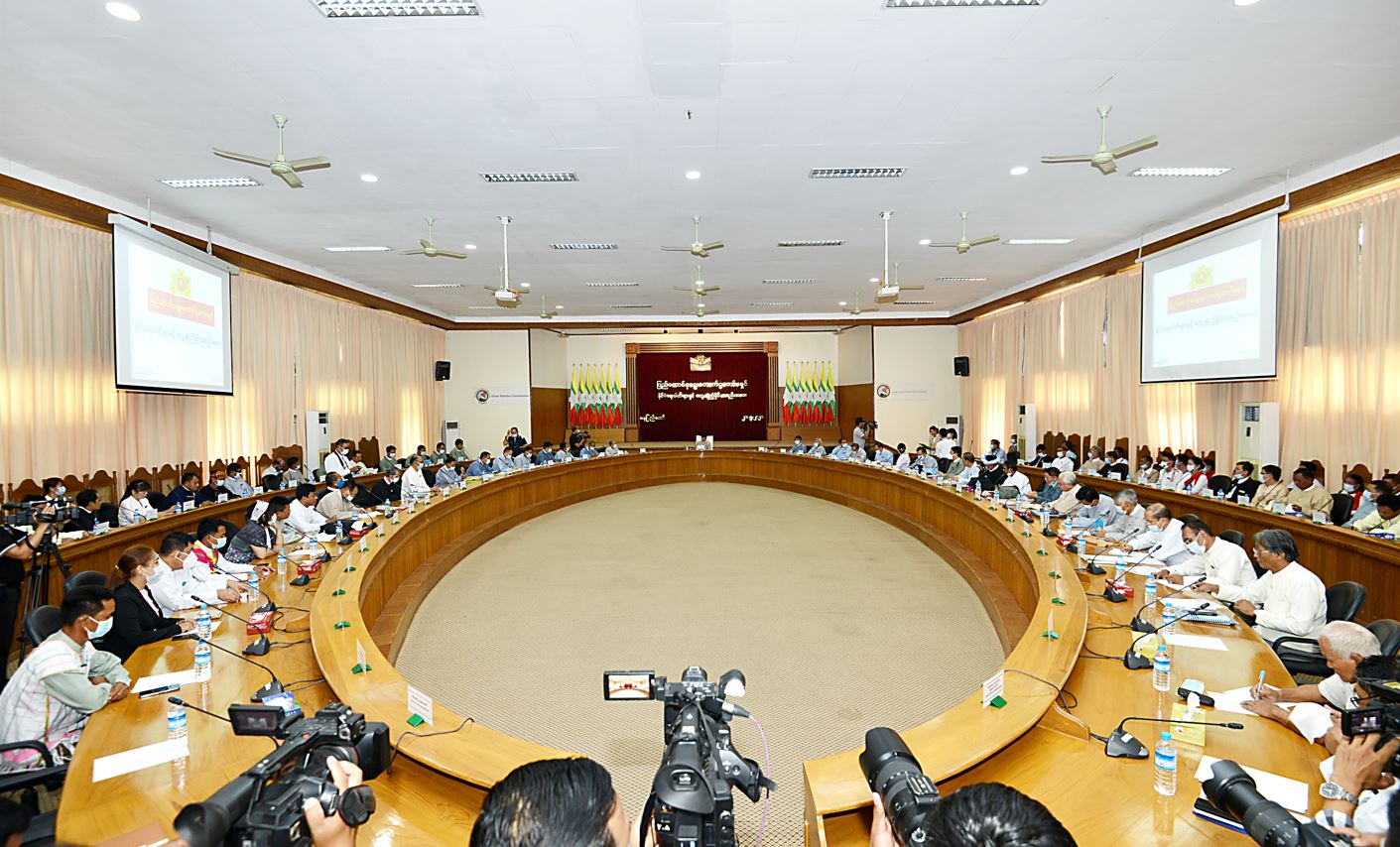
A meeting between the Union Election Commission and political parties.
He explained, "There is something to be said about the phrasing used in subsection (3). It states: 'Regarding matters of MPs meeting with foreign organizations, the meeting MPs shall submit and proceed through the respective Hluttaw office.' This part is completely normal. However, it adds: 'It is informed to send a copy to the Union Election Commission.' I think this is a bit unusual. If you look at subsection (2), it is clear. The directive is addressed to all political parties, not directly to the MPs. It is normal for the Election Commission to issue directives to political parties. They have the authority to issue orders and directives under Section 26 of the law. While subsection (2) is clear, the phrasing in subsection (3) that says 'informed to send a copy to the Union Election Commission' feels a bit strange. It doesn’t seem to align well with the main intent."
U Kyi Linn Htet added that normally, the parliament is directly guided by the Speaker of the Amyotha Hluttaw, the Speaker of the Pyithu Hluttaw, or the Speaker of the Union Hluttaw. He suggested that it would be smoother if the UEC requested copies from the political parties themselves or coordinated directly with the Hluttaw office.
Political analysts pointed out that given the current political climate in Myanmar, this directive might have been issued out of necessity due to concerns over foreign interference in the country's affairs.
On the other hand, military and political analysts highlighted a contradiction: while the government and the military have been urging Ethnic Armed Organizations (EAOs) to form political parties, contest elections, and pursue their demands through parliament, they are simultaneously dissolving political parties and tightening restrictions on MPs and political parties regarding meetings with foreign diplomats and organizations. They warned that this approach could negatively impact the peace process.