
CNI News
May 22, 2026
Military and political analysts are sharing their assessments on how Myanmar should address the impacts of foreign influence on the country.
Analysts point out that Myanmar is currently facing multiple regional challenges: the Bengali issue in the west; the US-backed Kachin Independence Army (KIA) liberation war in the northwest; the "Jia Pian" (online scam/fraud operations) issue involving Karen armed groups and Thai dominance in the south; and growing Chinese dominance alongside the Myanmar National Democratic Alliance Army’s (MNDAA) territorial expansion war in the northeast.
Given these developments, Myanmar can be said to be under the influence of foreign countries. Therefore, a political dialogue aimed at finding a political solution must be implemented as soon as possible, U Thar Tun Hla, Chairman of the Arakan National Party (ANP), told CNI News.
He said: "I want to say that it depends heavily on how we manage and solve Myanmar's problems. We need to study and analyze the situations of our neighboring countries and reshape a Union nation. The main point is that because our ability to solve internal problems is still weak, we are suffering from the impacts of foreign influence, as the current situation shows. Therefore, regarding how we should take action, we urgently need to implement political dialogues that find genuine political substance and solutions, with a clear political intent on how to build the current Myanmar as a Union state. The situation across the entire country has become complicated. It is not a case where one particular state is more complicated and another is not. Currently, the political problem is a complex issue for the entire nation. Because of this complexity, some people suffer less and others suffer more—I think that is the only difference. Since the political problem is tangled nationwide, we now need to discuss and implement a model for state-building."
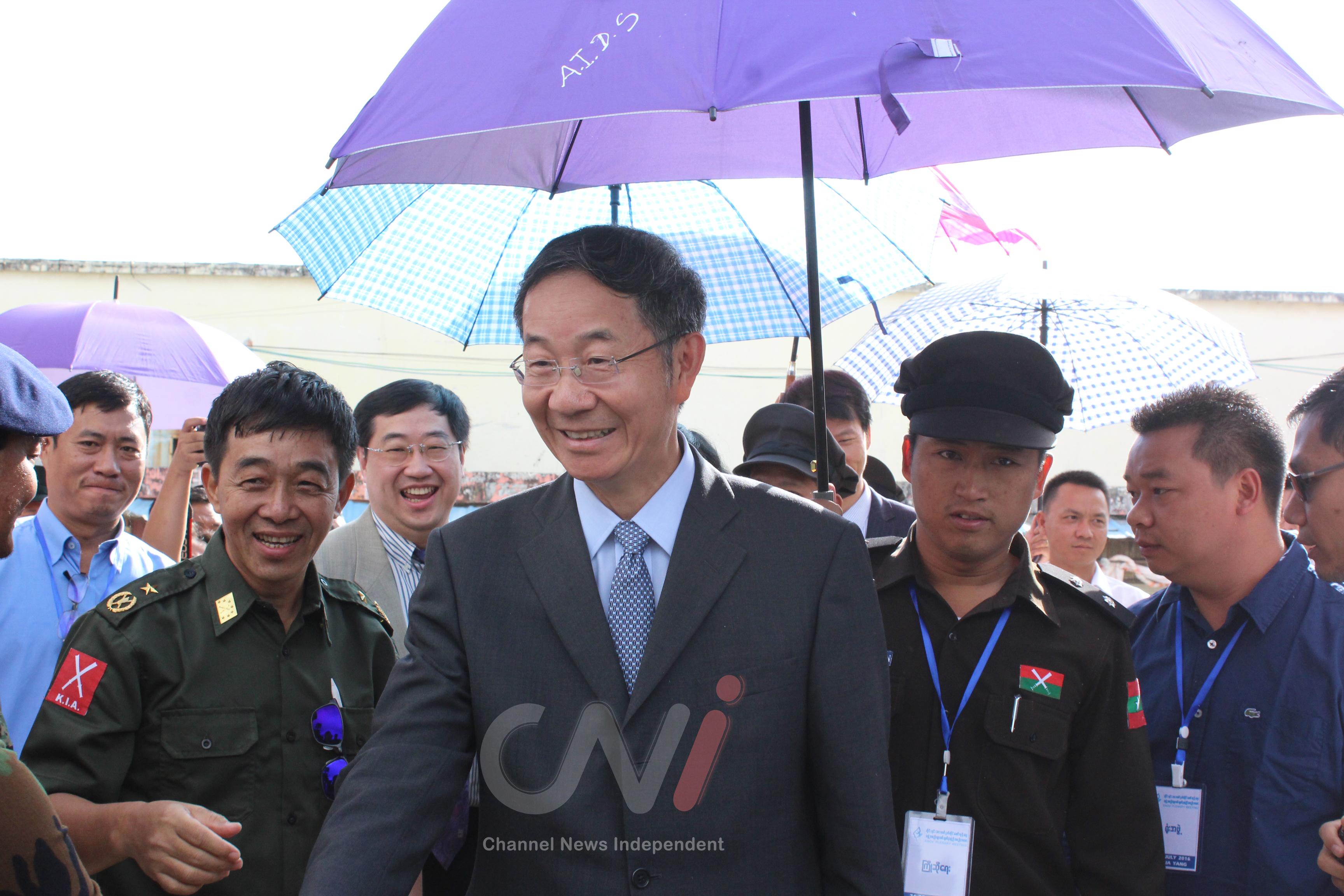
KIA leader Lieutenant General Gun Maw seen with former Chinese Special Envoy Mr. Sun Guoxiang.
According to the current situation, military and political analysts point out that China’s leverage is immense in Myanmar’s northeast, allowing China to manipulate the situation at will.
Analysts assess that foreign countries could either directly occupy Myanmar's territories or establish a puppet government/administrative mechanism that they can control as they wish, effectively turning the region into a subordinate buffer zone.
They note that the worst-affected area currently experiencing this foreign influence is northern Shan State. Since the MNDAA took control and began administering the region following Operation 1027, an increasing influx of Chinese nationals has been observed.
It is reported that in the territories captured and controlled by the MNDAA, only the Chinese language is permitted to be spoken, and only the Chinese Yuan is allowed as currency. Furthermore, signboards with Chinese characters, as well as Kokang household registration lists and identity cards, are being issued.
In these areas, land purchases by Chinese citizens are on the rise, and the MNDAA has been granting them business rights and mineral mining permissions.
Dr. M Kawn La, a political analyst, told CNI News that Myanmar's current situation is worse than the Kuomintang (KMT) invasion of 1951–52.

Leaders of the AA-MNDAA-TNLA seen together.
He stated: "What I want to appeal to both the EAOs (Ethnic Armed Organizations) and the current new government is that nothing is more important than the foreign danger. I urge both sides to make reasonable political compromises, implement the peace process swiftly, look at this danger, and protect against it as quickly as possible. If we remember, this is like the 1951 Kuomintang invasion. Back then, while we were still suppressing the Burma Communist Party, we also had to fight off the Kuomintang invasion. The current situation is similar to the Kuomintang invasion. However, back then, it was a spillover from the Chinese Civil War, so the United Nations handled and resolved it. Today, it is not easy for the UN to act. China is entering by overshadowing trade routes. They have protection. This makes it very difficult for the international community to take action. Therefore, this time is worse than the 1951–52 Kuomintang invasion. This is something we must definitely realize."
Military and political analysts assess that if this foreign influence cannot be prevented, Myanmar's oil, natural gas, jade, gemstone reserves, and strategic coastal ports will face unrestricted exploitation and manipulation.
They conclude that control over territory in Myanmar is fragmented among ethnic armed groups, local defense forces, and the military (Tatmadaw). If a foreign invasion occurs under these conditions, the central power system will completely collapse, the country could shatter into pieces, and the danger is severe enough that the nation could end up as a failed state.