
CNI News
14 March 2026
Political analyst U Htet Aung Kyaw told CNI News that while armed organizations and the general public in Myanmar claim to dislike military dictatorship, the country is practically facing "multiple military dictatorships."
He stated: "The revolutionary forms of the various armed groups in Myanmar likely do not share the exact same vision. Because the problems in Myanmar have persisted for so many years, the original core issues sometimes seem to have lost their shape. However, it’s not that they cannot be solved. While we all claim to oppose military dictatorship, almost all these groups have become dictatorships themselves—some small, some large. It is an undeniable fact that the public, while rejecting a single dictatorship, is now facing many."
If it were otherwise, building an army wouldn't be about making money; it’s an expensive venture. This has become a vicious cycle: are they raising armies to make money, or making money to raise armies? This problem continues without end."
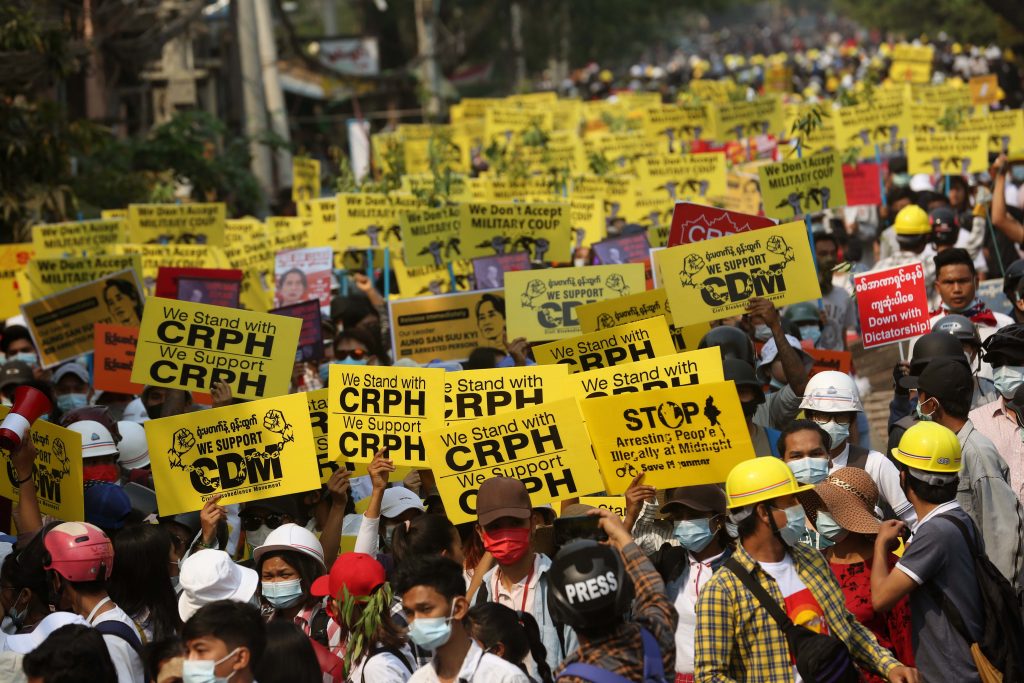
The public protesting in 2021
Myanmar has faced internal conflict since March 1948, shortly after gaining independence on January 4, 1948, and the issue remains unresolved to this day. Successive administrations—including those of U Ne Win, U Than Shwe, U Thein Sein, Daw Aung San Suu Kyi, and the current administration of Senior General Min Aung Hlaing—have held peace talks with armed groups, yet success remains elusive.
U Khun Sai, who is involved in the peace process, told CNI News that trust must first be established with the nearest armed organizations before more distant groups will feel confident enough to join the process.
He explained: "Currently, if they (government) want to move forward, they must build trust with the nearest armed groups and political parties. If they can achieve this, the groups further away will gain confidence and participate. This includes political parties close to the government, CSOs, and Ethnic Armed Organizations (EAOs) that are in regular contact. They need to be kept 'satisfied,' meaning their rights must be granted and their demands negotiated.
Discussions regarding the NCA (Nationwide Ceasefire Agreement)
These negotiations must also be made public. We need to show the people that we aren't just leading unilaterally, but that we are actively considering and valuing the thoughts, needs, and reasons of the other side. If those who aren't ready to talk yet see this and feel it is reliable, they will join. If we cannot satisfy or build trust with those closest to us, others will not come."
Military and political analysts pointed out that Myanmar's armed conflict is a problem involving all parties. Issues regarding democracy, federalism, peace, security, and ethnicity concern every organization and must be discussed equitably between all sides.
The armed conflict in Myanmar has expanded significantly following the political shifts after February 1, 2021, leading to a proliferation of armed groups. Currently, while the Myanmar military and the government are experiencing territorial losses, ethnic armed groups are increasingly focused on securing territorial control.