
CNI News
January 29, 2026
Political analyst U Htet Aung Kyaw told CNI News that if a new civilian government emerging after the election can effectively demonstrate national reforms, it is unlikely that the international community will not support the government.
The Malaysian Foreign Minister, Mohamad Hasan, stated on January 20 that ASEAN had clearly announced in advance that it would not send election observers and would not recognize the election.
On the other hand, Senior General Min Aung Hlaing stated on January 25, 2026—following the conclusion of the third phase of the election—that he does not understand the international community’s recognition or non-recognition, but rather recognizes the public's participation in casting their votes.
U Htet Aung Kyaw told CNI News that the international perspective depends solely on the capabilities of the incoming new government. He noted that an elected government framework is more flexible than the current landscape where the military holds absolute control.

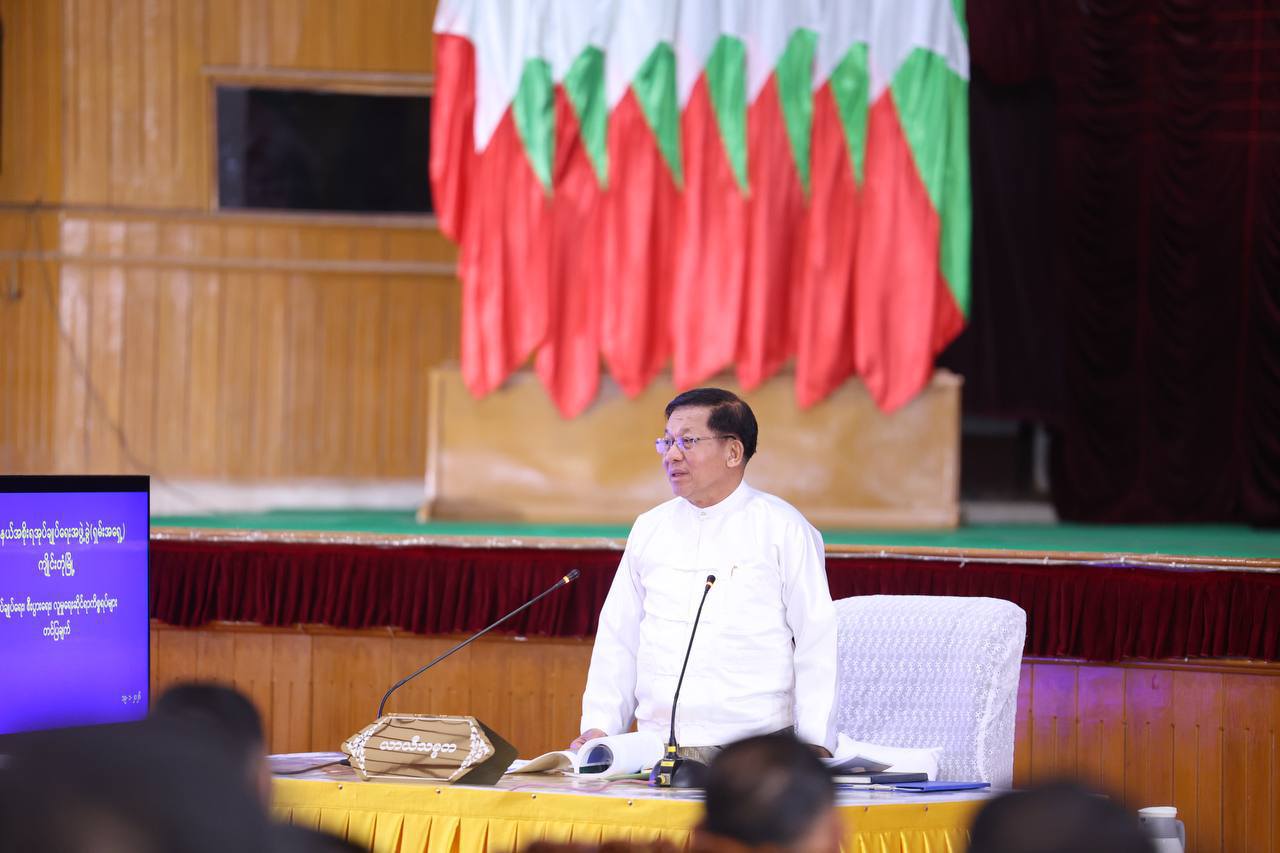
Senior General Min Aung Hlaing seen
He stated: "We are moving from a situation where the military holds 100% control to one where they might hold, say, 25%. Although the military-aligned Union Solidarity and Development Party (USDP) won the majority and everyone views them as the military, I don’t see it quite like that. It becomes an 'elected' body. Regardless of whether voter turnout was low or high, there was no set threshold for how many must vote for it to be valid; therefore, we must define it as an elected government. Such a government holds much more legitimacy than the current state. If this new government can truly show reforms, the countries that previously said they wouldn’t support it will change their attitudes. This is exactly what happened in 2010. Everything will fall into place depending on the new government’s performance and its goodwill toward the country."
Furthermore, U Htet Aung Kyaw added that regarding international relations, the country has already passed through the worst-case scenarios, and there is no reason for things to deteriorate further.
"In my view of international relations, 'it is never darker than at midnight.' We can say we have passed the worst. If an elected government emerges, there will be a better shift. If the resulting government handles matters smartly and can demonstrate real reforms, the 'rays of dawn' will appear. We can hope for that," he said.

Senior General Min Aung Hlaing seen
Dr. Hla Kyaw Zaw, an analyst of China-Myanmar affairs, told CNI News that while the government might gain some level of international legitimacy after its formation, there will be no way out unless internal issues are resolved.
She said: "Once the government is formed, it will gain some degree of international legitimacy as a 'De Facto Government'—a government actually in power. However, it won't be easy to overcome the crises the military is currently facing. While the Malaysian Foreign Minister said they won't recognize the election, a new government will appear regardless. It might receive some recognition internationally, but without solving domestic problems, there is no exit. I think our revolution will have to continue its course. There is no reason for an escape for them. Diplomatically, they might get some breathing room, though."
The multi-party democratic general election in Myanmar was held in three phases, starting from December 28, 2025, and was successfully concluded on January 25, 2026.