
CNI News
22 January 2026
Following the results of the multi-phase elections held in Myanmar, the incoming government is expected to remain under the direct leadership of the military, political analyst Sai Mein told CNI News.
He stated, "In truth, even during the U Thein Sein government era, military generals shed their uniforms before being elected. Back then, the presidential candidate was predictable. However, based on the current situation, many analysts see a developing 'game' regarding whether the military leader himself will take the presidency, or whether he will remain Commander-in-Chief to maintain control over the military. To be blunt, the government emerging in 2026 will still be one that aligns with the military's wishes. No matter how it is composed or formed, it will remain a government dominated and led by the military itself."
Political parties are expressing concern that the post-election government will be led by the military and the Union Solidarity and Development Party (USDP), resulting in a highly centralized administration.
These concerns stem from the fact that several high-ranking military officers were transitioned into the USDP to contest the election.
Another political analyst told CNI News that while there may be internal policy differences between some senior military officers and the USDP, the selection of a president within parliament (Hluttaw) will likely follow the party’s central decision.
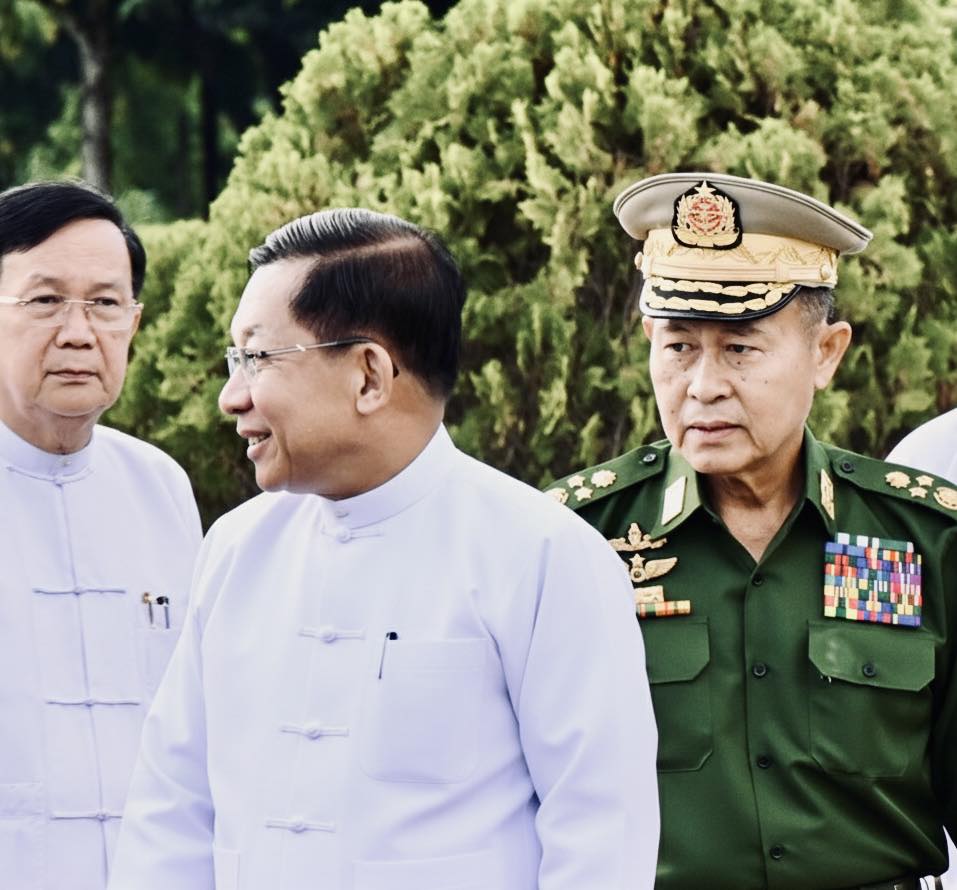
Military leaders seen.
"Although there are internal differences within the USDP, if the leadership reaches a consensus, they will likely vote accordingly," the analyst said. "For example, while it was generally said during the first parliament that representatives could decide for themselves, there were instructions on whom to vote for in critical matters. Since choosing a president is a vital issue, it will likely be guided by party decision—whether to vote for the Vice President nominated by the Pyithu Hluttaw or the one nominated by the military. They will likely decide who to nominate for the presidency only after reaching an agreement within the parliament."
In his message for the 78th Independence Day on January 4, 2026, Senior General Min Aung Hlaing, Chairman of the State Security and Peace Commission, stated that a government characterized by fairness, high voter distribution, and stability would be formed.
He stated, "By utilizing both the First-Past-The-Post (FPTP) and Proportional Representation (PR) systems, we will form governments that are fair, representative, and stable. State responsibilities will be handed over to the government emerging from the election results in accordance with democratic standards."
Political analysts point out that while some ethnic minority candidates ran uncontested under the PR system, simply including these minorities in the government does not yet constitute a practical political solution for the general public.