
CNI News
3 December 2025
To achieve lasting peace in Myanmar, the public should protest through nonviolent means and make their demands known, said Sai Htay Aung, Chairman of the Tai Leng (Shanni) Nationalities Development Party (TNDP), speaking to CNI News.
Military and political analysts point out that in peace-building processes, there are many differing viewpoints, ideologies, and approaches being attempted.
In Myanmar, every time a new government comes to power, the people, policies, and institutions involved in the peace process also change. As a result, the political foundations built by previous governments lose credibility, leading to continued deadlocks.
Sai Htay Aung of the TNDP told CNI that if peace cannot be achieved through negotiations with armed groups, then the public must resort to peaceful protest:

Armed groups, government officials, and political parties in discussion
“If an organization refuses to pursue peace, then people should protest against it.The government must have genuine goodwill.The desire for peace must come from within their hearts.There are many people who say they want peace, but in reality they don’t want it. Why? Because the longer peace is absent, the more freedom they have to conduct business.They are acting like warlords.If peace is achieved, they will have to live under the law — many groups don’t want that.So the public needs to be united.To overcome these challenges, people must protest peacefully against these armed groups.”
Analysts also note that peace cannot be achieved without considering the root causes of conflict — historical grievances, ideological disputes, and political beliefs.
Sai Htay Aung further said that in order to achieve lasting peace in Myanmar, the issue must be addressed through social and economic means:

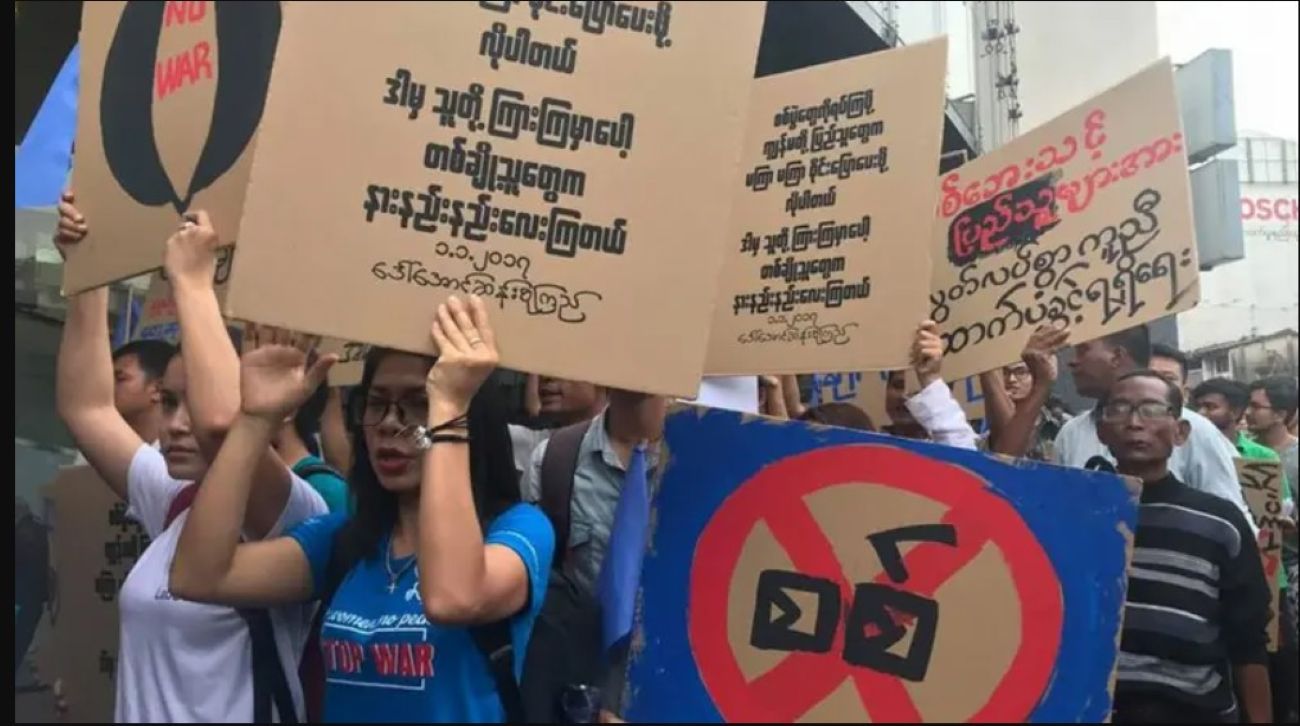
Public protesting to demand an end to the fighting
“I believe peace will have to be achieved through the people.Our peace process started back in 1989.From 1989 onward, armed groups made peace.At that time, the government told them: first take peace, and then you can do business.When a new government later discussed political matters with them, armed groups began operating businesses openly.Town and rural areas became interconnected, and they were given mineral concessions and special zones.So people came to believe that only those with arms could succeed — armed groups received privileges, while ordinary people did not.Because of that, many people tried to take up arms.They bought weapons and recruited members.This is why the country's biggest problem today stems from the peace process itself.To achieve lasting peace, we must address it through social and economic reforms.”
Military and political analysts also note that ideas such as establishing a single national army, officially recognizing ethnic armed groups, or granting them autonomous territories are approaches based on a “security perspective,” and cannot be implemented in a short time.
Currently, heavy clashes continue between the Myanmar military(Tatmadaw) and armed groups across the country, and peace efforts remain stalled.